


In short ⚡
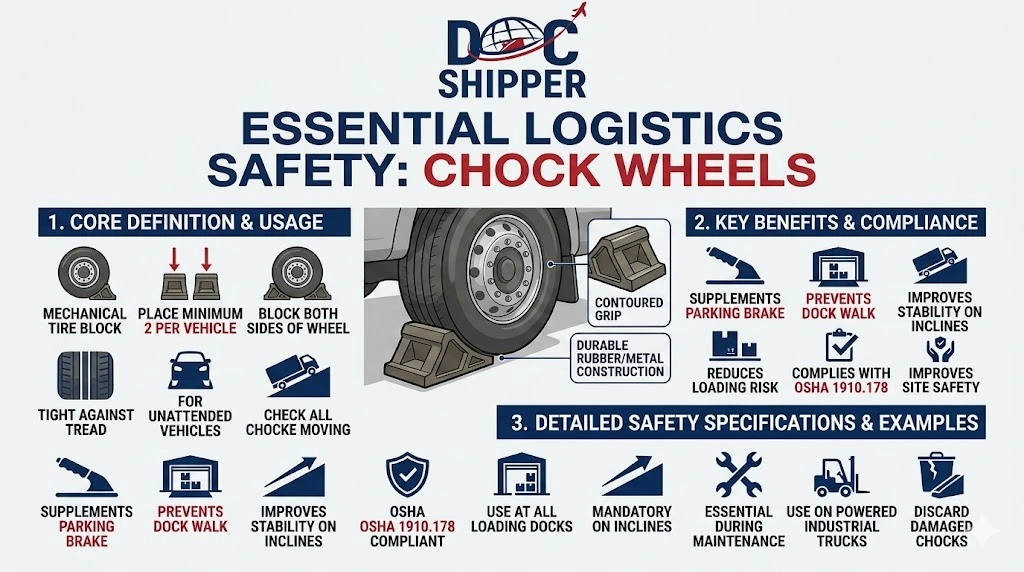
A chock is a wedge-shaped device placed against vehicle wheels to prevent unintended movement during loading, unloading, or parking operations. Essential in warehouses, ports, and freight terminals, chocks ensure safety compliance and protect cargo, equipment, and personnel from accidents caused by rolling vehicles.
Introduction
Every year, hundreds of workplace accidents occur due to unsecured vehicles rolling unexpectedly during cargo operations. A simple chock can prevent these incidents entirely.
In international logistics, where loading docks handle continuous truck traffic and container movements, wheel chocks represent a critical safety barrier. They’re mandatory under OSHA regulations and ISO standards for warehouse operations.
Key characteristics of effective chocks include:
- Material durability – rubber, polyurethane, or aluminum construction
- Size compatibility – matched to vehicle wheel diameter and weight
- Grip surface – textured design preventing slippage on various ground types
- Visibility features – bright colors or reflective strips for safety awareness
- Weather resistance – performance stability across temperature extremes
Technical Specifications & Safety Standards
The effectiveness of a chock depends on precise engineering matching vehicle weight, wheel diameter, and operational environment. OSHA Standard 1910.178 mandates wheel chocking for all parked industrial vehicles.
Material selection determines performance longevity. Rubber chocks offer excellent grip but degrade under UV exposure. Polyurethane models resist chemical spills common in industrial settings. Aluminum chocks withstand extreme loads but require textured surfaces to prevent slippage.
Dimensional requirements follow strict calculations. The chock height must equal at least 25% of the wheel diameter. Width should exceed tire contact patch by minimum 20%. A standard forklift with 18-inch wheels requires chocks measuring 4.5 inches high and 8 inches wide.
Regulatory compliance varies by jurisdiction. EU Directive 89/655/EEC requires chocks for all stationary vehicles during loading operations. US DOT regulations mandate chocking for commercial vehicles exceeding 10,000 lbs during cargo transfer. According to OSHA guidelines, failure to implement proper chocking procedures can result in citations and operational shutdowns.
Placement technique impacts effectiveness significantly. Chocks must contact both front and rear wheels on the same axle. Positioning occurs on the downhill side when ground slopes exist. Chains or ropes connecting paired chocks prevent displacement during vehicle movement.
At DocShipper, we audit warehouse facilities to ensure chocking protocols meet international safety standards, protecting both cargo integrity and worker safety throughout the supply chain.
Practical Applications & Case Studies
Real-world implementation of chocking systems reveals measurable safety improvements and operational efficiency gains across various logistics environments.
Comparative Analysis: Chock Types by Application
| Chock Type | Best Application | Load Capacity | Typical Cost |
|---|---|---|---|
| Rubber Wedge | Light trucks, vans | Up to 12,000 lbs | $15-30/pair |
| Polyurethane Heavy-Duty | Semi-trucks, trailers | Up to 80,000 lbs | $45-75/pair |
| Aluminum Industrial | Aircraft, heavy machinery | Over 100,000 lbs | $120-200/pair |
| Automatic Wheel Chocks | High-traffic loading docks | Variable (sensor-based) | $800-1,500/unit |
Case Study: Distribution Center Implementation
A European e-commerce fulfillment center processing 500 daily truck movements implemented mandatory chocking protocols in Q2 2023. Results after six months:
- Zero vehicle rollaway incidents (previously 3-4 annual occurrences)
- 18% reduction in loading dock damage claims (estimated savings: €47,000)
- Compliance audit score increased from 72% to 98%
- Worker safety perception improved by 34% (internal survey data)
- Insurance premium reduction of 12% following safety certification
Port Terminal Operations
Container terminals use specialized chocks for chassis and laden trucks awaiting customs clearance. A Singapore port authority study found that proper chocking reduced container handling delays by 23% by preventing unauthorized vehicle movement during inspection procedures.
The implementation cost averaged $8 per daily truck movement, while delay reduction generated $340 per incident in operational savings.
Conclusion
Effective chock implementation represents minimal investment with substantial safety and financial returns. Proper selection, placement, and maintenance protocols prevent accidents while ensuring regulatory compliance across international logistics operations.
Need guidance on warehouse safety equipment or logistics optimization? Contact DocShipper for expert consultation on supply chain security solutions.
📚 Quiz
Test Your Knowledge: Chock
Q1 — What is the primary purpose of a chock in logistics operations?
Q2 — According to safety standards, what is the minimum required height of a chock relative to the wheel it secures?
Q3 — A warehouse manager needs to secure a fully loaded semi-truck (80,000 lbs) at a high-traffic loading dock. Which chock type is the most appropriate choice?
🎯 Your Result
📞 Free Quote in 24hFAQ | Chock in Logistics: Definition, Usage & Practical Examples
For semi-trucks with 22.5-inch wheels, use chocks measuring at least 5.5 inches high and 10 inches wide, rated for 80,000 lbs minimum capacity.
Yes. OSHA regulations and DOT standards mandate chocking for commercial vehicles during loading/unloading operations. Non-compliance can result in fines up to $13,653 per violation.
Minimum two chocks per vehicle, positioned against front and rear wheels on the same axle. Sloped surfaces require four chocks (both axles).
Standard rubber chocks perform between -20°F to 120°F. For extreme climates, use polyurethane or aluminum chocks rated for -40°F to 180°F.
Brakes are vehicle-integrated systems; chocks are external safety devices providing redundant protection against unintended movement when brakes fail or disengage.
Inspect monthly for cracks, wear, or deformation. Replace rubber chocks every 2-3 years; polyurethane models last 5-7 years; aluminum chocks can last 10+ years with proper maintenance.
Yes, when parked for extended periods or during maintenance. OSHA 1910.178 specifically addresses powered industrial truck chocking requirements.
Yes. Automatic vehicle restraint systems deploy chocks mechanically when trucks dock, costing $800-1,500 per loading bay but eliminating human error.
Effectiveness reduces on ice. Use chocks with aggressive tread patterns and supplement with sand/salt application. Consider chains or spikes for extreme conditions.
OSHA recommends high-visibility colors (yellow, orange, red) with reflective strips. Color-coding can indicate load capacity or vehicle type in multi-use facilities.
Yes. Aircraft chocks are typically larger (18-24 inches high), made from aluminum or composite materials, and designed for tarmac surfaces and extreme weights.
Minimum chock height = 25% of wheel diameter. For a 40-inch wheel, use chocks at least 10 inches high. Add 20% for sloped surfaces.
Need Help with
Logistics or Sourcing ?
First, we secure the right products from the right suppliers at the right price by managing the sourcing process from start to finish. Then, we simplify your shipping experience - from pickup to final delivery - ensuring any product, anywhere, is delivered at highly competitive prices.


Fill the Form
Prefer email? Send us your inquiry, and we’ll get back to you as soon as possible.
Contact us




