


In short ⚡
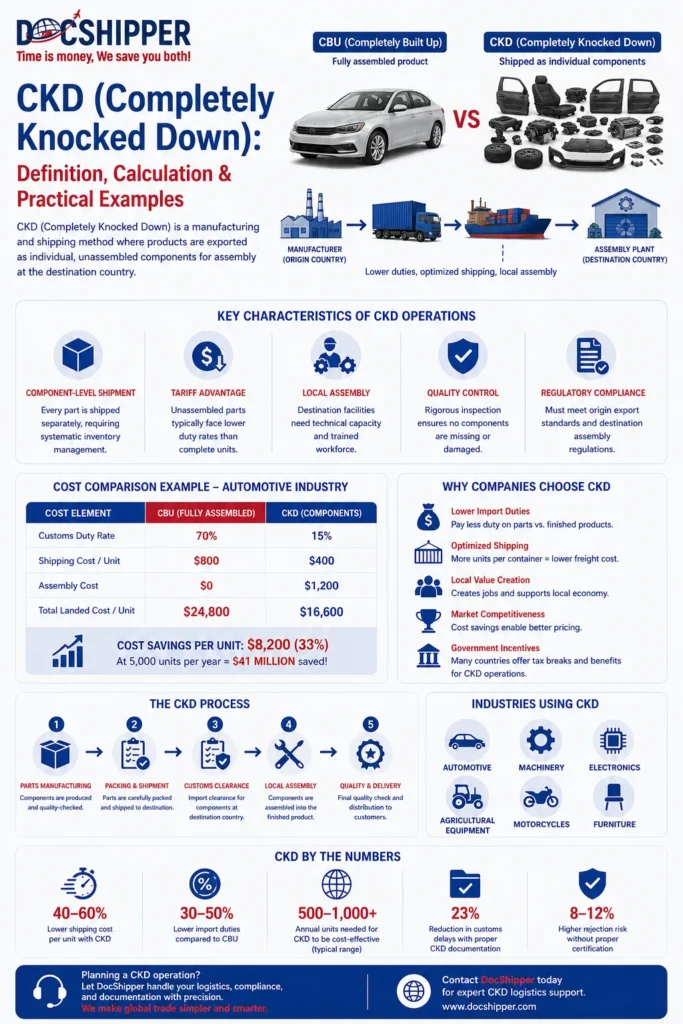
CKD (Completely Knocked Down) is a manufacturing and shipping method where products—typically vehicles or machinery—are exported as individual, unassembled components for assembly at the destination country. This approach reduces import duties, optimizes container space, and enables local manufacturing partnerships.Introduction
Many importers face a critical dilemma: should they import finished goods or disassembled components? The answer often determines profitability margins, compliance complexity, and market entry speed.
CKD shipping has become a cornerstone strategy in international automotive, electronics, and machinery trade. It addresses tariff barriers while creating local employment opportunities through assembly operations.
Key characteristics of CKD operations include:
- Component-level shipment: Every part arrives separately, requiring systematic inventory management
- Customs classification advantages: Unassembled parts typically face lower duty rates than complete units
- Local assembly requirements: Destination facilities must have technical capacity and trained workforce
- Quality control protocols: Rigorous inspection needed to ensure no components are missing or damaged
- Regulatory compliance: Must meet both origin country export standards and destination assembly regulations
Understanding CKD Mechanisms & Trade Implications
The CKD model operates on a fundamental economic principle: tariff engineering. Most countries apply higher import duties to finished goods than to individual components. A complete vehicle might face 30-50% tariffs, while disassembled parts may be taxed at 10-15%.
From a logistics perspective, packaging efficiency transforms shipping economics. A standard 40-foot container holds approximately 4 assembled vehicles but can accommodate components for 8-10 vehicles when properly packed. This doubles shipping efficiency and reduces per-unit transportation costs by 40-60%.
The legal framework governing CKD operations varies significantly by jurisdiction. The World Trade Organization recognizes CKD as a legitimate trade practice under the General Agreement on Tariffs and Trade (GATT), but countries may impose local content requirements. For instance, some nations mandate that 30-60% of components must be locally sourced within 3-5 years to maintain preferential duty treatment.
Assembly complexity directly impacts operational viability. Simple products like bicycles or furniture require minimal technical infrastructure—basic tools and semi-skilled labor suffice. Complex machinery like automobiles demands specialized facilities, trained technicians, quality assurance systems, and often technology transfer agreements with the original manufacturer.
At DocShipper, we evaluate total landed cost for clients considering CKD strategies. This includes component shipping, customs duties, assembly labor, facility overhead, quality control, and inventory carrying costs. Our analysis often reveals that CKD becomes economically advantageous when annual volumes exceed 500-1,000 units, depending on product complexity.
For authoritative guidance on international trade classifications, consult the World Customs Organization Harmonized System, which provides standardized codes for CKD components versus finished goods.
Practical Examples & Comparative Data
The automotive industry provides the clearest CKD cost-benefit illustration. Consider a mid-size sedan exported from Japan to Vietnam:
| Import Method | Customs Duty Rate | Shipping Cost/Unit | Assembly Cost | Total Landed Cost |
|---|---|---|---|---|
| Fully Assembled (CBU) | 70% | $800 | $0 | $24,800 |
| CKD Components | 15% | $400 | $1,200 | $16,600 |
| Cost Savings per Unit: | $8,200 (33%) |
This 33% cost reduction becomes even more significant at scale. A manufacturer producing 5,000 units annually saves $41 million through CKD operations—funds that can be reinvested in market expansion, local workforce development, or price competitiveness.
Real-world case study: A European agricultural equipment manufacturer entered the Indian market in 2019. Initial analysis showed:
- CBU import option: 40% customs duty + $2,500 shipping = $18,500 total landed cost per tractor
- CKD alternative: 10% duty + $1,200 shipping + $2,800 assembly = $13,000 total cost
- Result: 30% cost advantage enabled competitive pricing, capturing 12% market share within 18 months
- Additional benefit: Local assembly created 150 jobs, earning government incentives worth $800,000 annually
- Long-term impact: After three years, local content reached 40%, further reducing component import costs by 25%
Electronics manufacturers similarly leverage CKD strategies. A smartphone producer shipping to Brazil discovered that importing complete phones incurred 60% duties, while component kits faced only 18% tariffs. Combined with Brazil’s generous tax incentives for local manufacturing, the CKD approach reduced per-unit costs by $45—critical in a price-sensitive market.
DocShipper recently assisted a furniture importer transitioning from CBU to CKD. We coordinated component sourcing from three countries, managed consolidated shipping, and arranged assembly partnerships in the destination market. The client achieved 28% cost savings while reducing lead times from 8 weeks to 5 weeks through optimized container loading.
Conclusion
CKD shipping transforms international trade economics by converting tariff barriers into competitive advantages while fostering local industrial development. Success requires careful total cost analysis, reliable assembly partnerships, and expert logistics coordination.
Need guidance on implementing a CKD strategy for your products? Contact DocShipper for a comprehensive feasibility assessment and end-to-end supply chain management.
📚 Quiz
Test Your Knowledge: CKD (Completely Knocked Down)
Q1 — What does the CKD method fundamentally involve?
Q2 — A common misconception about CKD is that it always increases total landed cost due to added assembly expenses. What does the data actually show?
Q3 — A European machinery manufacturer wants to enter the Brazilian market. Importing complete units incurs 60% customs duties, while component kits face only 18%. The company produces 800 units per year. Which approach best fits a CKD strategy?
🎯 Your Result
📞 Free Quote in 24hFAQ | CKD (Completely Knocked Down): Definition, Calculation & Practical Examples
CKD (Completely Knocked Down) involves shipping every individual component separately, requiring full assembly. SKD (Semi-Knocked Down) ships partially assembled modules, reducing destination assembly complexity and time.
Automotive manufacturing dominates CKD operations, followed by heavy machinery, agricultural equipment, electronics, furniture, and HVAC systems. Any product with high tariffs on finished goods becomes a CKD candidate.
Customs officials cross-reference component lists against manufacturer specifications, inspect packaging for assembly instructions, and may require certificates of origin. Some jurisdictions conduct periodic factory audits to confirm legitimate assembly operations.
Break-even typically occurs between 500-1,000 units annually for complex products like vehicles. Simpler items like furniture may justify CKD at 200-300 units. Comprehensive cost modeling is essential for accurate determination.
Yes, global sourcing is common. However, rules of origin become complex when determining final product eligibility for preferential trade agreements. Proper documentation and customs expertise are critical.
Missing components, damaged parts during shipping, version mismatches, and assembly errors are primary concerns. Robust inventory management systems, detailed packing lists, and trained assembly teams mitigate these risks.
Simple products require 1-4 hours per unit. Complex machinery like automobiles needs 8-20 hours depending on automation level. Initial assembly runs take longer as workers learn processes.
For sophisticated products, manufacturers typically mandate licensing agreements covering assembly processes, quality standards, and intellectual property protection. These agreements often include training provisions and ongoing technical support.
Production halts until replacements arrive, causing costly delays. Best practices include 5-10% buffer stock for critical parts, expedited shipping agreements with suppliers, and comprehensive insurance coverage.
Yes, optimized container utilization reduces shipping frequency and fuel consumption. However, this benefit may be offset by local assembly energy use and potentially less efficient manufacturing compared to centralized production facilities.
FTAs often eliminate or reduce tariffs on both components and finished goods, narrowing CKD's cost advantage. However, local content requirements in many FTAs still favor CKD operations that incorporate domestic components.
Standard marine cargo insurance covers component loss or damage during transit. Additional coverage should address assembly errors, component compatibility issues, and business interruption from delayed or incomplete shipments.
Need Help with
Logistics or Sourcing ?
First, we secure the right products from the right suppliers at the right price by managing the sourcing process from start to finish. Then, we simplify your shipping experience - from pickup to final delivery - ensuring any product, anywhere, is delivered at highly competitive prices.


Fill the Form
Prefer email? Send us your inquiry, and we’ll get back to you as soon as possible.
Contact us




