


In short ⚡
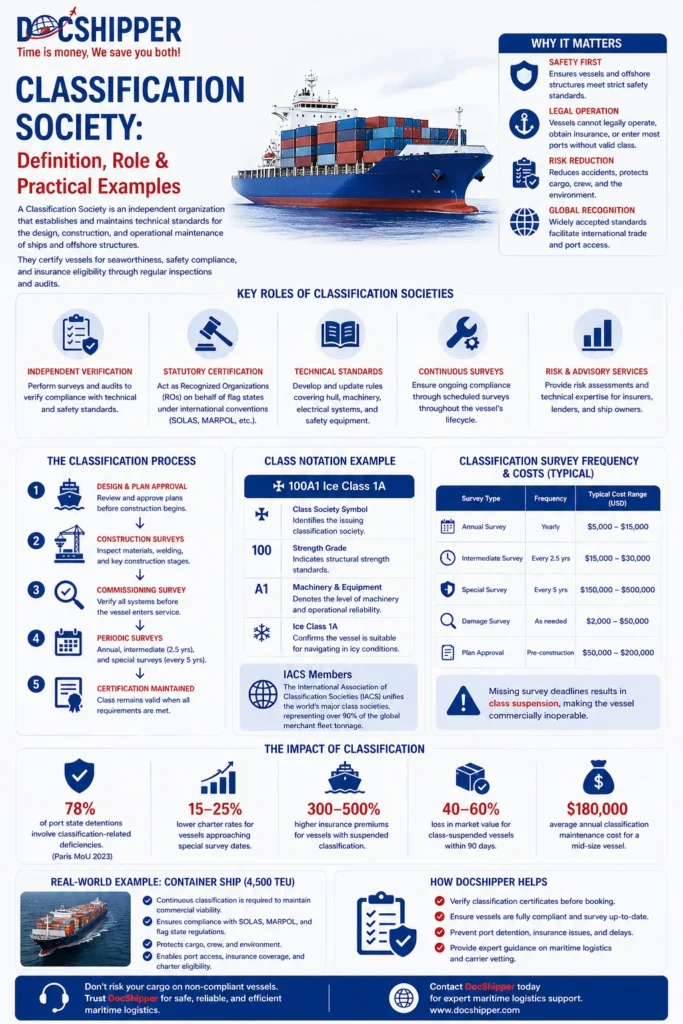
A Classification Society is an independent organization that establishes and maintains technical standards for the design, construction, and operational maintenance of ships and offshore structures. These societies certify vessels for seaworthiness, safety compliance, and insurance eligibility through regular inspections and audits.
Introduction
Many importers and exporters underestimate the critical role of Classification Societies in international maritime trade. Without valid classification certificates, vessels cannot legally operate, obtain insurance, or enter most ports worldwide.
These organizations serve as the backbone of maritime safety and operational standards. They bridge the gap between flag state regulations and actual vessel compliance, ensuring that ships transporting your cargo meet stringent safety requirements.
Key characteristics of Classification Societies include:
- Independent verification of vessel construction and maintenance standards
- Statutory certification on behalf of flag states and maritime authorities
- Technical rule development covering hull integrity, machinery, and safety systems
- Continuous survey programs ensuring ongoing compliance throughout vessel lifecycle
- Risk assessment services for insurers, lenders, and cargo owners
Technical Framework & Regulatory Authority
Classification Societies operate under a dual mandate. They develop proprietary technical standards while simultaneously acting as Recognized Organizations (ROs) authorized by flag states to perform statutory inspections under international conventions like SOLAS and MARPOL.
The International Association of Classification Societies (IACS) unifies the world’s major classification bodies, including Lloyd’s Register, DNV, Bureau Veritas, and eight others. IACS members account for over 90% of the global merchant fleet tonnage. Their unified requirements establish baseline standards that exceed minimum regulatory thresholds.
The class notation system provides detailed technical specifications. A typical notation like “✠100A1 Ice Class 1A” indicates hull construction standards, machinery certification, and operational capabilities. Each symbol carries specific design and maintenance requirements that surveyors verify during inspections.
Surveys follow a strict schedule: annual surveys for general condition, intermediate surveys at 2.5-year intervals, and special surveys every five years involving comprehensive structural examinations. Missing deadlines results in class suspension, rendering the vessel commercially inoperable.
At DocShipper, we verify classification certificates for all chartered vessels to ensure your cargo travels on fully compliant ships, eliminating risks of port detention or insurance invalidation.
The International Maritime Organization (IMO) recognizes classification societies through flag state authorization frameworks detailed at imo.org, establishing the legal foundation for their regulatory functions.
Practical Applications & Industry Data
Understanding how classification impacts your shipments requires examining real operational scenarios and industry benchmarks. Classification status directly affects freight rates, insurance premiums, and port acceptance.
Comparative Analysis: Classification Society Services
| Service Type | Frequency | Typical Cost Range | Business Impact |
|---|---|---|---|
| Annual Survey | Yearly | $5,000–$15,000 | Maintains class validity |
| Special Survey | Every 5 years | $150,000–$500,000 | Determines vessel lifespan extension |
| Damage Survey | As needed | $2,000–$50,000 | Required for insurance claims |
| Plan Approval | Pre-construction | $50,000–$200,000 | Mandatory for new builds |
Use Case: Container Ship Classification Impact
A 4,500 TEU container vessel operating on Asia-Europe routes requires continuous classification to maintain commercial viability:
- Insurance premium differential: Vessels with suspended class pay 300–500% higher premiums
- Port state control: 78% of detentions involve classification-related deficiencies (Paris MoU 2023 data)
- Charter rate impact: Charterers discount rates by 15–25% for vessels approaching special survey dates
- Operational costs: Annual classification maintenance averages $180,000 for this vessel size
- Resale value: Class-suspended vessels lose 40–60% of market value within 90 days
At DocShipper, our freight forwarding team pre-screens vessel classifications before booking cargo space, protecting clients from unexpected delays or additional costs related to non-compliant tonnage.
Conclusion
Classification Societies represent the essential quality assurance mechanism in maritime logistics, directly impacting cargo safety, transit reliability, and insurance validity. Their certification determines whether vessels can legally operate in international trade.
Need assistance verifying vessel compliance for your shipments? Contact DocShipper for expert guidance on maritime logistics and carrier vetting.
📚 Quizz
Test Your Knowledge: Classification Society
Q1 — What is the primary role of a Classification Society?
Q2 — A vessel's classification is suspended due to missed survey deadlines. Which of the following consequences is correct?
Q3 — A cargo owner is booking space on a container ship for a high-value shipment on an Asia-Europe route. Which action best reflects correct use of classification society knowledge?
🎯 Your Result
📞 Free Quote in 24hFAQ | Classification Society: Definition, Role & Practical Examples
The vessel becomes commercially inoperable. Insurance coverage terminates immediately, port authorities deny entry, and charterers can cancel contracts. Owners must address deficiencies and undergo re-inspection before resuming operations.
Flag states hold legal jurisdiction over vessels, while classification societies provide technical expertise. Most flag states delegate inspection and certification duties to recognized classification societies through formal authorization agreements.
Yes. Charter parties often specify IACS-member classification as a minimum requirement. Cargo owners can mandate particular societies known for stringent standards in specialized trades like LNG or chemical transport.
Fees vary by 10–20% among IACS members, with European societies typically charging premium rates. However, recognition breadth and survey network coverage often justify cost differentials for global operators.
Annual surveys require 2–5 days depending on vessel size. Special surveys extend to 3–6 weeks, including drydocking periods. Emergency damage surveys can be completed within 24–48 hours for urgent cargo operations.
Commercial vessels over 24 meters engaged in international trade require classification. Exceptions include certain fishing vessels, military craft, and pleasure yachts under 500 GT, though voluntary classification remains common.
Class notations define a vessel's technical specifications and operational capabilities. Notations like "Ice Class" or "Oil Tanker" determine route permissions, cargo eligibility, and insurance underwriting terms.
Yes, through a formal transfer process requiring document review and condition surveys. However, transfers often trigger additional inspections and may reveal previously unidentified deficiencies requiring costly repairs.
Through survey schedules, condition monitoring, and class suspension authority. Societies report serious deficiencies to flag states and port authorities. Persistent non-compliance results in permanent class withdrawal.
They approve design plans, supervise construction milestones, witness critical tests, and issue provisional certificates upon delivery. This oversight ensures vessels meet international standards before entering service.
IACS-member certificates receive universal recognition under IMO conventions and port state control regimes. Non-IACS societies face restricted acceptance, particularly in major trading regions like EU and North America.
IACS publishes unified requirement updates annually, with major revisions every 3–5 years. Individual societies may implement stricter standards independently. Owners receive 12–24 months' notice for compliance implementation.
Need Help with
Logistics or Sourcing ?
First, we secure the right products from the right suppliers at the right price by managing the sourcing process from start to finish. Then, we simplify your shipping experience - from pickup to final delivery - ensuring any product, anywhere, is delivered at highly competitive prices.


Fill the Form
Prefer email? Send us your inquiry, and we’ll get back to you as soon as possible.
Contact us




