


In short ⚡
Core competencies are the unique combination of strategic resources, skills, and capabilities that provide a company with competitive advantages in its market. These distinctive strengths enable organizations to deliver superior value, differentiate from competitors, and sustain long-term profitability through difficult-to-replicate expertise.
Introduction
Many businesses struggle to articulate what truly sets them apart from competitors. Without clearly defined core competencies, companies risk spreading resources too thin across multiple initiatives that deliver minimal strategic value.
In international logistics and supply chain management, identifying core competencies becomes critical for survival. Organizations must concentrate efforts on activities where they possess genuine expertise rather than attempting to excel in every operational area.
- Strategic focus: Core competencies guide resource allocation toward highest-impact activities
- Competitive advantage: They create barriers preventing easy replication by competitors
- Customer value: These capabilities directly enhance product or service offerings
- Long-term sustainability: True competencies evolve and strengthen over time
- Cross-functional integration: They span multiple departments and business units
Strategic Framework & Implementation
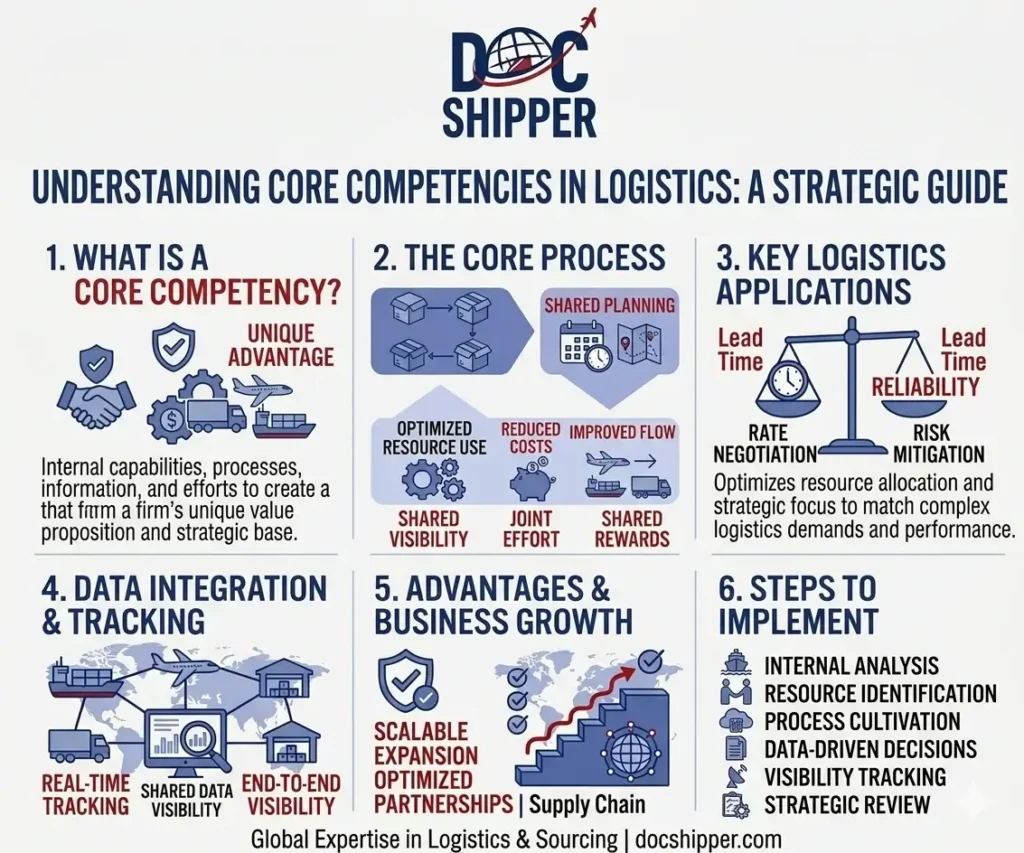
Core competencies must satisfy three essential criteria established by management theorists Prahalad and Hamel. First, they provide access to diverse markets by enabling expansion into multiple product categories or geographic regions. Second, they deliver significant customer benefits that customers recognize and value. Third, they prove difficult for competitors to imitate due to complex organizational processes or proprietary knowledge.
Identifying genuine core competencies requires rigorous internal analysis. Organizations should evaluate which capabilities meet all three criteria simultaneously rather than settling for ordinary operational strengths. This assessment involves cross-functional teams examining processes, technologies, and knowledge bases across the entire enterprise.
The resource-based view of strategy emphasizes that sustainable advantages emerge from valuable, rare, inimitable, and non-substitutable resources. Companies must continuously invest in developing these strategic assets through training, technology acquisition, and process refinement. Neglecting core competencies allows them to atrophy, eroding competitive position.
In logistics operations, supply chain visibility represents a common core competency. Organizations like DocShipper leverage advanced tracking systems, customs expertise, and global partner networks to provide clients with real-time shipment monitoring. This capability requires years of relationship building and technological integration that competitors cannot quickly replicate.
Strategic alignment ensures core competencies support overall business objectives. According to the Harvard Business Review framework, companies should organize around competencies rather than traditional business units. This structure facilitates knowledge sharing and prevents competency fragmentation across divisions.
Practical Examples & Data Analysis
Examining industry leaders reveals how core competencies translate into market dominance. The following comparative analysis demonstrates competency differentiation across logistics sectors:
| Company | Core Competency | Competitive Impact | Market Result |
|---|---|---|---|
| FedEx | Integrated air-ground network | Overnight delivery guarantee | Premium pricing power |
| Maersk | End-to-end container logistics | Seamless multimodal integration | 25% global container share |
| DHL | International customs expertise | Faster border clearance | Leadership in cross-border e-commerce |
| DocShipper | Sourcing-to-delivery integration | Single-point accountability | Reduced supply chain complexity |
Case Study: Technology-Enabled Competency Development
A mid-sized freight forwarder identified predictive shipment analytics as a potential core competency. The company invested $2.3 million over 18 months to develop machine learning algorithms analyzing historical shipping data. Results included 34% reduction in delivery delays and 19% decrease in customer inquiries about shipment status.
This competency satisfied all three criteria. It provided access to premium-tier clients requiring guaranteed delivery windows. Customers valued the proactive exception management that prevented costly production disruptions. Competitors struggled to replicate the capability due to proprietary algorithms and extensive historical data requirements.
Financial impact proved substantial. The company commanded 12-15% price premiums over standard services while maintaining 89% customer retention rates. Within three years, this single competency generated $8.7 million in incremental revenue against the initial investment.
Key Implementation Metrics:
- Development timeframe: 12-36 months for meaningful competency establishment
- Investment requirement: Typically 3-7% of annual revenue for competency enhancement
- Performance indicators: Customer retention rates, price premium sustainability, market share growth
- Competitive moat duration: 3-5 years before significant competitor replication
- ROI expectations: 200-400% return over 5-year horizon for successfully developed competencies
Conclusion
Core competencies represent the strategic foundation enabling companies to deliver unique value and sustain competitive advantages. Organizations must rigorously identify, develop, and protect these capabilities while aligning resources around their most distinctive strengths.
Need assistance identifying or leveraging core competencies in your international logistics operations? Contact DocShipper for strategic consultation on optimizing your supply chain capabilities.
📚 Quiz
Test Your Knowledge: Core Competencies
Q1 — Which of the following best defines a core competency according to Prahalad and Hamel's framework?
Q2 — A company's core competency can become obsolete over time. What is the most effective way to prevent this?
Q3 — A mid-sized freight forwarder develops a proprietary predictive analytics platform that reduces delivery delays by 34% and commands a 12–15% price premium. Which statement best describes this capability?
🎯 Your Result
📞 Free Quote in 24hFAQ | Core Competencies: Definition, Strategic Framework & Practical Examples
Core competencies meet three criteria: providing access to multiple markets, delivering significant customer value, and proving difficult to imitate. General capabilities may excel in one area but lack the strategic depth and competitive protection of true core competencies.
Most successful organizations focus on 3-5 core competencies. Spreading efforts across too many areas dilutes resources and prevents achieving genuine excellence. Concentration enables deeper investment and stronger competitive differentiation.
Yes, market shifts and technological disruption can render previously valuable competencies irrelevant. Companies must continuously evaluate competency relevance and invest in evolution to maintain strategic value as customer needs and competitive landscapes change.
Assess through customer perception studies, competitive benchmarking, financial performance metrics, and replication difficulty analysis. Strong competencies demonstrate sustained price premiums, high customer retention, and minimal competitive encroachment over multi-year periods.
Strategic outsourcing allows organizations to concentrate resources on core competencies while accessing specialized expertise for supporting functions. This approach enhances overall efficiency provided partner selection maintains quality standards and protects proprietary knowledge.
Culture fundamentally enables or constrains competency building. Organizations with learning-oriented cultures, cross-functional collaboration, and continuous improvement mindsets develop stronger competencies faster than hierarchical, siloed structures that impede knowledge sharing.
Digital transformation creates opportunities for new competencies while threatening existing ones. Data analytics, automation, and connectivity enable previously impossible capabilities but require significant investment and organizational change to realize strategic value.
Absolutely. Smaller organizations often excel by developing niche competencies in specialized markets. Limited resources necessitate sharper focus, potentially creating stronger differentiation than larger competitors attempting to serve broader customer bases.
Core competencies provide the foundation for innovation by offering deep expertise in specific domains. Companies leverage existing competencies to develop new products, enter adjacent markets, and create novel customer solutions that competitors cannot easily replicate.
Conduct formal competency reviews annually with continuous monitoring of market relevance. Major industry disruptions, technological breakthroughs, or significant competitive moves warrant immediate reassessment to ensure strategic alignment remains intact.
While fundamental competencies remain consistent, their application and relative importance may vary by geography. Cultural preferences, regulatory environments, and competitive landscapes influence how companies deploy competencies across different markets.
Excessive dependence creates vulnerability to market disruption and competency obsolescence. Organizations must balance leveraging existing strengths with exploring adjacent capabilities that provide strategic flexibility and future growth options.
Need Help with
Logistics or Sourcing ?
First, we secure the right products from the right suppliers at the right price by managing the sourcing process from start to finish. Then, we simplify your shipping experience - from pickup to final delivery - ensuring any product, anywhere, is delivered at highly competitive prices.


Fill the Form
Prefer email? Send us your inquiry, and we’ll get back to you as soon as possible.
Contact us




