


In short ⚡
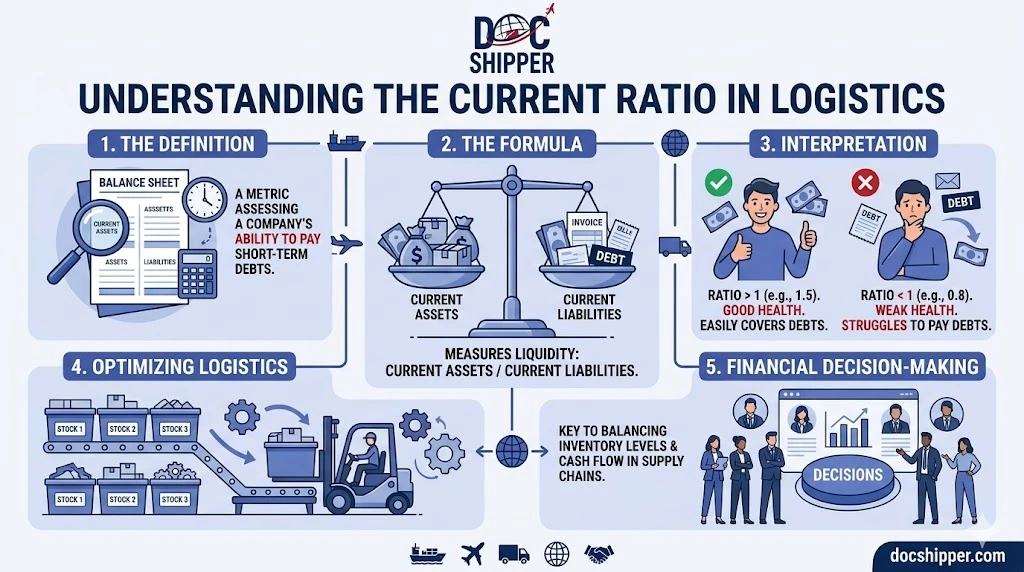
The Current Ratio is a liquidity metric measuring a company's ability to cover short-term obligations with its current assets. Calculated by dividing current assets by current liabilities, it indicates financial health and operational sustainability in international trade operations.
Introduction
Many importers and exporters struggle to assess whether their trading partners possess sufficient financial stability to fulfill contractual obligations. This uncertainty creates significant risks in international logistics operations.
The Current Ratio serves as a fundamental indicator in evaluating the financial resilience of businesses engaged in cross-border trade. For logistics providers and freight forwarders, understanding this metric prevents costly disruptions caused by partner insolvency.
- Liquidity measurement: Quantifies available resources versus immediate debts
- Risk assessment tool: Identifies potential payment defaults before shipment
- Operational planning: Guides credit terms and payment structure decisions
- Partnership evaluation: Validates supplier and buyer financial capacity
- Banking requirement: Often mandatory for trade finance approvals
Understanding Current Ratio in Depth
The calculation formula remains straightforward: Current Assets ÷ Current Liabilities = Current Ratio. Current assets include cash, accounts receivable, inventory, and marketable securities convertible within twelve months. Current liabilities encompass accounts payable, short-term debt, and accrued expenses due within the same period.
A ratio above 1.0 indicates the company possesses more current assets than liabilities. Most financial institutions consider ratios between 1.5 and 3.0 healthy for logistics operations. Ratios below 1.0 signal potential liquidity problems, while extremely high ratios may suggest inefficient asset utilization.
In international trade, this metric carries particular weight. The payment cycles in cross-border transactions often extend 60-90 days, creating cash flow vulnerabilities. Exporters must verify that importers maintain sufficient liquidity to honor payment terms, especially when offering open account conditions.
The industry context significantly influences ratio interpretation. Manufacturing companies typically require higher ratios (2.0+) due to inventory-heavy operations. Service-based logistics providers may operate efficiently with lower ratios (1.2-1.5) given minimal inventory requirements.
According to Bank for International Settlements guidelines, financial institutions assess Current Ratio alongside other metrics when approving letters of credit and trade finance facilities. At DocShipper, we systematically verify this indicator when evaluating new partnerships to ensure operational continuity throughout the supply chain.
Regulatory implications vary by jurisdiction. EU directives require certain transparency in financial reporting for companies exceeding specific thresholds. Understanding these requirements helps logistics operators maintain compliance while assessing partner viability.
Practical Examples & Data Analysis
Consider a European importer with €500,000 in current assets (€200,000 cash, €180,000 receivables, €120,000 inventory) and €250,000 in current liabilities. The Current Ratio calculates to 2.0 (€500,000 ÷ €250,000), indicating solid liquidity for ongoing operations.
| Company Profile | Current Assets | Current Liabilities | Current Ratio | Risk Level |
|---|---|---|---|---|
| Asian Manufacturer | $2,400,000 | $1,200,000 | 2.0 | Low |
| EU Distributor | €850,000 | €900,000 | 0.94 | High |
| US Freight Forwarder | $680,000 | $450,000 | 1.51 | Moderate |
| Latin American Exporter | $1,500,000 | $500,000 | 3.0 | Very Low |
Real-world scenario: A logistics company evaluating a new supplier in Vietnam discovered a Current Ratio of 0.85. Further investigation revealed the supplier had overextended credit to customers while facing delayed receivables. This insight prompted renegotiation of payment terms to 50% advance payment, mitigating potential shipment delays.
Industry benchmarks from 2023 data show manufacturing exporters average 2.1, while third-party logistics providers maintain 1.6. These figures help contextualize individual company performance against sector norms.
Seasonal variations significantly impact the ratio. Retailers importing for holiday seasons may show temporarily depressed ratios in Q3 due to inventory buildup, recovering in Q4 post-sales. Analyzing trends across multiple quarters provides more accurate assessment than single-period snapshots.
Warning signals include declining ratios over consecutive quarters, ratios below industry averages, or sudden spikes suggesting asset liquidation. These patterns warrant deeper financial due diligence before committing to large shipments or extended credit terms.
At DocShipper, we integrate Current Ratio analysis into our partner vetting process, combining it with payment history and market reputation to ensure reliable service delivery across our global network.
Conclusion
The Current Ratio remains an essential diagnostic tool for assessing financial stability in international logistics partnerships. Proper interpretation prevents costly disruptions while enabling informed risk management decisions.
Need expert guidance on financial due diligence for your supply chain partners? Contact DocShipper for comprehensive logistics solutions backed by thorough partner evaluation.
📚 Quiz
Test Your Knowledge: Current Ratio
Q1 — What does the Current Ratio measure?
Q2 — A logistics partner shows a Current Ratio of 4.5. What does this most likely indicate?
Q3 — You are evaluating a new Vietnamese supplier and discover their Current Ratio is 0.85. What is the most appropriate course of action?
🎯 Your Result
📞 Free Quote in 24hFAQ | Current Ratio: Definition, Calculation & Concrete Examples
For logistics providers, a ratio between 1.2 and 2.0 typically indicates healthy liquidity. Service-based operations require lower ratios than asset-intensive manufacturers due to minimal inventory holdings and faster cash conversion cycles.
Quick Ratio excludes inventory from current assets, providing a more conservative liquidity measure. It better reflects immediate payment capacity, particularly valuable when assessing partners with slow-moving inventory in international trade.
Ratios exceeding 3.0 may indicate inefficient capital deployment. Excess cash sitting idle rather than invested in growth suggests suboptimal asset management, though this poses less risk than low ratios.
Quarterly assessments align with standard financial reporting cycles. For high-value partnerships or volatile markets, monthly calculations provide better trend visibility and earlier warning of deteriorating financial conditions.
While universally applicable, interpretation varies significantly by industry. Capital-intensive sectors require higher ratios than service businesses. Always compare against industry-specific benchmarks rather than absolute standards.
Common triggers include unexpected debt obligations, customer payment defaults, inventory write-downs, or aggressive expansion financing. Investigating the underlying cause determines whether the drop represents temporary stress or structural weakness.
Exchange rate movements impact both assets and liabilities denominated in foreign currencies. Companies with mismatched currency exposure may show ratio volatility unrelated to operational performance, requiring currency-adjusted analysis.
No single metric provides complete evaluation. Current Ratio should combine with debt-to-equity ratio, cash flow analysis, and payment history for comprehensive credit risk assessment in international trade relationships.
Ratios below 1.0 typically warrant immediate payment terms or advance deposits. Ratios between 1.0-1.5 may justify shorter payment cycles (30 days instead of 60), while ratios above 2.0 support extended terms.
Seasonal operations establish credit lines to smooth ratio variations, maintain higher off-season ratios as buffers, and communicate seasonal patterns to partners. Multi-year trend analysis provides clearer financial health pictures than single-period snapshots.
While declining ratios signal financial stress, they don't guarantee bankruptcy. Combined with negative cash flow, increasing debt levels, and market share loss, low Current Ratios become stronger insolvency predictors requiring immediate risk mitigation.
Obsolete or slow-moving inventory inflates current assets artificially, overstating liquidity. Detailed inventory aging analysis reveals whether listed assets convert to cash realistically, particularly critical when evaluating importers with perishable or fashion-dependent goods.
Need Help with
Logistics or Sourcing ?
First, we secure the right products from the right suppliers at the right price by managing the sourcing process from start to finish. Then, we simplify your shipping experience - from pickup to final delivery - ensuring any product, anywhere, is delivered at highly competitive prices.


Fill the Form
Prefer email? Send us your inquiry, and we’ll get back to you as soon as possible.
Contact us




