


In short ⚡
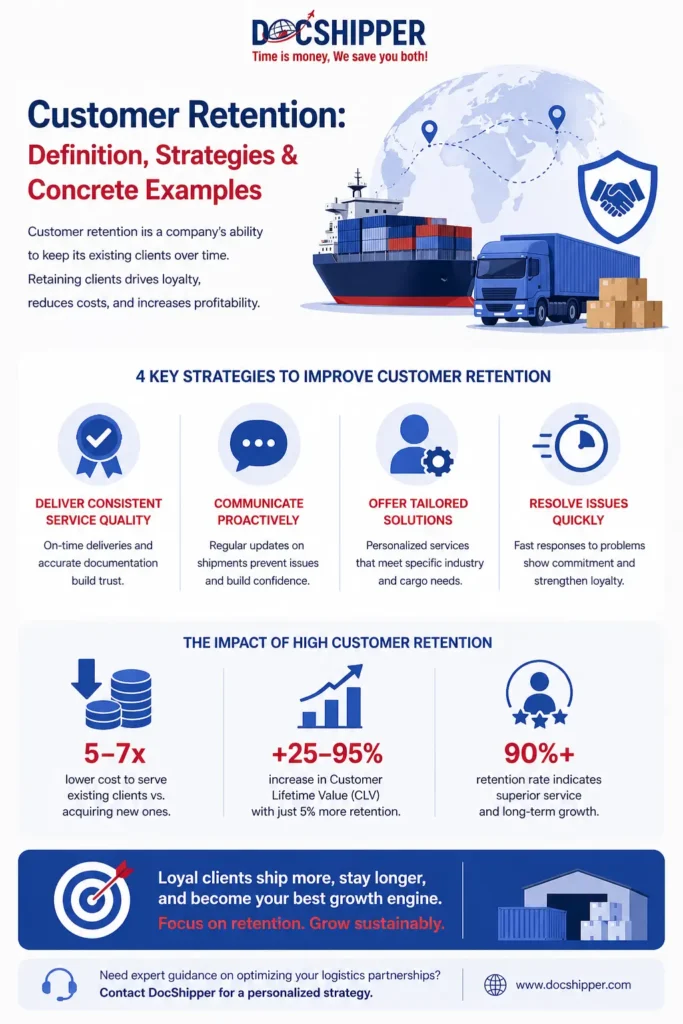
Customer retention refers to a company's ability to keep its existing clients over a defined period. It measures loyalty through repeat purchases and long-term engagement. High retention reduces acquisition costs and increases profitability, making it a critical metric in international logistics and freight forwarding services.Introduction
Many logistics companies focus exclusively on acquiring new clients while neglecting their existing customer base. This approach creates a costly cycle where businesses constantly chase new contracts without building sustainable relationships. In international freight forwarding, where transactions are complex and trust is paramount, customer retention becomes the foundation of long-term profitability.
Retaining clients in logistics services directly impacts revenue stability. A loyal customer generates predictable cash flow and often increases their shipping volume over time. The cost of serving existing clients is typically 5 to 7 times lower than acquiring new ones.
Key characteristics of effective customer retention in logistics include:
- Consistent service quality: On-time deliveries and accurate documentation build trust.
- Proactive communication: Regular updates on shipment status prevent anxiety and complaints.
- Personalized solutions: Tailored services addressing specific industry needs (perishables, hazardous goods, oversized cargo).
- Competitive pricing transparency: Clear quotations without hidden fees strengthen relationships.
- Problem resolution speed: Quick responses to customs delays or damaged goods demonstrate commitment.
In-Depth Analysis & Retention Strategies
Customer retention in logistics operates on three fundamental pillars: operational excellence, relationship management, and value addition. Unlike transactional businesses, freight forwarding requires continuous engagement across multiple touchpoints—from initial quotation to final delivery and post-shipment follow-up.
The retention rate formula provides measurable insight: [(Customers at End of Period – New Customers) / Customers at Start] × 100. For example, if a freight forwarder starts January with 200 clients, gains 50 new ones, and ends with 220, the retention rate is [(220-50)/200] × 100 = 85%. Industry benchmarks suggest that logistics companies achieving 90%+ retention rates demonstrate superior service quality.
Technology integration significantly impacts retention. Real-time tracking systems, automated customs documentation, and AI-powered shipment forecasting reduce friction points. Clients value visibility—knowing exactly where their cargo is at any moment eliminates uncertainty. According to the International Chamber of Commerce, digitalization in trade logistics improves customer satisfaction scores by an average of 34%.
Account management structure determines retention success. Dedicated account managers who understand specific industry requirements create personalized experiences. A pharmaceutical company importing temperature-sensitive vaccines requires different handling than an automotive manufacturer shipping spare parts. This specialization builds irreplaceable expertise.
Loyalty programs and volume incentives encourage repeat business. Tiered pricing models reward high-volume shippers with better rates. Exclusive benefits like priority booking during peak seasons or complimentary warehousing for 48 hours strengthen commercial ties.
At DocShipper, we implement quarterly business reviews with key accounts to assess performance metrics, identify improvement areas, and align on future shipping needs. This proactive approach prevents client attrition before dissatisfaction occurs.
Concrete Examples & Performance Data
Examining real-world retention scenarios reveals actionable patterns. Consider three logistics companies with different retention approaches and their corresponding business outcomes:
| Company Profile | Retention Rate | Key Strategy | Annual Revenue Growth |
|---|---|---|---|
| Basic Freight Forwarder | 68% | Price-focused, minimal follow-up | +3% |
| Technology-Enabled Provider | 87% | Real-time tracking + automated alerts | +18% |
| Full-Service Logistics Partner | 94% | Dedicated managers + value-added services | +31% |
The data demonstrates clear correlation between retention investment and revenue expansion. Companies prioritizing relationship depth over transaction volume achieve sustainable growth.
Use Case: Electronics Importer Retention Strategy
A European electronics distributor importing components from Asia faced frequent delays with their previous forwarder. After switching to a retention-focused provider, they experienced:
- 98% on-time delivery rate (up from 73%)
- 47% reduction in customs clearance time through pre-clearance documentation
- Dedicated Slack channel for instant communication with account team
- Quarterly cost optimization reviews identifying $23,000 annual savings through route consolidation
- 3-year contract renewal with 40% volume increase commitment
This case illustrates how operational improvements translate into commercial loyalty. The importer’s total logistics spend increased, but so did their business predictability and profit margins.
Retention Metrics That Matter:
- Net Promoter Score (NPS): Measures likelihood of client recommendations. Logistics leaders achieve NPS above 50.
- Customer Lifetime Value (CLV): Total revenue expected from a client relationship. Increasing retention by 5% can boost CLV by 25-95%.
- Churn Rate: Percentage of clients lost per period. Best-in-class logistics companies maintain churn below 8% annually.
- Repeat Purchase Rate: Frequency of recurring shipments. Monthly shippers generate 12x more revenue than one-time users.
- Support Ticket Resolution Time: Speed of problem-solving. Sub-4-hour response times correlate with 89% retention rates.
Conclusion
Customer retention in logistics transcends simple service delivery—it requires strategic relationship building, technological enablement, and continuous value demonstration. Companies that invest in retention infrastructure achieve superior profitability and market resilience compared to acquisition-focused competitors.
Need expert guidance on optimizing your logistics partnerships? Contact DocShipper for a personalized retention strategy assessment.
📚 Quiz
Test Your Knowledge: Customer Retention
Q1 — What does "customer retention" primarily measure in a logistics context?
Q2 — A freight forwarder starts the quarter with 200 clients, acquires 50 new ones, and ends with 220. What is their retention rate?
Q3 — A logistics client experiences a customs delay. Which approach best supports long-term customer retention?
🎯 Your Result
📞 Free Quote in 24hFAQ | Customer Retention: Definition, Strategies & Concrete Examples
Industry benchmarks suggest 85-90% is competitive, while top-performing logistics companies achieve 92-95% retention. Rates below 80% indicate service quality or pricing issues requiring immediate attention.
Retention focuses on maintaining existing relationships through consistent service, while acquisition targets new clients through marketing and sales. Retention typically costs 5-7 times less and generates higher profit margins.
Digital tools like real-time tracking, automated documentation, and predictive analytics reduce friction points. Clients using self-service portals show 23% higher retention rates due to increased transparency and control.
Absolutely. Personalized service often outweighs scale advantages. Small providers leveraging niche expertise and responsive communication frequently achieve higher retention than large corporations with impersonal processes.
Monthly tracking provides actionable insights, while quarterly deep-dives identify trends. Annual reviews miss early warning signs of client dissatisfaction that could prevent churn.
Failing to communicate proactively during delays or issues. Clients tolerate occasional problems but not information blackouts. Transparent updates maintain trust even when circumstances are challenging.
When structured correctly, yes. Volume-based discounts and exclusive benefits (priority booking, extended payment terms) increase switching costs. However, programs must deliver genuine value, not just symbolic gestures.
Retained clients require less marketing spend, generate predictable revenue, and often increase shipment volumes over time. Studies show a 5% retention increase can boost profits by 25-95% depending on business model.
Accurate, timely customs paperwork prevents costly delays. Proactive compliance checks and digital document repositories accessible to clients build confidence and reduce administrative burden on both parties.
Strategic compensation for service failures can salvage relationships. However, systemic refunds indicate operational problems requiring root cause fixes. One-time goodwill gestures paired with process improvements are most effective.
Dedicated managers who understand client industries and anticipate needs create irreplaceable value. Personal relationships reduce price sensitivity and increase tolerance for occasional service hiccups.
NPS measures advocacy likelihood, which strongly correlates with retention. Clients scoring 9-10 (promoters) renew contracts at 91% rates, while detractors (0-6) churn at 68%. Tracking both metrics provides comprehensive loyalty insight.
Need Help with
Logistics or Sourcing ?
First, we secure the right products from the right suppliers at the right price by managing the sourcing process from start to finish. Then, we simplify your shipping experience - from pickup to final delivery - ensuring any product, anywhere, is delivered at highly competitive prices.


Fill the Form
Prefer email? Send us your inquiry, and we’ll get back to you as soon as possible.
Contact us




