


In short ⚡
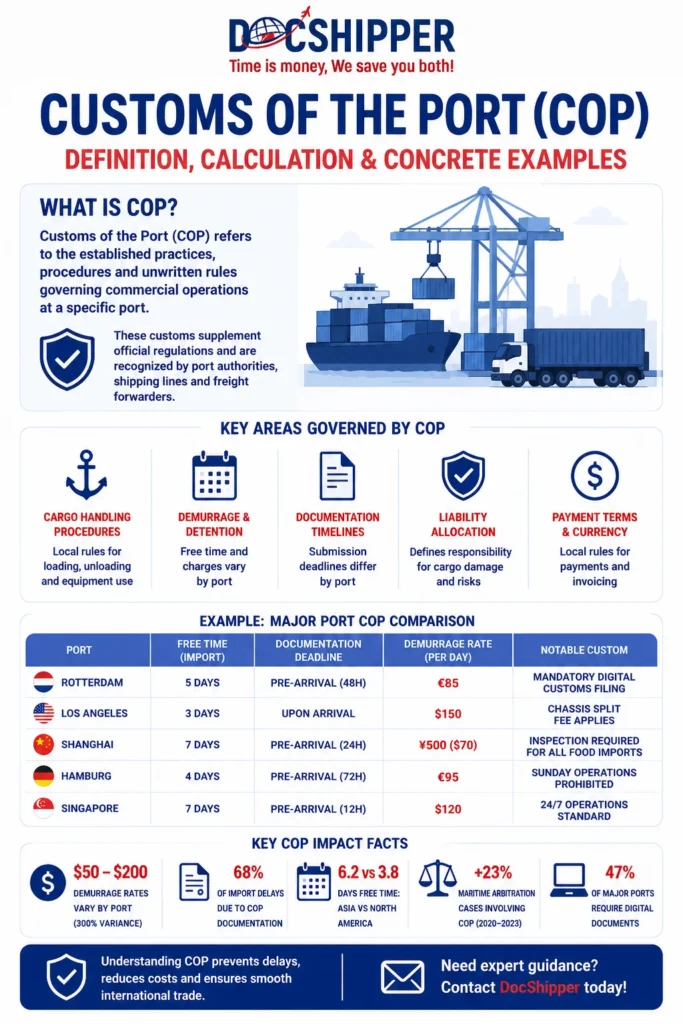
Customs of the Port (COP) refers to the established practices, procedures, and unwritten rules governing commercial operations at a specific port. These customs dictate how cargo handling, documentation, dispute resolution, and business transactions are conducted, often supplementing official regulations with local operational standards recognized by port authorities, shipping lines, and freight forwarders.
Introduction
International shippers frequently encounter unexpected delays or additional charges because they overlooked local port customs. Understanding Customs of the Port prevents costly mistakes in import/export operations.
Every port worldwide operates under unique operational norms developed through decades of commercial practice. These customs bridge gaps between international maritime law and daily logistics reality.
Key characteristics of COP include:
- Local precedence: Practices vary significantly between Rotterdam, Shanghai, and Los Angeles
- Legal recognition: Courts often uphold COP as binding contractual terms
- Operational efficiency: Streamlines processes through shared understanding among stakeholders
- Dispute resolution: Provides framework for handling cargo claims and demurrage issues
- Documentation standards: Defines acceptable formats and submission timelines
Understanding COP: Legal Framework & Operational Impact
Customs of the Port function as supplementary contractual terms in maritime commerce. When a bill of lading references “subject to COP,” it incorporates these practices into the shipping agreement.
The legal foundation stems from Article III of the Hague-Visby Rules, which acknowledges local customs in cargo handling responsibilities. Courts worldwide recognize COP as legitimate trade usage when practices are notorious, certain, and reasonable.
Five critical operational areas governed by COP:
1. Cargo handling procedures: Each port establishes norms for loading/unloading sequences, equipment usage, and stevedore responsibilities. Hamburg, for example, requires specific lashing methods for containers that differ from Antwerp’s standards.
2. Demurrage and detention calculations: Free time allowances vary dramatically. Singapore offers 7 days free time for import containers, while some U.S. ports provide only 48 hours before charges accrue.
3. Documentation submission timelines: Customs clearance document deadlines differ. Dubai requires pre-arrival manifests 24 hours before vessel berthing, whereas Sydney accepts documents up to arrival time.
4. Liability allocation: Who bears responsibility for cargo damage during port operations? COP defines whether the carrier, terminal operator, or shipper assumes risk during specific handling phases.
5. Payment terms and currency: Local customs dictate acceptable payment methods, currency preferences, and invoicing practices for port services.
At DocShipper, we maintain updated databases of COP requirements across 150+ ports worldwide, ensuring our clients avoid compliance issues and unexpected costs. Our logistics experts verify local practices before shipment execution.
The International Maritime Organization (IMO) provides guidelines on how COP interacts with international maritime conventions, though enforcement remains localized.
Practical Applications & Real-World Scenarios
Understanding theoretical definitions proves insufficient without examining how COP impacts actual shipping operations. The following scenarios illustrate financial and operational consequences.
Comparative Analysis: Major Port Customs
| Port | Free Time (Import) | Documentation Deadline | Demurrage Rate (per day) | Notable Custom |
|---|---|---|---|---|
| Rotterdam | 5 days | Pre-arrival (48h) | €85 | Mandatory digital customs filing |
| Los Angeles | 3 days | Upon arrival | $150 | Chassis split fee applies |
| Shanghai | 7 days | Pre-arrival (24h) | ¥500 ($70) | Inspection required for all food imports |
| Hamburg | 4 days | Pre-arrival (72h) | €95 | Sunday operations prohibited |
| Singapore | 7 days | Pre-arrival (12h) | $120 | 24/7 operations standard |
Use Case: Electronics Shipment to Hamburg
Scenario: A U.S. electronics manufacturer ships 40 containers of consumer goods to Hamburg. The shipper, unfamiliar with Hamburg’s COP, faces unexpected costs.
Issue: The shipper assumed standard 5-day free time based on Rotterdam experience. Hamburg’s COP provides only 4 days, and the consignee couldn’t clear customs over the weekend due to Sunday operation restrictions.
Financial impact:
- Excess storage: 3 additional days × 40 containers × €95/day = €11,400
- Expedited customs clearance (Monday rush): €2,800
- Total unplanned costs: €14,200
Prevention: DocShipper’s pre-shipment consultation would have identified Hamburg’s weekend restrictions, allowing the shipper to schedule arrival on Tuesday, ensuring full utilization of free time.
Key Data Points on COP Impact
1. Cost variability: Demurrage rates across top 20 global ports range from $50 to $200 per container per day, representing 300% variance.
2. Documentation compliance: 68% of import delays stem from COP-related documentation misunderstandings, according to World Bank logistics performance data.
3. Free time differences: Asian ports average 6.2 days free time versus 3.8 days in North American ports, significantly impacting supply chain planning.
4. Dispute resolution: Maritime arbitration cases involving COP increased 23% between 2020-2023, highlighting growing complexity in global trade.
5. Digital transformation: 47% of major ports now require electronic submission of customs documents, creating new COP standards around digital compliance.
Conclusion
Customs of the Port represent the operational DNA of international shipping, transforming abstract regulations into practical procedures. Mastering COP requirements prevents costly delays and ensures smooth cargo flow through global supply chains.
Need expert guidance navigating port-specific requirements? Contact DocShipper for comprehensive logistics support tailored to your shipping routes.
📚 Quiz
Test Your Knowledge: Customs of the Port (COP)
Q1 — What best describes "Customs of the Port" (COP) in international shipping?
Q2 — A shipper argues that COP should be ignored because they conflict with international maritime conventions like the Hague-Visby Rules. Is this correct?
Q3 — A U.S. exporter ships 40 containers to Hamburg, assuming 5 days of free time based on prior Rotterdam experience. The cargo arrives on a Friday. What is the most likely outcome under Hamburg's COP?
🎯 Your Result
📞 Free Quote in 24hFAQ | Customs of the Port (COP): Definition, Calculation & Concrete Examples
Yes, when COP are notorious, certain, and reasonable, courts recognize them as implied contractual terms. Maritime law in most jurisdictions upholds established port customs as binding on parties engaging in commerce at that location.
Contact the port authority directly, consult your freight forwarder, or reference publications like Fairplay or Lloyd's List. Professional logistics providers like DocShipper maintain comprehensive COP databases for major global ports.
No, COP supplement rather than override conventions like Hague-Visby Rules. They fill operational gaps not addressed by international law, but cannot contradict mandatory legal provisions.
Rarely mid-contract, but COP evolve over time. Ports update practices periodically, typically with advance notice. Your shipping contract references COP "as of" the shipment date.
Consequences include cargo holds, additional fees, priority loss in berthing schedules, or blacklisting by port authorities. Repeated violations may result in increased scrutiny for future shipments.
No, dangerous goods, refrigerated cargo, and oversized shipments often have specialized customs. Each cargo category may face unique handling requirements and documentation standards.
Free trade zones within ports may operate under modified customs, often with extended free time and simplified documentation. However, general port COP still apply for vessel operations and cargo handling.
Yes, though less documented than major hubs. Regional ports develop customs through local practice, which may be more flexible but also less predictable for international shippers.
Occasionally for high-volume shippers or unique circumstances. Ports may grant waivers for demurrage extensions or documentation timelines, but such arrangements require advance negotiation and formal approval.
Digital platforms standardize some practices while creating new customs around electronic submissions, blockchain documentation, and automated clearance. Ports transitioning to smart systems are actively redefining COP.
Some aspects appear in tariff schedules, but many customs exist as unwritten operational norms. Comprehensive understanding requires combining official publications with practical industry knowledge.
Experienced forwarders serve as COP interpreters, translating local practices into actionable shipping plans. They navigate documentation requirements, timing constraints, and procedural nuances on behalf of shippers unfamiliar with specific ports.
Need Help with
Logistics or Sourcing ?
First, we secure the right products from the right suppliers at the right price by managing the sourcing process from start to finish. Then, we simplify your shipping experience - from pickup to final delivery - ensuring any product, anywhere, is delivered at highly competitive prices.


Fill the Form
Prefer email? Send us your inquiry, and we’ll get back to you as soon as possible.
Contact us




:%20Definition%20&%20Guide%20for%202026)