


In short ⚡
Customs Value Only (CVO) is a freight insurance term where coverage is limited exclusively to the customs declared value of goods, excluding freight and insurance costs. This restricted approach protects only the merchandise value against loss or damage during international transit, making it the most economical yet limited insurance option for low-risk shipments.Introduction
When shipping internationally, many businesses mistakenly assume their cargo is fully protected, only to discover their insurance covers just the customs value—excluding freight charges, duties, or profit margins. This gap can result in substantial financial losses during claims.
Customs Value Only insurance represents the baseline protection level in international logistics. Unlike comprehensive coverage (CIF value + 10%), CVO policies reimburse solely the declared customs value, making them suitable for specific commercial contexts but potentially inadequate for high-value or margin-sensitive shipments.
Key characteristics of CVO insurance include:
- Coverage limited to the FOB (Free On Board) value declared to customs authorities
- Excludes transportation costs, insurance premiums, and profit margins
- Lower premium rates compared to full replacement value insurance
- Typically applied to low-risk commodities or intra-company transfers
- May not satisfy contractual obligations under certain Incoterms (CIF, CIP)
Technical Framework & Insurance Implications
The customs value forms the foundation for calculating import duties and taxes, but it intentionally excludes several cost components that contribute to the total landed cost. Understanding this distinction is critical for risk management.
Under WTO Valuation Agreement principles, customs value typically equals the transaction value—the price actually paid or payable for goods when sold for export. This excludes post-shipment costs like international freight, insurance, and destination handling charges.
When selecting CVO insurance, shippers accept several limitations:
Coverage gaps emerge because the policy reimburses only the invoice value submitted to customs. If a $50,000 shipment incurs $8,000 in ocean freight and $2,000 in insurance, a total loss under CVO coverage yields only $50,000—leaving the shipper to absorb $10,000 in unrecovered costs.
Incoterms compatibility becomes problematic under CIF (Cost, Insurance, Freight) or CIP (Carriage and Insurance Paid To) terms, which require the seller to provide insurance covering at least 110% of the contract value. CVO policies typically fail to meet this threshold, potentially breaching contractual obligations.
Profit margin exposure represents another vulnerability. If goods are manufactured at $30,000 cost but sold for $50,000 customs value, CVO insurance recovers only the declared $50,000—not the anticipated $70,000 retail value or lost profit opportunity.
Regulatory considerations vary by jurisdiction. The European Union’s Union Customs Code (Article 70) and the U.S. Customs and Border Protection regulations (19 CFR Part 152) establish strict valuation methodologies that directly impact CVO coverage limits. Shippers must ensure their declared values comply with these frameworks to avoid both customs penalties and insurance claim disputes.
At DocShipper, we systematically review clients’ insurance coverage against their Incoterms and contractual obligations, ensuring CVO policies are only recommended when appropriate for the shipment profile and risk tolerance.
For authoritative guidance on customs valuation, refer to the World Customs Organization Valuation Database.
Practical Scenarios & Comparative Analysis
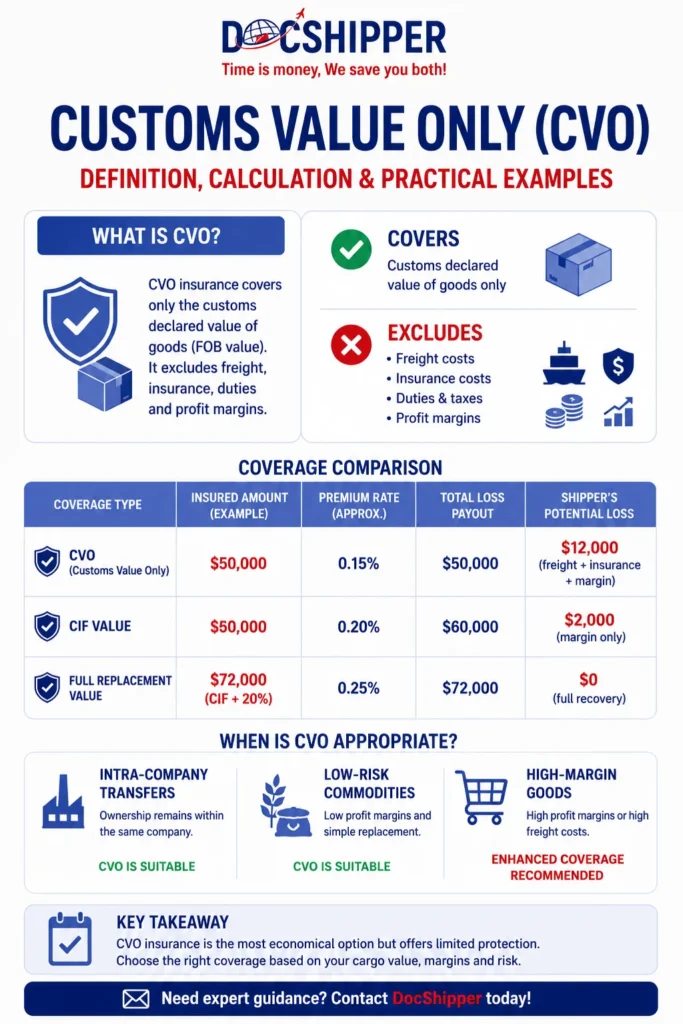
To illustrate CVO insurance implications, consider three common shipping scenarios with varying coverage outcomes:
| Coverage Type | Insured Amount | Premium Rate | Total Loss Payout | Shipper’s Loss |
|---|---|---|---|---|
| CVO (Customs Value Only) | $50,000 | 0.15% | $50,000 | $12,000 (freight + insurance + margin) |
| CIF Value | $60,000 | 0.20% | $60,000 | $2,000 (profit margin only) |
| Full Replacement Value | $72,000 (CIF + 20%) | 0.25% | $72,000 | $0 (full recovery) |
Use Case 1: Intra-Company Transfer
A multinational corporation ships manufacturing equipment valued at $200,000 from its German facility to its Chinese subsidiary. Since ownership remains within the corporate group and replacement cost equals book value, CVO insurance at $200,000 provides adequate protection. Premium savings of approximately $400 annually justify the limited coverage.
Use Case 2: High-Margin Consumer Goods
An electronics retailer imports smartphones with a customs value of $80,000 but a retail value of $140,000. Ocean freight costs $6,000. Under CVO coverage, a total loss yields $80,000—leaving a $66,000 shortfall ($60,000 lost profit + $6,000 freight). Upgrading to full replacement value insurance for an additional $150 premium would have eliminated this exposure.
Use Case 3: Commodity Bulk Shipment
A grain trader ships 500 tons of wheat valued at $120,000 FOB with minimal profit margins (8%). Freight costs $15,000. CVO insurance adequately covers the commodity value, as the trader’s primary concern is the grain itself rather than ancillary costs. The 0.10% premium rate ($120) makes CVO economically optimal.
Key decision factors when evaluating CVO insurance:
- Profit margin sensitivity: Products with margins exceeding 20% generally require enhanced coverage
- Freight cost proportion: When transportation exceeds 15% of customs value, CVO gaps widen significantly
- Contractual obligations: CIF/CIP Incoterms mandate coverage beyond CVO minimums
- Replacement complexity: Goods requiring lengthy remanufacturing or sourcing benefit from full value protection
- Claims history: Routes with elevated loss rates justify comprehensive coverage despite premium differences
DocShipper provides comparative insurance analysis for every shipment, calculating the cost-benefit ratio across coverage tiers to ensure clients select the optimal protection level for their specific cargo profile and risk appetite.
Conclusion
Customs Value Only insurance serves a strategic purpose for low-risk, low-margin shipments where cost minimization outweighs comprehensive protection. However, most commercial shipments benefit from enhanced coverage that accounts for total landed costs and profit expectations.
Need expert guidance on selecting the right insurance coverage for your international shipments? Contact DocShipper for a customized risk assessment and insurance strategy tailored to your logistics requirements.
📚 Quiz
Test Your Knowledge: Customs Value Only (CVO)
Q1 — What does Customs Value Only (CVO) insurance cover?
Q2 — A shipper exports electronics with a customs value of $80,000, ocean freight of $6,000, and a retail value of $140,000. Under a CVO policy, what is the shipper's financial shortfall in the event of a total loss?
Q3 — Which of the following shipment scenarios is CVO insurance most appropriate for?
🎯 Your Result
📞 Free Quote in 24hFAQ | Customs Value Only (CVO): Definition, Calculation & Practical Examples
CVO insurance covers only the declared customs value of goods—typically the FOB invoice amount—excluding freight charges, insurance premiums, duties, taxes, and profit margins. It provides the minimum protection level for international shipments.
No. CIF terms require the seller to provide insurance covering at least 110% of the contract value (CIF value + 10%). CVO insurance covers only the FOB value, falling short of this contractual obligation and potentially exposing the seller to liability.
CVO premiums typically range from 0.10% to 0.20% of insured value, while full replacement value insurance costs 0.25% to 0.40%. For a $100,000 shipment, this translates to $100–$200 for CVO versus $250–$400 for comprehensive coverage—a savings of $150–$200.
Generally no. Insurance policies must be arranged before the insured interest attaches—typically at the point of loading. Post-departure upgrades are rarely accepted by underwriters due to adverse selection risk and the inability to inspect pre-shipment conditions.
Undervaluing goods for customs purposes creates dual risks: customs penalties for false declaration and potential claim denial if the insurer determines the declared value was fraudulent. Overvaluation may trigger customs audits but ensures adequate insurance coverage.
CVO policies typically cover both total and partial losses, subject to policy terms and deductibles. However, the reimbursement is proportional to the customs value, not the replacement cost, potentially leaving gaps in partial loss scenarios involving high-margin goods.
CVO works well for bulk commodities (grains, ores, raw materials), intra-company transfers, and low-margin products where the customs value closely approximates total economic exposure. High-value electronics, fashion goods, and specialized equipment generally require enhanced coverage.
Subtract the customs value from your total economic exposure: (Freight + Insurance + Customs Value + Expected Profit) – Customs Value = Coverage Gap. For example, if total exposure is $75,000 and customs value is $50,000, your gap is $25,000.
Not always. Many forwarders offer default CVO coverage to minimize premium costs and administrative complexity. Shippers should proactively request coverage analysis based on their specific cargo value, Incoterms, and risk tolerance rather than accepting default options.
Yes. Shippers can purchase CVO as base coverage and add specific riders for theft, delay, or consequential loss. However, this piecemeal approach often costs more than purchasing comprehensive coverage initially, making it economically inefficient for most shipments.
CVO insurance does not affect duty calculations—duties are assessed on the customs value regardless of insurance coverage level. However, if insurance costs are included in the CIF value for duty purposes, this creates a discrepancy with CVO coverage that excludes those costs.
Standard claim documentation includes: commercial invoice showing customs value, bill of lading or airway bill, packing list, survey report documenting loss or damage, customs entry documents, and proof of payment. The insurer will verify the customs value against official declarations before settlement.
Need Help with
Logistics or Sourcing ?
First, we secure the right products from the right suppliers at the right price by managing the sourcing process from start to finish. Then, we simplify your shipping experience - from pickup to final delivery - ensuring any product, anywhere, is delivered at highly competitive prices.


Fill the Form
Prefer email? Send us your inquiry, and we’ll get back to you as soon as possible.
Contact us




:%20Definition%20&%20Guide%20for%202026)