


In short ⚡
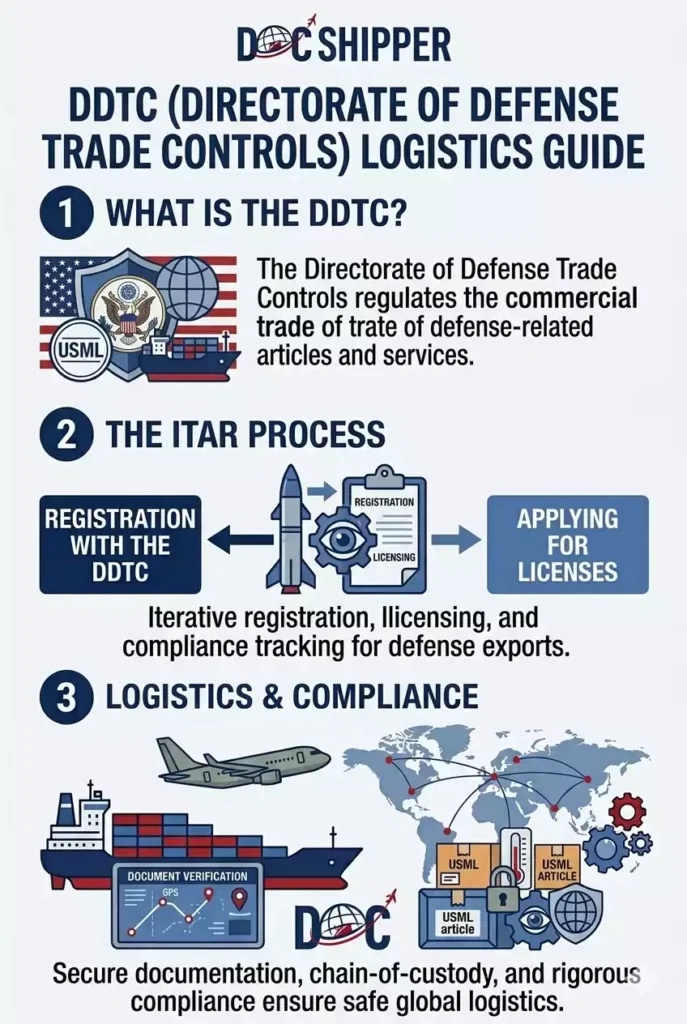
DDTC (Directorate of Defense Trade Controls) is the U.S. Department of State bureau responsible for administering and enforcing the International Traffic in Arms Regulations (ITAR). The DDTC controls the export and temporary import of defense articles, technical data, and defense services to ensure national security compliance and prevent unauthorized technology transfers.Introduction
Many companies unknowingly violate U.S. export controls by misclassifying defense-related products or sharing technical data with foreign nationals without proper authorization. The Directorate of Defense Trade Controls (DDTC) exists to prevent such violations that could compromise national security.
In international trade involving military equipment, dual-use technologies, or defense services, understanding DDTC jurisdiction is critical. Even commercial products with potential military applications may fall under its oversight.
The DDTC’s authority extends to:
- Defense articles: Military hardware, components, and accessories listed on the U.S. Munitions List (USML)
- Technical data: Blueprints, drawings, specifications, and manufacturing know-how related to defense items
- Defense services: Training, technical assistance, or consulting related to USML items
- Registration requirements: Mandatory registration for manufacturers, exporters, and brokers of defense articles
- Licensing procedures: Authorization mechanisms for temporary and permanent exports
Regulatory Framework & Authority
The DDTC operates under the Arms Export Control Act (AECA) and implements the International Traffic in Arms Regulations (ITAR). These regulations define what constitutes a defense article and establish the legal framework for controlling their movement across borders.
The U.S. Munitions List (USML) categorizes defense articles into 21 categories ranging from firearms to spacecraft systems. Unlike dual-use items controlled by the Commerce Department, USML items have predominantly military applications and face stricter controls.
Key regulatory mechanisms include:
- DSP-5 licenses: Permanent export licenses for defense articles to foreign end-users
- DSP-73 licenses: Temporary import licenses for foreign defense articles entering the U.S.
- Technical Assistance Agreements (TAAs): Required for providing defense services to foreign persons
- Manufacturing License Agreements (MLAs): Authorization for foreign production of USML items
- Registration requirements: Annual registration with DDTC mandatory for manufacturers and exporters
The DDTC also enforces end-use monitoring to ensure exported defense articles are used only for authorized purposes. Violations can result in civil penalties up to $500,000 per violation and criminal prosecution including imprisonment. Reference the official DDTC website for current regulations.
At DocShipper, we conduct preliminary USML classification reviews to help clients identify whether their products require DDTC oversight, minimizing the risk of inadvertent violations during international shipments.
Compliance Requirements & Practical Examples
Compliance with DDTC regulations requires systematic procedures and documentation. Approximately 65% of first-time exporters underestimate the complexity of defense trade controls, leading to costly delays or enforcement actions.
Case Study: Aerospace Component Export
A U.S. manufacturer of satellite guidance systems needs to export components to a European defense contractor. The compliance process includes:
- Product classification: Determining the component falls under USML Category XV (spacecraft systems)
- DDTC registration: Ensuring current registration status (renewed annually by specific deadline)
- License application: Submitting DSP-5 with technical specifications, end-user documentation, and purchase agreement
- Processing time: Awaiting DDTC review (typically 60-90 days for standard applications)
- Shipment execution: Exporting only after receiving license approval and maintaining export records for 5 years
| Document Type | Purpose | Processing Time |
|---|---|---|
| DSP-5 | Permanent export of defense articles | 60-90 days |
| DSP-61 | Temporary export (demos, trade shows) | 30-45 days |
| DSP-73 | Temporary import of foreign defense articles | 30-45 days |
| TAA | Technical assistance to foreign entities | 90-120 days |
Critical Compliance Elements:
- Deemed exports: Sharing technical data with foreign nationals within the U.S. requires authorization
- Foreign Person Rule: U.S. persons abroad remain subject to ITAR when handling defense articles
- Embargoed destinations: Exports to certain countries are prohibited regardless of license application
- Recordkeeping: Maintaining comprehensive documentation for 5 years minimum
- Employee training: Regular ITAR awareness programs for personnel handling controlled items
DocShipper maintains relationships with licensed freight forwarders experienced in DDTC-regulated shipments, ensuring proper documentation and compliance throughout the logistics chain.
Conclusion
The Directorate of Defense Trade Controls represents a critical regulatory framework for companies engaged in defense trade. Proper classification, licensing, and compliance procedures protect both national security interests and business operations from severe penalties.
Need guidance on DDTC compliance for your international shipments? Contact DocShipper for expert support in navigating defense trade regulations.
📚 Quiz
Test Your Knowledge: DDTC (Directorate of Defense Trade Controls)
1. What is the primary regulatory scope of the DDTC?
2. A U.S. defense contractor shares technical blueprints for a missile guidance system with a foreign national employee working at their U.S. facility. Does this require DDTC authorization?
3. Your company manufactures aerospace components that could have both commercial and military applications. Which factor determines whether DDTC has jurisdiction?
🎯 Your Result
📞 Free Quote in 24hFAQ | DDTC (Directorate of Defense Trade Controls): Definition, Role & Compliance Requirements
DDTC controls defense articles under ITAR, while the Bureau of Industry and Security (BIS) regulates dual-use items under EAR. DDTC-controlled items have predominantly military applications, whereas BIS items serve both commercial and military purposes. The key distinction lies in the U.S. Munitions List (DDTC) versus the Commerce Control List (BIS).
Yes, any person engaged in the business of manufacturing or exporting defense articles must register with DDTC, regardless of export frequency. Registration is required before submitting license applications and must be renewed annually. The registration fee is currently $2,250 per year, with exemptions only for certain government agencies.
Civil penalties can reach $500,000 per violation or twice the value of the transaction, whichever is greater. Criminal violations under the Arms Export Control Act may result in fines up to $1 million and imprisonment for up to 20 years. Additional consequences include debarment from export privileges and reputational damage.
Standard license applications (DSP-5) typically require 60-90 days for processing. Temporary export licenses (DSP-61) may be processed in 30-45 days. Complex cases involving sensitive technologies or destinations may take longer. Expedited processing is available in certain circumstances but requires additional justification.
A deemed export occurs when technical data or defense articles are released to a foreign person within the United States. This includes sharing information with foreign national employees, contractors, or visitors. DDTC authorization is required for deemed exports, making employee nationality a critical compliance consideration for defense contractors.
Yes, commercial items with defense-related applications may be controlled if they meet USML criteria. Items specifically designed, modified, or configured for military applications fall under DDTC jurisdiction regardless of their commercial availability. The "catch-all" provision in ITAR allows DDTC to control items not explicitly listed if they provide a critical military advantage.
The U.S. Munitions List organizes defense articles into 21 categories covering firearms, explosives, vessels, aircraft, spacecraft, military electronics, and related technologies. Each category contains specific item descriptions and associated technical data. Recent reforms have clarified definitions and moved some items to Commerce Department control.
Technical discussions disclosing ITAR-controlled technical data require authorization through a Technical Assistance Agreement (TAA) or appropriate export license. General marketing information and public domain data do not require licenses. Companies should implement procedures to ensure employees distinguish between controlled and non-controlled information during foreign interactions.
DSP-5 licenses authorize permanent exports of defense articles, meaning the items leave U.S. control indefinitely. DSP-61 licenses cover temporary exports where items will return to the U.S., such as demonstrations, trade shows, or repairs. DSP-61 applications require less documentation but impose return deadlines and restrictions on end-use.
DDTC conducts end-use monitoring through post-shipment verification, requiring exporters to maintain records documenting item disposition. Foreign consignees may receive site visits from U.S. embassy personnel. License conditions often include reporting requirements for item transfer, destruction, or return. Exporters remain responsible for ensuring authorized end-use throughout the item's lifecycle.
No, DDTC licenses are company-specific and non-transferable. If your company is acquired or undergoes significant organizational changes, existing licenses may require amendment or new applications. Exporters must notify DDTC of corporate changes that affect registration information within 30 days, ensuring compliance continuity during business transitions.
DDTC maintains country-specific policies that range from general approvals to complete embargoes. Countries under U.S. arms embargo include Iran, North Korea, Syria, and others as designated by the State Department. Even for non-embargoed destinations, certain sensitive technologies face heightened scrutiny based on foreign policy and national security considerations.
Need Help with
Logistics or Sourcing ?
First, we secure the right products from the right suppliers at the right price by managing the sourcing process from start to finish. Then, we simplify your shipping experience - from pickup to final delivery - ensuring any product, anywhere, is delivered at highly competitive prices.


Fill the Form
Prefer email? Send us your inquiry, and we’ll get back to you as soon as possible.
Contact us




:%20Definition,%20Role%20&%20Compliance%20Requirements)