


In short ⚡
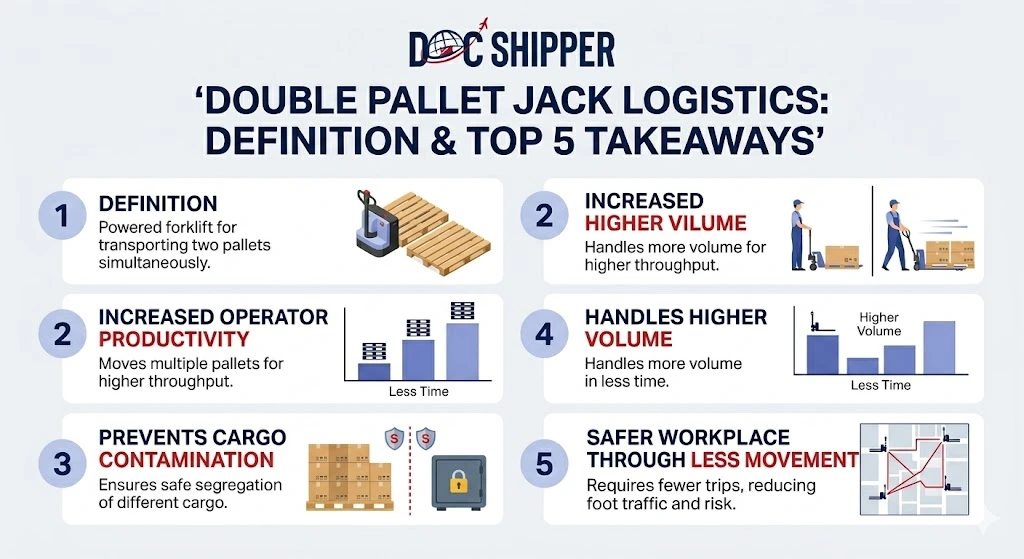
A double-pallet jack is a specialized material handling equipment designed to lift and transport two standard pallets simultaneously. This heavy-duty hydraulic device features an extended fork length (typically 2,400mm) and reinforced construction, enabling operators to move double the cargo volume compared to standard pallet jacks, significantly improving warehouse productivity and reducing handling time.
Introduction
Warehouse managers frequently face a critical bottleneck: loading and unloading operations consume excessive labor hours while increasing operational costs. Traditional single-pallet jacks require twice as many trips to move the same cargo volume, directly impacting throughput efficiency.
In international logistics and freight forwarding, the double-pallet jack addresses this challenge by doubling cargo handling capacity per trip. This equipment proves essential in container loading operations, cross-docking facilities, and distribution centers where time-sensitive shipments demand maximum efficiency.
- Extended fork length: 2,400mm to 2,700mm accommodating two Euro pallets (800x1200mm) or standard pallets (1000x1200mm)
- Load capacity: Typically 2,000kg to 3,000kg total weight capacity
- Hydraulic system: Reinforced pump mechanism for stable dual-pallet lifting
- Wheel configuration: Heavy-duty polyurethane or nylon wheels with wider load distribution
- Operational efficiency: Reduces handling time by up to 50% compared to standard jacks
Technical Specifications & Operational Mechanics
The double-pallet jack operates through a reinforced hydraulic system that distributes lifting force across extended forks. The tandem fork design maintains load balance through precision-engineered weight distribution, preventing tipping during transport.
Key operational considerations include load positioning—cargo must be evenly distributed across both pallets to maintain stability. The center of gravity shifts significantly with dual-pallet configuration, requiring operators to maintain slower turning speeds and wider turning radii compared to standard equipment.
Regulatory compliance varies by jurisdiction. The European Union’s Machinery Directive 2006/42/EC establishes safety standards for manual handling equipment, including load capacity marking and operator training requirements.
Fork construction typically employs high-tensile steel with reinforced welds at stress points. The hydraulic pump mechanism features larger cylinder bore diameter to handle increased load mass. Wheel durometer selection impacts floor protection—softer compounds (85A-92A) suit polished concrete, while harder materials (95A+) provide better outdoor performance.
At DocShipper, we specify double-pallet jacks for container stuffing operations where clients need to maximize loading efficiency. Our warehouse teams verify equipment capacity ratings before deployment to prevent overloading incidents that could damage cargo or delay shipments.
The ergonomic handle design becomes critical with dual-pallet loads. Extended lever arms reduce operator force requirements, while adjustable handle heights accommodate different user preferences. Modern units incorporate brake systems—either foot-operated or integrated into the handle mechanism—essential for controlling momentum on inclined surfaces.
Practical Applications & Performance Data
Double-pallet jacks deliver measurable productivity gains across various logistics scenarios. Comparative analysis demonstrates their impact on operational metrics and cost efficiency.
| Operation Type | Standard Jack | Double-Pallet Jack | Efficiency Gain |
|---|---|---|---|
| 20ft Container Loading (20 pallets) | 20 trips × 3 min = 60 min | 10 trips × 3.5 min = 35 min | 42% faster |
| Warehouse Cross-Docking (40 pallets/hour) | 40 movements | 20 movements | 50% reduction |
| Labor Cost (8-hour shift) | 2 operators required | 1 operator sufficient | 50% cost saving |
| Floor Space Utilization | Standard aisle width (2.5m) | Requires 3.2m aisle width | 28% more space |
Use Case: Automotive Parts Distribution
A European automotive supplier implemented double-pallet jacks in their 15,000m² distribution center. Previous operations required four operators to handle 320 pallet movements daily. Post-implementation, two operators achieved the same throughput, reducing labor costs by €42,000 annually while cutting loading dock dwell time from 45 to 28 minutes per truck.
Container stuffing optimization: When loading mixed cargo into 40ft high-cube containers, double-pallet jacks enable simultaneous positioning of complementary shipments. This reduces container floor damage from repeated single-pallet positioning and improves weight distribution compliance with maritime safety regulations.
Operational limitations: Narrow warehouse aisles below 3 meters create maneuvering challenges. Tight turning radii require three-point turns, negating time savings. Floor condition critically impacts performance—uneven surfaces or expansion joints exceeding 10mm width cause instability with dual loads.
ROI calculation: Average equipment cost ranges €800-€1,400 depending on capacity and features. With labor savings of €180-€250 per week in medium-volume operations, typical payback period spans 6-8 months. High-volume facilities handling 500+ pallets daily achieve ROI within 3-4 months.
Industry adoption rates: Food and beverage distribution shows highest utilization (67% of facilities), followed by retail consolidation centers (54%) and manufacturing logistics (41%). E-commerce fulfillment centers increasingly deploy these units for bulk receiving operations where suppliers deliver double-stacked pallets.
Conclusion
The double-pallet jack represents a strategic investment for operations prioritizing throughput efficiency and labor optimization. Proper equipment selection, operator training, and facility layout planning determine success in implementation.
Need expert guidance on material handling equipment for your logistics operations? Contact DocShipper for customized warehouse solutions tailored to your cargo handling requirements.
📚 Quizz
Test Your Knowledge: Double-Pallet Jack
Q1 — What is the primary purpose of a double-pallet jack?
Q2 — A warehouse manager assumes a double-pallet jack can be used in any aisle where a standard pallet jack operates. Is this correct?
Q3 — A logistics team is loading a 20ft container with 20 pallets. Which scenario correctly reflects the use of a double-pallet jack?
🎯 Your Result
📞 Free Quote in 24hFAQ | Double-Pallet Jack: Definition, Capacity & Practical Applications
Most commercial double-pallet jacks safely handle 2,000kg to 3,000kg total capacity. Always verify the manufacturer's rated capacity on the equipment nameplate and never exceed this limit to prevent structural failure or operator injury.
Yes, provided both pallets have compatible dimensions and the combined width doesn't exceed fork length. Common configurations include two Euro pallets (800x1200mm) or two standard pallets (1000x1200mm), but mixing sizes requires careful load balancing.
Effective operation requires minimum 3.0-3.2 meters aisle width for safe turning and maneuvering. Narrower aisles force operators into time-consuming multi-point turns that eliminate productivity advantages.
Extended forks (2,400-2,700mm) increase turning radius by approximately 40-50%. Operators need additional space for directional changes and must exercise greater caution in congested warehouse areas or near racking systems.
While manual pallet jacks typically don't require formal certification, many companies mandate internal training programs covering load balancing, safe operating speeds, and stability principles specific to dual-pallet configurations.
Inspect hydraulic seals and wheel bearings weekly. Lubricate pivot points monthly. Conduct comprehensive hydraulic system checks quarterly. Replace worn wheels when diameter reduction exceeds 15% of original specification to maintain load stability.
Yes, provided the dock plate is rated for combined equipment and cargo weight (typically 4,000kg minimum). Ensure dock plates have proper edge protection and that the transition angle doesn't exceed 10 degrees to prevent load shifting.
Avoid surfaces with cracks exceeding 10mm width, expansion joints without beveled edges, wet or oily floors, and inclines greater than 5 degrees. These conditions compromise wheel traction and load stability with dual-pallet configurations.
Polyurethane wheels (85-95A durometer) provide better floor protection and quieter operation, ideal for retail environments. Nylon wheels offer superior load capacity and durability for heavy industrial use but may damage polished concrete floors.
With proper maintenance, industrial-grade units last 8-12 years in medium-use environments (50-100 pallet movements daily). High-volume operations (200+ movements daily) typically require replacement or major overhaul after 5-7 years.
Yes, but select models with weather-resistant hydraulic seals and hard rubber wheels (95A+ durometer). Avoid use on unpaved surfaces, gravel, or soft ground where wheel penetration creates instability. Ensure loading areas have solid, level concrete pads.
Uneven weight distribution between pallets creates lateral instability. Maintain weight variance below 15% between pallets. Position heavier pallet toward the operator when possible. Always lower forks completely during transport to minimize center of gravity height.
Need Help with
Logistics or Sourcing ?
First, we secure the right products from the right suppliers at the right price by managing the sourcing process from start to finish. Then, we simplify your shipping experience - from pickup to final delivery - ensuring any product, anywhere, is delivered at highly competitive prices.


Fill the Form
Prefer email? Send us your inquiry, and we’ll get back to you as soon as possible.
Contact us




