


In short ⚡
The Denied Party Listing (DPL) is a U.S. government database maintained by the Bureau of Industry and Security (BIS) containing individuals, entities, and vessels prohibited from receiving U.S. exports. Companies must screen all parties against this list to ensure export compliance and avoid severe penalties including fines and loss of export privileges.
Introduction
One of the most critical yet overlooked aspects of international trade is verifying that your business partners are legally permitted to receive goods. Shipping to a denied party can result in criminal prosecution, even if done unknowingly.
The Denied Party Listing serves as the U.S. government’s primary tool for preventing sensitive technology and goods from reaching entities that pose national security risks. This screening requirement applies to all export transactions subject to the Export Administration Regulations (EAR).
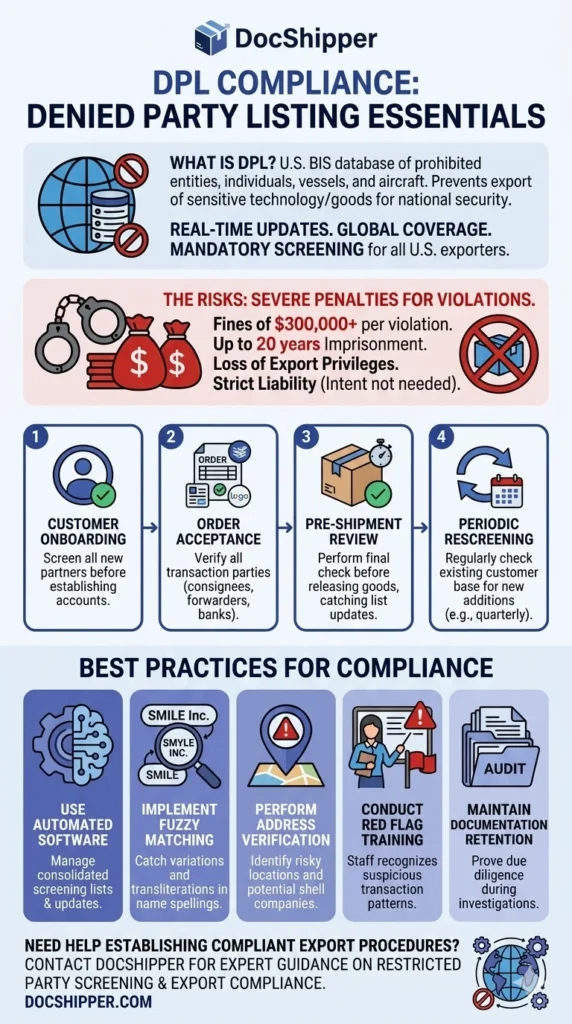
Key characteristics of the DPL include:
- Mandatory screening for all U.S. exporters and their foreign subsidiaries
- Real-time updates as entities are added or removed from the list
- Global reach covering parties in any country worldwide
- Comprehensive coverage including individuals, companies, vessels, and aircraft
- Severe penalties for violations ranging from $300,000 per violation to 20 years imprisonment
Legal Framework & Compliance Mechanisms
The Denied Party Listing operates under the authority of the Export Administration Regulations (EAR), specifically 15 CFR Part 764. Entities are placed on the DPL through administrative proceedings when they violate export control laws or engage in activities contrary to U.S. national security interests.
The denial order itself specifies the scope and duration of the restriction. Some parties face comprehensive denial of all export privileges, while others may have targeted restrictions on specific product categories. Orders typically range from 10 to 20 years, though permanent denials exist for egregious violations.
Companies must implement restricted party screening at multiple transaction stages. The BIS requires screening before submitting quotations, accepting orders, and shipping goods. This “know your customer” obligation extends to all parties in the transaction including consignees, end-users, freight forwarders, and financial institutions.
The consolidated screening list approach has become industry best practice. Rather than checking only the DPL, exporters should screen against all U.S. government restricted party lists including the SDN List (OFAC), Entity List (BIS), and Unverified List (BIS). Automated screening software has become essential for managing this complexity.
Violations carry strict liability, meaning intent is not required for prosecution. Even inadvertent shipments to denied parties constitute violations. The BIS considers factors like the existence of compliance programs and self-disclosure when determining penalties, but no defense eliminates liability entirely.
At DocShipper, we integrate automated DPL screening into our export documentation workflow, flagging potential matches before shipments are processed to prevent compliance breaches.
For official guidance, consult the Bureau of Industry and Security DPL page.
Screening Procedures & Real-World Cases
Implementing effective DPL screening requires systematic procedures and understanding of common risk scenarios. Real-world cases demonstrate both the consequences of non-compliance and best practices for prevention.
Screening Implementation Comparison
| Screening Method | Coverage | Update Frequency | Risk Level |
|---|---|---|---|
| Manual checking (BIS website) | DPL only | As performed | High (human error) |
| Excel-based screening | Multiple lists | Manual updates | Medium-High (outdated data) |
| Automated software (entry-level) | Consolidated lists | Daily | Medium (false positives) |
| Enterprise compliance platform | Global restricted parties | Real-time | Low (with proper configuration) |
Case Study: Technology Export Violation
In 2019, a U.S. electronics distributor paid $850,000 in civil penalties after shipping semiconductor testing equipment to a Chinese entity on the DPL. The company had screening procedures but failed to check alternative name spellings. The denied party used a slight variation of its registered name on the purchase order.
Key lessons from enforcement cases:
- Fuzzy matching algorithms are essential for catching name variations and transliterations
- Address verification helps identify shell companies operating from known denied party locations
- Red flag training enables staff to recognize suspicious transaction patterns
- Documentation retention of screening results proves due diligence during investigations
- Escalation procedures ensure potential matches receive appropriate legal review
Practical Screening Workflow
Effective compliance programs incorporate DPL screening at these critical checkpoints:
- Customer onboarding: Screen all new business partners before establishing accounts
- Order acceptance: Verify all transaction parties including freight forwarders and banks
- Pre-shipment review: Final check before releasing goods, catching list updates
- Periodic rescreening: Quarterly checks of existing customer base for new additions
At DocShipper, our compliance team performs multi-stage DPL verification and maintains audit trails for all international shipments, providing clients with documented proof of due diligence.
Conclusion
The Denied Party Listing represents a non-negotiable compliance requirement for U.S. exporters and their global partners. Implementing robust screening procedures protects companies from severe penalties while supporting national security objectives.
Need assistance establishing compliant export procedures? Contact DocShipper for expert guidance on restricted party screening and export compliance.
📚 Quiz
Test Your Knowledge: Denied Party Listing (DPL)
Q1 — What is the Denied Party Listing (DPL)?
Q2 — A company ships goods to a denied party but claims it was unintentional. Are they still liable for a DPL violation?
Q3 — A U.S. exporter wants to use a freight forwarder to ship goods overseas. The forwarder's name appears as a potential match on the DPL. What is the correct course of action?
🎯 Your Result
📞 Free Quote in 24hFAQ | DPL (Denied Party Listing): Definition, Verification & Compliance Examples
The DPL is updated continuously as denial orders are issued or expire. The Bureau of Industry and Security publishes changes in the Federal Register and updates the online database immediately. Exporters should implement daily screening or real-time API integration to ensure current data.
Yes, foreign companies handling U.S.-origin goods or goods containing controlled U.S. content must screen against the DPL. The Export Administration Regulations apply extraterritorially to re-exports and foreign-produced items incorporating U.S. technology. Non-U.S. entities can face enforcement actions for violations.
Immediately cease all transactions and file a voluntary self-disclosure with BIS within 30 days. Do not attempt to recall the shipment without BIS guidance. Self-disclosure significantly reduces penalties, though violations remain prosecutable. Consult export control counsel before taking action.
Yes, through petition to BIS after demonstrating compliance with the denial order and showing rehabilitation. Petitions typically require waiting periods of 5-10 years and proof of changed circumstances. The process involves administrative review and can take 12-18 months.
The DPL restrictions apply to exports of goods, software, and technology, including technical data and assistance. Providing engineering services, technical support, or software downloads to denied parties constitutes a violation. Service contracts require the same screening as product sales.
The DPL contains parties completely prohibited from receiving U.S. exports. The Entity List identifies parties subject to specific license requirements for certain items. DPL parties cannot receive anything without BIS authorization, while Entity List parties may receive non-controlled items freely.
No penalties exist for good-faith screening that produces false positives. Companies should document their review process for clearing non-matches. Over-screening is legally safer than under-screening. However, repeatedly blocking legitimate customers due to poor screening configuration may create business liability.
Use multiple data points including full address, date of birth (for individuals), and identification numbers. Implement fuzzy matching with appropriate tolerance levels. When uncertainty exists, request additional identification from the customer or seek BIS advisory opinion. Document your decision-making process thoroughly.
No, using a denied party as a freight forwarder constitutes a violation even if they never take ownership of goods. All service providers in the export transaction chain must be screened. This includes logistics companies, customs brokers, banks, and insurance providers.
Screen all party names, addresses, and any available identification numbers. For companies, check parent organizations, subsidiaries, and known aliases. For vessels and aircraft, verify registration numbers and names. Screening should cover consignees, end-users, purchasers, intermediate consignees, and ultimate consignees.
No statutory safe harbor exists, but BIS considers mitigating factors including compliance program quality, voluntary disclosure, and cooperation during investigations. Companies demonstrating systematic screening procedures and immediate corrective action typically receive reduced penalties compared to those with no compliance efforts.
The Export Administration Regulations require retaining export records for five years from the export date. Best practice includes maintaining screening documentation for the same period, including negative results. These records prove due diligence during audits and investigations.
Need Help with
Logistics or Sourcing ?
First, we secure the right products from the right suppliers at the right price by managing the sourcing process from start to finish. Then, we simplify your shipping experience - from pickup to final delivery - ensuring any product, anywhere, is delivered at highly competitive prices.


Fill the Form
Prefer email? Send us your inquiry, and we’ll get back to you as soon as possible.
Contact us




