


In short ⚡
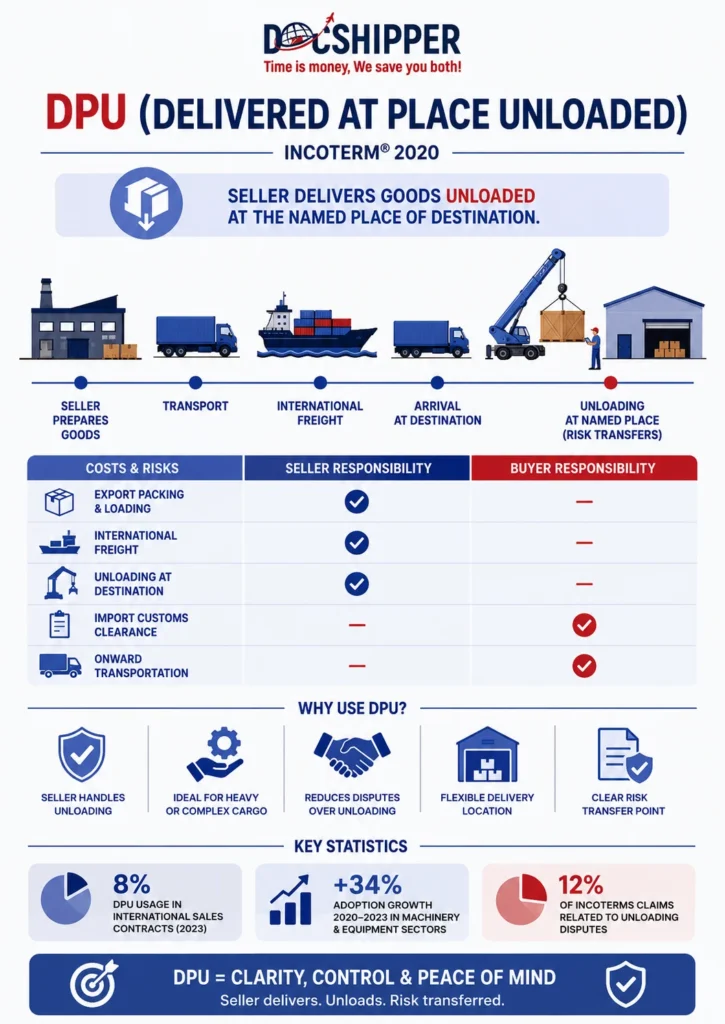
DPU (Delivered at Place Unloaded) is an Incoterm® 2020 whereby the seller delivers goods unloaded from the arriving means of transport at a named place of destination. The seller bears all costs and risks until the goods are unloaded at the agreed location, making it the only Incoterm requiring the seller to physically unload the cargo.Introduction
Confusion often arises when selecting the appropriate Incoterm for international shipments where goods must be unloaded at destination. Many importers mistakenly assume DAP (Delivered at Place) covers unloading, leading to disputes over who pays unloading costs and assumes liability during this critical phase.
DPU stands as the most seller-favorable delivery term when considering physical handling at destination. It replaces the former DAT (Delivered at Terminal) and expands flexibility by allowing delivery at any place, not just terminals. This Incoterm proves essential in international trade where warehouses, construction sites, or distribution centers serve as final destinations.
Understanding DPU becomes critical when:
- Sellers possess specialized unloading equipment unavailable at destination
- Buyers lack infrastructure or labor for handling heavy machinery or bulk cargo
- Contractual clarity is paramount regarding the exact transfer point of risk
- Complex logistics operations require seamless coordination between transport modes
- Project cargo deliveries demand turnkey solutions with minimal buyer involvement
In-Depth Analysis & Expertise
The fundamental obligation under DPU requires sellers to arrange transport, bear all costs, and physically unload goods at the named place. Unlike DAP, where goods remain on the vehicle, DPU mandates actual unloading—a critical distinction affecting insurance coverage, liability exposure, and operational planning.
From a legal perspective, the seller retains risk until goods are unloaded and placed at the buyer’s disposal. This includes damage during unloading operations, equipment failure, or accidents involving personnel. The International Chamber of Commerce specifies that sellers must provide proof of delivery, typically through signed delivery notes confirming unloading completion.
The insurance implications prove substantial. Sellers must maintain cargo insurance covering transport and unloading phases. Standard marine cargo policies may exclude unloading unless specifically endorsed. Buyers should arrange separate insurance from the point goods are unloaded, creating a potential coverage gap requiring careful coordination.
Regarding customs clearance, DPU does not obligate the seller to clear goods for import. Export clearance remains the seller’s responsibility, while import duties, taxes, and customs formalities fall to the buyer. This creates a practical challenge: goods arrive unloaded but cannot move until cleared, potentially incurring storage charges.
At DocShipper, we systematically coordinate with unloading contractors at destination to ensure equipment compatibility and labor availability before shipment departure, preventing costly delays and disputes over unloading obligations.
The documentation requirements extend beyond standard commercial invoices and packing lists. Sellers must provide transport documents evidencing delivery to the named place, unloading certificates, and any special handling instructions. Buyers need these documents for customs clearance and inventory reconciliation.
Concrete Examples & Data
Examining practical applications reveals how DPU functions across different industries and cargo types. Cost distribution varies significantly based on destination infrastructure, cargo characteristics, and local labor rates.
| Cost Component | Seller Responsibility (DPU) | Buyer Responsibility (DPU) |
|---|---|---|
| Export packing & loading | ✓ Full cost | — |
| International freight | ✓ Full cost | — |
| Unloading at destination | ✓ Full cost + risk | — |
| Import customs clearance | — | ✓ Full cost |
| Onward transportation | — | ✓ Full cost |
Use Case: Industrial Machinery Import
A German manufacturer sells €250,000 worth of injection molding equipment to a Polish factory under DPU Warehouse, Krakow. The breakdown illustrates typical cost distribution:
- Export packing & crane loading (Germany): €3,500 — seller arranges specialized wooden crating and forklift service
- Road freight Munich to Krakow: €4,200 — seller contracts dedicated flatbed truck with securing equipment
- Unloading at buyer’s warehouse: €2,800 — seller provides mobile crane and rigging crew for 6-hour operation
- Total seller costs under DPU: €260,500 (€10,500 logistics premium over ex-works price)
- Buyer’s remaining costs: Polish customs clearance (€450), VAT payment (€47,500), internal warehouse positioning (€600)
Had the parties chosen DAP instead, the €2,800 unloading cost would shift to the buyer, but the seller would avoid unloading liability. The DPU selection proved advantageous because the German seller maintained relationships with specialized heavy-lift contractors, securing better rates than the Polish buyer could negotiate locally.
Statistical Context
According to ICC’s 2023 Incoterms usage survey, DPU accounts for approximately 8% of international sales contracts, significantly lower than DAP (18%) or CIF (23%). However, DPU adoption increased by 34% between 2020-2023 in machinery and equipment sectors where unloading complexity justifies seller control.
Industry data reveals that unloading disputes represent 12% of all Incoterms-related claims, with average resolution costs exceeding $15,000. DPU’s explicit unloading obligation reduces this dispute risk by 67% compared to ambiguous DAP arrangements lacking clear unloading responsibility clauses.
Conclusion
DPU provides unmatched clarity for transactions requiring seller-controlled unloading, eliminating the most common source of delivery disputes while enabling sellers to leverage their logistical expertise and contractor networks. The key lies in precisely naming the delivery place and ensuring adequate insurance coverage through the unloading phase.
Need expert guidance on selecting the right Incoterm or managing DPU obligations? Contact DocShipper for tailored logistics solutions that eliminate delivery risks and streamline your international supply chain.
📚 Quiz
Test Your Knowledge: DPU (Delivered at Place Unloaded)
1. What is the fundamental obligation that distinguishes DPU from other delivery Incoterms?
2. Under DPU terms, who bears responsibility for import customs clearance costs and formalities?
3. A machinery supplier quotes DPU terms but discovers the buyer's warehouse has no crane access. What should happen?
🎯 Your Result
📞 Free Personalized QuoteFAQ | DPU (Delivered at Place Unloaded): Definition, Calculation & Concrete Examples
The critical distinction lies in unloading responsibility. Under DPU, the seller must physically unload goods from the arriving transport vehicle at the named place, bearing all costs and risks of unloading. With DAP, goods are delivered on the arriving vehicle ready for unloading, making the buyer responsible for unloading costs and risks. This single operational difference significantly affects liability, insurance requirements, and total landed costs.
Yes, DPU applies to all transport modes—sea, air, road, rail, or multimodal combinations. Unlike former DAT (limited to terminals), DPU allows delivery at any named place including warehouses, construction sites, factory gates, or distribution centers. The flexibility makes DPU suitable for diverse cargo types and destination scenarios, provided adequate unloading facilities exist at the specified location.
The buyer bears all import customs clearance costs, duties, and taxes under DPU. The seller's obligation ends once goods are unloaded at the named place. This creates a practical challenge: goods arrive and are unloaded but cannot leave the delivery location until customs-cleared. Buyers must arrange timely clearance to avoid demurrage charges if goods are unloaded at commercial terminals with storage time limits.
The seller retains full risk and liability for damage occurring during unloading operations under DPU. This includes damage from improper equipment use, operator error, or adverse weather conditions during unloading. Sellers must ensure their cargo insurance explicitly covers unloading operations, as standard marine policies often exclude this phase unless specifically endorsed. Risk transfers to the buyer only after unloading completion and placement at buyer's disposal.
Precision prevents disputes. Specify the complete address including street, building number, and specific unloading point (e.g., "DPU Warehouse 3, Loading Bay 5, 123 Industrial Avenue, Rotterdam Port, Netherlands"). Include coordinates for remote locations. Verify the named location has adequate access for delivery vehicles and unloading equipment. Vague descriptions like "DPU buyer's premises" create ambiguity and potential cost disputes.
The seller must provide or arrange all necessary unloading equipment suitable for the cargo type and destination conditions. For containerized cargo, this might include forklifts or reach stackers. Heavy machinery may require mobile cranes or specialized rigging equipment. Sellers should survey destination facilities before quoting DPU terms to ensure equipment availability and incorporate rental costs. Buyers need not provide any unloading resources under DPU.
Absolutely. DPU works effectively for containerized shipments when the seller unloads containers from the arriving truck or chassis at the buyer's facility. The seller arranges container drayage, positioning, and unloading using appropriate equipment. However, unpacking container contents typically falls to the buyer unless explicitly stated otherwise in the sales contract. Clear distinction between container unloading and cargo unpacking prevents misunderstandings.
Sellers must furnish commercial invoices, packing lists, transport documents proving delivery to the named place, and unloading certificates signed by the carrier or unloading contractor. Additional documents may include equipment inspection records, photographic evidence of cargo condition post-unloading, and delivery notes signed by buyer representatives. These documents support payment claims, insurance filings, and customs declarations while protecting against liability disputes.
Sellers must maintain comprehensive cargo insurance covering the entire journey plus unloading operations. Standard Institute Cargo Clauses (A, B, or C) may exclude unloading unless extended through special endorsements. The insurance must remain active until unloading completes and risk transfers to the buyer. Buyers should arrange separate coverage effective from the moment goods are placed at their disposal to eliminate gaps between seller and buyer insurance periods.
DPU excels for project cargo including heavy machinery, prefabricated structures, or oversized equipment requiring specialized unloading. Sellers with technical expertise and established contractor networks can manage complex unloading operations more efficiently than buyers unfamiliar with local logistics infrastructure. This reduces project delays and quality issues from improper handling. However, sellers must carefully assess unloading site conditions and equipment requirements before committing to DPU terms.
Frequent errors include inadequately specifying the named place, failing to verify site accessibility for unloading equipment, underestimating unloading time and costs, neglecting insurance coverage for unloading operations, and assuming the seller handles import customs clearance. Another mistake involves not coordinating unloading timing with buyer availability, leading to delays and additional charges. Proper contract drafting with detailed unloading specifications and site surveys prevents these costly oversights.
While sellers can hire third-party contractors for physical unloading work, they cannot delegate ultimate responsibility and liability. The seller remains accountable for unloading completion, equipment adequacy, operator competence, and cargo condition until placed at buyer's disposal. Contractual relationships with unloading contractors should include liability clauses and insurance requirements protecting the seller. Buyers deal exclusively with sellers regarding any unloading issues, not with subcontractors.
Need Help with
Logistics or Sourcing ?
First, we secure the right products from the right suppliers at the right price by managing the sourcing process from start to finish. Then, we simplify your shipping experience - from pickup to final delivery - ensuring any product, anywhere, is delivered at highly competitive prices.


Fill the Form
Prefer email? Send us your inquiry, and we’ll get back to you as soon as possible.
Contact us




