


In short ⚡
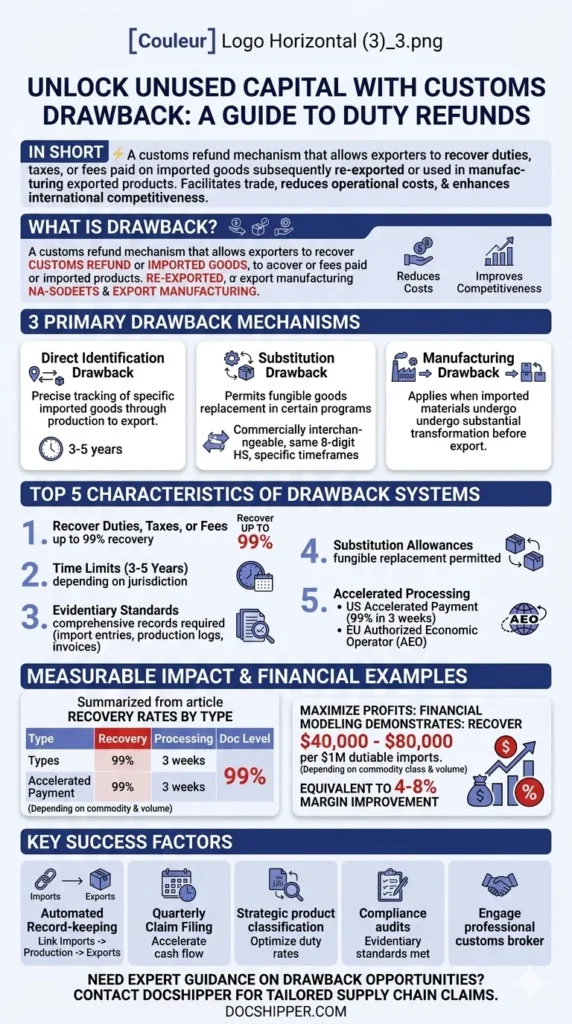
Drawback is a customs refund mechanism that allows exporters to recover duties, taxes, or fees paid on imported goods or materials when those goods are subsequently re-exported or used in manufacturing exported products. This trade facilitation tool reduces operational costs and enhances international competitiveness for businesses engaged in global supply chains.
Introduction
Many importers unknowingly pay thousands in customs duties on materials they later export—money that could be recovered through drawback claims. This confusion stems from complex regulations and administrative requirements that vary across jurisdictions.
In international trade, drawback serves as a critical financial instrument. It eliminates the economic burden of double taxation on goods crossing multiple borders. For manufacturers using imported components in export production, this mechanism directly impacts profit margins and pricing strategies.
Key characteristics of drawback systems include:
- Duty recovery on imported materials incorporated into exported finished goods
- Time-limited claims typically ranging from 3 to 5 years depending on jurisdiction
- Documentary requirements proving the link between imports and exports
- Substitution allowances permitting fungible goods replacement in certain programs
- Accelerated processing for authorized economic operators with compliance track records
Drawback Mechanisms & Regulatory Framework
Drawback operates through three primary mechanisms globally. Direct identification drawback requires precise tracking of specific imported goods through production to export. Substitution drawback permits commercially interchangeable goods to replace the actual imports. Manufacturing drawback applies when imported materials undergo substantial transformation before export.
The legal foundation varies by country. In the United States, 19 U.S.C. § 1313 governs drawback claims, administered by U.S. Customs and Border Protection. The European Union operates under Article 116 of the Union Customs Code, which establishes repayment and remission conditions for customs duties.
Claim eligibility depends on proving the causal relationship between import and export transactions. Exporters must maintain comprehensive records including import entries, production logs, export declarations, and commercial invoices. The three-year statute of limitations applies in most jurisdictions, though some countries extend this to five years.
Accelerated payment programs benefit compliant traders. In the U.S., the Accelerated Payment (AP) program releases 99% of the claim amount within three weeks for approved participants. The EU’s Authorized Economic Operator (AEO) status similarly expedites processing and reduces documentation burdens.
At DocShipper, we systematically review client shipments to identify drawback opportunities and prepare compliant claim documentation, ensuring maximum duty recovery while maintaining customs compliance standards.
Substitution rules require particular attention. Goods must be commercially interchangeable and possess the same eight-digit Harmonized System classification. The substituted merchandise must be imported and exported within specific timeframes—typically three years in the U.S. system.
Practical Examples & Financial Impact
Consider a U.S. electronics manufacturer importing components from Asia. The company imports $500,000 worth of semiconductors annually, paying $25,000 in customs duties (5% rate). These components are incorporated into devices exported to Latin America. Through manufacturing drawback, the company recovers $23,750 (95% of duties paid), directly improving net margins.
| Drawback Type | Recovery Rate | Processing Time | Documentation Level |
|---|---|---|---|
| Direct Identification | 99% | 6-12 months | High (lot tracking required) |
| Substitution | 99% | 6-12 months | Medium (commercial interchangeability) |
| Manufacturing | 99% | 8-14 months | High (production records) |
| Accelerated Payment (U.S.) | 99% | 3 weeks | High (pre-approval required) |
Case Study: Textile Industry
A European garment manufacturer imports cotton fabric from India valued at €200,000, incurring €20,000 in customs duties (10% rate). The fabric is cut, sewn, and exported as finished clothing to the Middle East. Under EU drawback provisions, the company claims €19,800 refund (99% recovery). Over five years, this generates €99,000 in recovered capital—equivalent to hiring two additional production staff.
Critical success factors for maximizing drawback benefits:
- Automated record-keeping systems linking import entries to production batches and export shipments
- Quarterly claim filing rather than annual submissions to accelerate cash flow
- Professional customs broker engagement to navigate complex regulatory requirements
- Compliance audits ensuring documentation meets evidentiary standards before submission
- Strategic product classification to optimize duty rates and drawback eligibility
Financial modeling demonstrates that companies processing $1 million in annual dutiable imports can recover $40,000-$80,000 depending on commodity classification and export volume. This represents 4-8% margin improvement for businesses operating on typical 10-15% profit margins.
Conclusion
Drawback represents a significant but underutilized financial recovery tool for exporters and manufacturers. Proper implementation requires robust documentation systems and regulatory expertise but delivers measurable cost reductions.
Need assistance identifying drawback opportunities or preparing compliant claims? Contact DocShipper for expert guidance tailored to your supply chain.
📚 Quiz
Test Your Knowledge: Drawback
1. What is the core definition of "drawback" in international trade?
2. A company claims drawback by exporting commercially identical goods instead of the exact imported merchandise. Which drawback mechanism does this describe?
3. A U.S. electronics manufacturer pays $25,000 in duties on imported semiconductors and incorporates them into devices exported abroad. What is the maximum drawback refund the company can expect to recover?
🎯 Your Result
📞 Free Quote in 24hFAQ | Drawback: Definition, Calculation & Practical Examples
Drawback refunds duties already paid on imports later exported, while duty suspension (like bonded warehouses) defers payment until goods enter domestic commerce. Drawback involves retrospective claims; suspension is prospective.
Most jurisdictions impose a three-year statute of limitations from the export date. The U.S. extended this to five years in 2016 under the Trade Facilitation and Trade Enforcement Act.
Yes, under certain conditions. Unused merchandise drawback allows refunds when imported goods are destroyed under customs supervision instead of exported, provided proper documentation and witnessing protocols are followed.
Essential documents include import entries, commercial invoices, bills of lading, production records linking imports to exports, export declarations, and certificates of manufacture or delivery. Substitution claims require additional commercial interchangeability evidence.
Drawback typically covers regular customs duties, anti-dumping duties, and countervailing duties. Excise taxes and certain fees may be excluded depending on jurisdiction. Always verify specific applicability with customs authorities.
This allows claiming refunds when commercially identical goods are exported instead of the actual imported merchandise. The substitute must match the imported good's eight-digit HS code and quality specifications.
Costs vary based on claim complexity. DIY filing costs only time and administrative effort. Professional customs brokers typically charge 15-25% of recovered amounts or flat fees ranging from $500-$5,000 per claim depending on volume and complexity.
Absolutely. Even modest import/export volumes can generate meaningful recoveries. Businesses importing $100,000 annually in dutiable goods may recover $4,000-$8,000, justifying professional assistance or streamlined internal processes.
Customs authorities provide rejection reasons. Claimants can submit additional documentation, correct errors, or appeal decisions through administrative review processes. Most rejections stem from incomplete documentation rather than ineligibility.
Yes. Fraudulent claims incur severe penalties including fines, duty assessments, and potential criminal charges. Negligent errors may result in claim denial and interest charges. Maintaining accurate records and seeking professional guidance minimizes risk.
Post-Brexit, UK and EU operate separate customs territories. Goods moving between them now qualify for drawback as international trade. UK exporters can claim under UK regulations; EU businesses follow Union Customs Code provisions.
Yes, this is manufacturing drawback. The imported components must be physically incorporated into or consumed during production of the exported article. Precise record-keeping linking imports to specific export batches is essential.
Need Help with
Logistics or Sourcing ?
First, we secure the right products from the right suppliers at the right price by managing the sourcing process from start to finish. Then, we simplify your shipping experience - from pickup to final delivery - ensuring any product, anywhere, is delivered at highly competitive prices.


Fill the Form
Prefer email? Send us your inquiry, and we’ll get back to you as soon as possible.
Contact us




