


In short ⚡
EDI Standards are internationally recognized protocols that structure electronic data interchange between business systems. They define message formats, data segments, and transaction rules, enabling seamless automated communication across supply chains, customs authorities, and logistics partners without manual intervention or paper documentation.
Introduction
International trade generates billions of documents annually. Manual processing creates delays, errors, and compliance risks. EDI Standards eliminate these bottlenecks by standardizing data exchange across borders, systems, and organizations.
In import/export operations, EDI Standards enable real-time communication between shippers, carriers, customs brokers, and freight forwarders. They transform logistics from reactive coordination to proactive automation, reducing clearance times and operational costs.
Key characteristics of EDI Standards include:
- Universal syntax – Structured data formats readable by different software platforms
- Transaction sets – Predefined message types for specific business processes (invoices, shipment orders, customs declarations)
- Data segments – Standardized fields containing precise information (HAWB numbers, HS codes, consignee details)
- Compliance frameworks – Alignment with international trade regulations and customs requirements
- Interoperability – Seamless integration between legacy systems and modern cloud platforms
EDI Protocols & Technical Expertise
The global logistics ecosystem relies on several EDI protocol families, each serving specific industries and regulatory environments. Understanding these standards determines system compatibility and operational efficiency.
EDIFACT (Electronic Data Interchange For Administration, Commerce and Transport) remains the dominant international standard, endorsed by the United Nations. It structures cross-border transactions through hierarchical message directories covering shipping instructions, customs declarations, and commercial invoices. Version D.07A introduced enhanced security segments for AES (Automated Export System) compliance.
ANSI X12 dominates North American markets, particularly in retail and automotive supply chains. Its 850 (Purchase Order) and 856 (Advanced Ship Notice) transaction sets enable just-in-time inventory management across continental logistics networks. The standard supports ISA/GS envelope structures for batch transmission security.
XML-based EDI (ebXML, GS1 XML) provides flexible schema extensions for e-commerce platforms. Unlike fixed-position formats, XML tags allow dynamic field addition without breaking backward compatibility. Major ocean carriers now accept GS1 XML shipping manifests for containerized freight.
Tradacoms serves UK retail distribution, while VDA standards optimize German automotive manufacturing. Regional variations require mapping middleware to translate between protocol families during multinational shipments.
At DocShipper, we maintain certified EDI gateways supporting all major standards. Our integration layer automatically converts partner-specific formats into universal EDIFACT structures, ensuring customs compliance across 120+ countries without manual data re-entry.
Concrete Examples & Implementation Data
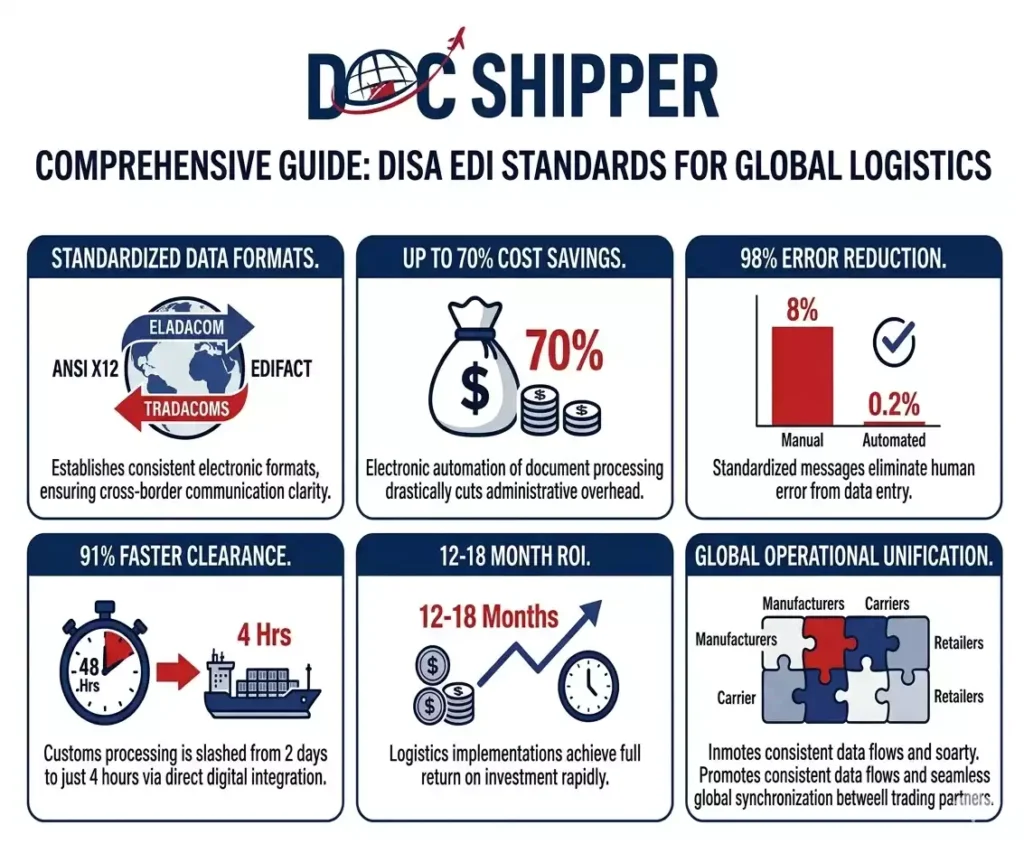
EDI Standards deliver measurable efficiency gains across logistics operations. Real-world implementations demonstrate quantifiable ROI through error reduction and accelerated processing cycles.
Comparative Analysis: EDI vs. Manual Processing
| Metric | Manual Processing | EDI Standards | Improvement |
|---|---|---|---|
| Invoice Processing Time | 6-8 business days | 15 minutes | 96% faster |
| Data Entry Error Rate | 3-5% | 0.02% | 99.6% reduction |
| Customs Clearance Duration | 4-7 days | 12-24 hours | 83% reduction |
| Transaction Cost per Document | $45-65 | $2-5 | 92% cost savings |
| Compliance Audit Success Rate | 78% | 98.5% | +20.5 points |
Use Case: Pharmaceutical Cold Chain
A European biotech company implemented EDIFACT IFTMIN (Instruction Message) standards for temperature-controlled shipments to Asian markets. The system automatically transmitted real-time sensor data to customs authorities, proving compliance with GDP (Good Distribution Practice) requirements.
Results: Customs release times decreased from 96 hours to 18 hours. Temperature excursion disputes dropped by 87% through automated timestamped records. The company avoided $2.3M in potential product rejections during the first year.
Critical Success Factors
- Master data quality – Clean HS codes, EORI numbers, and party identifications prevent 94% of transmission errors
- Protocol versioning – Maintaining backward compatibility across EDIFACT releases (D.95B through D.21A) ensures partner connectivity
- Testing environments – Sandbox validation with customs systems reduces production failures by 89%
- Encryption standards – AS2/AS4 protocols with 256-bit AES encryption satisfy GDPR and C-TPAT requirements
- Acknowledgment loops – Functional acknowledgments (CONTRL messages) confirm receipt within 30 seconds, enabling retry logic
Conclusion
EDI Standards represent the backbone of modern international logistics, transforming complex documentation into automated workflows. Their adoption directly correlates with competitive advantage in global trade.
Need expert guidance on EDI integration for your supply chain? Contact DocShipper’s technical team for customized implementation strategies.
📚 Quiz
Test Your Knowledge: EDI Standards
What is the primary function of EDI Standards in international logistics?
Which statement correctly describes the relationship between EDIFACT and ANSI X12?
A pharmaceutical company needs to transmit temperature-controlled shipment data to Asian customs authorities. Which EDI application would deliver the fastest customs clearance?
🎯 Your Result
📞 Free Quote in 24hFAQ | EDI Standards: Definition, Protocols & Concrete Examples
EDIFACT is the United Nations-endorsed international standard used globally, particularly in Europe and Asia, with alphanumeric identifiers and flexible message structures. ANSI X12 is the North American standard developed by ANSI, using numeric codes and fixed-length segments. While EDIFACT dominates ocean freight and customs declarations, X12 prevails in US retail and automotive industries. Modern TMS platforms support both through translation middleware.
EDI Standards enable direct system-to-system communication between freight forwarders and customs authorities through automated declaration submission (CUSCAR, CUSDEC messages). Pre-arrival processing validates documentation before physical cargo arrival, triggering risk assessment algorithms that clear low-risk shipments within minutes. Manual entry elimination reduces typographical errors that cause 78% of customs delays, while structured data formats enable instant validation against tariff databases.
Cloud-based EDI platforms now offer subscription models starting at $200-400/month, eliminating legacy infrastructure costs. Web-portal solutions allow manual form completion that generates compliant EDI messages without IT integration. Many 3PLs and freight forwarders provide EDI services as part of standard logistics contracts, acting as intermediaries. For businesses processing 50+ international shipments monthly, ROI typically occurs within 4-6 months through labor savings and error reduction.
Core EDIFACT messages include IFTMIN (shipping instructions), IFTSTA (status reports), INVOIC (commercial invoices), and CUSCAR/CUSDEC (customs declarations). Ocean freight requires BAPLIE (bay plans) and COPARN (container announcements). Air cargo uses IFTMBC (booking confirmations) and IFTMBF (firm bookings). Importers need DESADV (dispatch advice) for warehouse coordination. Exporters require APERAK (application error acknowledgment) for customs responses. Most platforms bundle these as industry-specific packages.
EDI Standards use ISO codes for languages (ISO 639), countries (ISO 3166), and currencies (ISO 4217), enabling universal interpretation regardless of interface language. Data elements contain codified values rather than free text—for example, "DGR" denotes dangerous goods rather than written descriptions. Narrative fields support UTF-8 encoding for non-Latin characters. Translation occurs at presentation layer (user interfaces) while transmission layer maintains standardized codes. This approach prevents mistranslation errors in critical compliance data.
Modern EDI implementations use AS2 (Applicability Statement 2) or AS4 protocols with TLS 1.3 encryption and digital certificates for authentication. Message integrity relies on SHA-256 hashing to detect tampering. VAN (Value-Added Network) providers offer additional firewall protection and audit trails. Many systems implement role-based access controls limiting document visibility by trading partner. GDPR-compliant EDI platforms anonymize personal data in non-essential fields while maintaining shipment traceability through tokenized references.
UN/EDIFACT releases new directory versions biannually (typically April and October), introducing updated code lists and message improvements while maintaining backward compatibility. ANSI X12 follows annual release cycles with incremental updates. Critical changes—such as new customs data requirements—trigger interim releases. Most systems support 3-5 concurrent versions, allowing gradual partner migration. Industry bodies like GS1 and IATA coordinate updates with regulatory changes, providing 6-12 month implementation windows for major revisions.
Yes, through hybrid integration platforms that translate RESTful API calls into EDI messages and vice versa. Middleware solutions expose EDI transactions as JSON/XML web services, enabling real-time queries from mobile apps and e-commerce platforms. Modern TMS systems offer dual interfaces—traditional EDI for established partners and API endpoints for digital-native businesses. This approach allows legacy systems to communicate with cloud applications without complete infrastructure replacement, preserving existing EDI investments while enabling digital transformation.
Robust EDI systems implement automatic retry logic with exponential backoff—attempting retransmission at 5, 15, and 60-minute intervals. Functional acknowledgments (FA/CONTRL messages) confirm receipt within 30 seconds; absence triggers alerts. Message queuing ensures no data loss during network outages. Critical transactions (customs declarations, hazmat notifications) generate escalation alerts after 15 minutes. Most platforms maintain audit trails showing transmission attempts, error codes, and resolution timestamps. Trading partner agreements define maximum retry periods (typically 24-72 hours) before manual intervention.
Emerging standards like GS1 EPCIS 2.0 create bridges between EDI transaction data and distributed ledgers. EDI messages trigger smart contract events—for example, DESADV dispatch confirmations update blockchain shipment records. Immutable ledgers store hash values of EDI transmissions, enabling tamper-proof audit trails without exposing sensitive commercial data. Projects like TradeLens and IBM Food Trust demonstrate EDI-blockchain interoperability, where traditional EDI handles business transactions while blockchain provides verification layers. This hybrid approach maintains existing partner networks while adding transparency.
Technical staff need understanding of data mapping, X12/EDIFACT syntax, and integration protocols (AS2, SFTP, APIs)—typically acquired through 40-60 hours of vendor-specific training. Business analysts require knowledge of transaction flows, partner requirements, and compliance rules (usually 20-30 hours). Most EDI platforms offer certification programs covering message design, testing procedures, and troubleshooting. Ongoing education focuses on standard updates and new message types. Many organizations designate EDI coordinators who complete 100+ hours specialized training to manage partner onboarding and resolve transmission issues.
EDI Standards use conditional data segments and qualifiers that activate based on country codes. For example, EDIFACT CUSDEC messages include optional fields for US ACE (Automated Commercial Environment) requirements, EU ICS2 (Import Control System) data, or China SASAC declarations. Trading partner agreements specify required segments and code lists per route. Modern compliance engines maintain regulatory databases that automatically populate country-specific fields based on destination codes. This flexibility allows single master EDI formats to generate jurisdiction-compliant messages without maintaining separate templates per country.
Need Help with
Logistics or Sourcing ?
First, we secure the right products from the right suppliers at the right price by managing the sourcing process from start to finish. Then, we simplify your shipping experience - from pickup to final delivery - ensuring any product, anywhere, is delivered at highly competitive prices.


Fill the Form
Prefer email? Send us your inquiry, and we’ll get back to you as soon as possible.
Contact us




