


In short ⚡
Electronic Mail (E-Mail) is a digital communication method that enables the transmission of messages, documents, and data between parties via internet protocols. In international logistics, email serves as the primary communication channel for coordinating shipments, exchanging documentation, and maintaining compliance records across supply chains.
Introduction
In global trade, a single miscommunicated instruction can delay shipments by days and cost thousands in demurrage fees. Electronic mail remains the backbone of logistics communication, handling over 80% of commercial exchanges between freight forwarders, customs brokers, and carriers.
Despite emerging technologies like API integrations and blockchain, email persists as the universal standard. Its flexibility, legal acceptability, and widespread adoption make it indispensable for coordinating cross-border movements.
Key characteristics in logistics context:
- Asynchronous communication – enables coordination across time zones without simultaneous availability
- Document trails – creates auditable records for customs compliance and dispute resolution
- Attachment capabilities – transmits Bills of Lading, packing lists, certificates of origin, and invoices
- Multi-party threading – maintains conversation history between shippers, consignees, forwarders, and authorities
- Regulatory acceptance – recognized by customs agencies worldwide as valid communication for declarations
E-Mail Framework in Logistics Operations
The strategic use of email in supply chain management extends beyond simple messaging. Understanding its technical and operational parameters ensures compliance and efficiency.
Protocol standards govern email transmission in commercial contexts. SMTP (Simple Mail Transfer Protocol), POP3, and IMAP form the technical infrastructure. For sensitive shipments, encrypted email protocols like S/MIME or PGP protect confidential commercial data from interception during international transfers.
Legal validity of email communication varies by jurisdiction but gains recognition under frameworks like the UNCITRAL Model Law on Electronic Commerce. The EU’s eIDAS regulation establishes qualified electronic signatures transmitted via email as legally equivalent to handwritten signatures. According to EU Regulation 910/2014, timestamped emails serve as proof of transaction timing in customs disputes.
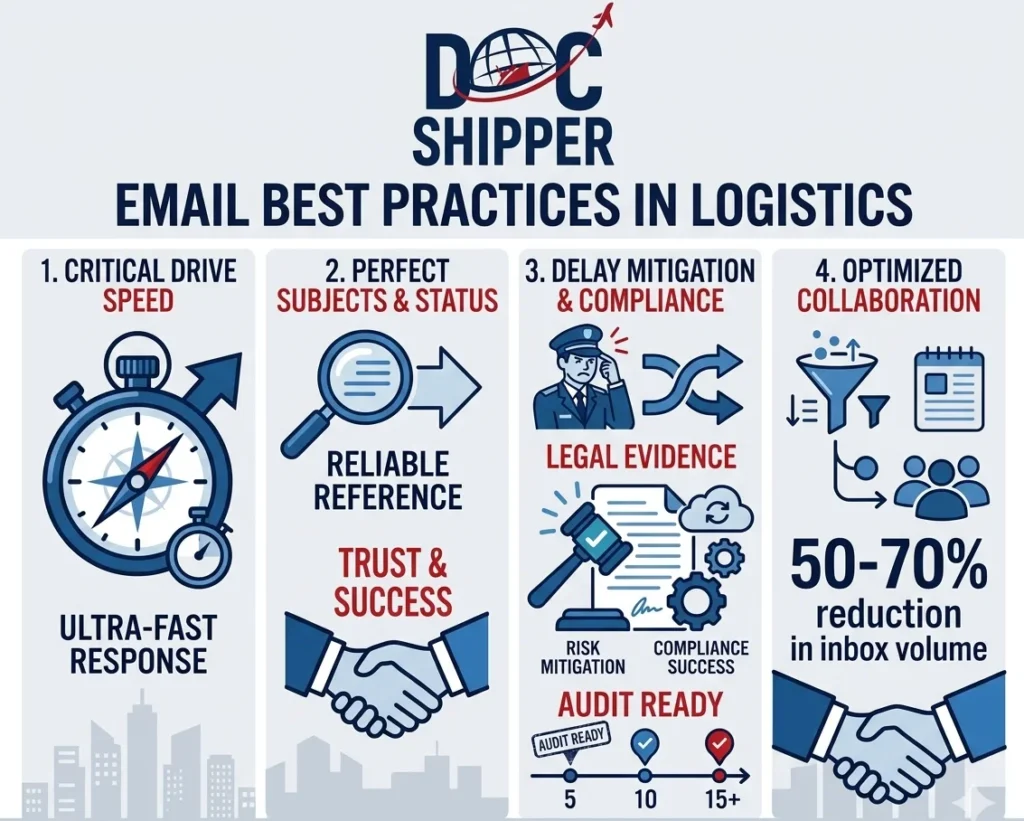
Document management protocols require structured approaches. Industry best practices mandate subject line conventions (e.g., “BL#[number] – [Port] – [Date]”) and standardized attachment naming. At DocShipper, we implement systematic filing systems that automatically categorize incoming shipment emails by reference number, ensuring instant retrieval during customs audits.
Response time expectations differ by logistics segment. Express freight operations typically require <4-hour response windows during business hours, while ocean freight tolerates 24-hour cycles. Delay in email communication directly impacts demurrage charges—a single missed pickup notification can trigger $150-$300 daily container fees.
Compliance archiving mandates vary globally. EU regulations require 10-year retention of commercial correspondence, while US customs stipulates 5 years from entry date. Cloud-based email systems with immutable backup features provide verifiable chains of custody. The failure to produce email evidence during customs investigations can result in penalties exceeding 40% of shipment value under certain trade compliance programs.
Practical Applications & Industry Data
Real-world logistics scenarios demonstrate email’s operational criticality. Understanding common workflows and performance metrics optimizes supply chain coordination.
Shipment lifecycle management involves distinct email phases. Booking confirmations, shipping instructions, pre-alerts, arrival notices, and delivery confirmations each trigger automated or manual email workflows. Research indicates 73% of logistics delays stem from communication gaps rather than physical transportation issues.
| Email Type | Average Response Time | Cost Impact of Delay |
|---|---|---|
| Customs document request | 2-6 hours | $200-$800/day (storage) |
| Booking confirmation | 4-12 hours | Missed sailing (7-14 days) |
| Delivery coordination | 1-4 hours | Redelivery fee ($150-$400) |
| Rate quote request | 24-48 hours | Market rate fluctuation risk |
Case Study: Container Release Scenario
A textile importer receives vessel arrival notice via email on Monday 9:00 AM. Customs requires additional certification. The importer forwards the request to their supplier in Bangladesh at 10:30 AM (4:30 PM local time, after business hours). Response arrives Tuesday 2:00 AM (importer timezone). Documentation reaches customs by 11:00 AM. Total delay: 26 hours. Container demurrage accrual: $275. This scenario repeats across millions of global shipments annually, representing billions in avoidable costs.
Automation impact shows measurable efficiency gains. Companies implementing email-to-ERP integration reduce manual data entry errors by 68% and accelerate document processing by 40%. Automated parsing of structured email data (tracking numbers, container IDs, dates) feeds directly into visibility platforms without human intervention.
Security vulnerabilities require attention. Phishing attacks targeting logistics professionals increased 87% between 2021-2023, with fraudulent payment instruction emails causing $43 million in losses to freight forwarders in 2023 alone. Implementation of DMARC, SPF, and DKIM authentication protocols reduces spoofing risk by over 90%.
Mobile accessibility changes operational dynamics. 61% of logistics professionals now access shipment emails primarily via mobile devices. This shift demands responsive email templates and concise communication—messages exceeding 150 words see 40% lower mobile engagement rates.
Conclusion
Electronic mail remains the universal language of international logistics, bridging time zones, systems, and organizational boundaries. Mastering email protocols directly impacts shipment velocity and cost control in global supply chains.
Need expert guidance on optimizing your logistics communication workflows? Contact DocShipper for tailored solutions that streamline your international shipping operations.
📚 Quiz
Test Your Knowledge: Electronic Mail in Logistics
What is the primary function of electronic mail in international logistics operations?
According to industry research, what percentage of logistics delays stem from communication gaps rather than physical transportation issues?
A customs document request is received via email but response is delayed by 24 hours. What is the most likely consequence?
🎯 Your Result
📞 Free Quote in 24hFAQ | Electronic Mail (E-Mail) in Logistics: Definition, Usage & Best Practices
Emails with proper timestamps and authentication serve as admissible evidence in most jurisdictions. Under the Uniform Electronic Transactions Act (UETA) and international equivalents, digital correspondence carries the same legal weight as paper documents. Courts accept emails as proof of agreement terms, delivery instructions, and notification compliance. However, authentication requirements vary—some jurisdictions demand digital signatures or third-party timestamping services for high-value disputes. Maintaining unaltered email archives with metadata intact strengthens evidentiary value during audits or litigation.
Retention periods depend on regulatory frameworks and shipment types. US customs requires 5 years from entry date for import documentation. EU regulations mandate 10-year retention for VAT-related commercial correspondence. Hazardous materials shipments may require 15+ years under DOT regulations. Best practice involves implementing tiered archival systems—active access for 2 years, compressed storage for 3-10 years, and secure long-term backup beyond. Cloud-based email systems with immutable backup features ensure compliance while reducing physical storage costs.
Electronic Bills of Lading (eBLs) transmitted via secure platforms are legally recognized under the Rotterdam Rules and national legislation in 70+ countries. However, pure email attachment of scanned BLs lacks the cryptographic security and chain-of-custody verification required for negotiable documents. Platforms like Bolero, essDOCS, and CargoX provide blockchain-verified eBL transmission that satisfies legal requirements. Standard email serves for non-negotiable sea waybills but cannot replace negotiable Bills of Lading without specialized secure infrastructure.
Business Email Compromise (BEC) attacks targeting freight forwarders increased 340% from 2020-2023. Common tactics include domain spoofing (changing one letter in legitimate addresses), account takeover via phishing, and man-in-the-middle interception of payment instructions. Criminals monitor email threads for weeks before injecting fraudulent wire transfer requests during critical shipment phases. Mitigation strategies include multi-factor authentication, transaction verification via secondary channels, email authentication protocols (DMARC/DKIM/SPF), and employee training on social engineering recognition.
Delayed email responses trigger cascading financial impacts throughout the supply chain. Missing a customs document request by 24 hours can extend clearance by 3-5 business days, accruing $150-$400 daily in container demurrage and $50-$200 in storage fees. Late booking confirmations cause missed vessel sailings, adding 7-14 days transit time and potential expedited freight costs of 40-80% premium over standard rates. Industry data shows companies with sub-4-hour email response protocols reduce shipment delays by 62% and save an average of $890 per container compared to slower communicators.
Encryption necessity depends on information sensitivity and regulatory requirements. Standard shipment coordination emails containing tracking numbers and general cargo descriptions rarely require encryption. However, messages containing commercial invoices, pricing negotiations, or personally identifiable information (PII) benefit from TLS encryption at minimum. Defense, pharmaceutical, and high-value electronics shipments often mandate end-to-end encryption using S/MIME or PGP. GDPR compliance may require encryption when emails contain consignee personal data. Balance security needs against operational friction—overly complex encryption systems reduce user compliance and slow communication.
Effective subject lines enable instant recognition and automated sorting. Best practice includes: shipment reference number, origin-destination pair, and document type. Format example: "BL#MAEU123456789 – Shanghai-Rotterdam – SI Required". This structure allows recipients to prioritize urgency, automated systems to route messages correctly, and archive searches to retrieve specific shipments instantly. Adding status indicators like [URGENT], [CUSTOMS HOLD], or [DELIVERY TODAY] improves triage efficiency. Studies show properly formatted subject lines reduce average email processing time by 40% compared to vague descriptors like "Shipment Update".
Email volume management requires systematic approaches. Implement rule-based filtering that automatically categorizes messages by shipment reference, sender type, and urgency level. Establish communication protocols specifying which updates require email versus portal notifications. Consolidate routine status updates into daily digest formats rather than individual alerts. Deploy collaborative platforms (Slack, Teams) for internal coordination while reserving email for external stakeholders and formal documentation. Companies adopting these strategies report 50-70% reduction in inbox volume while maintaining communication quality. Automated parsing of structured data from emails into management systems eliminates duplicate manual entry.
Automated responses serve specific functions when properly designed. Acknowledgement autoresponders confirming receipt of booking requests or documents provide assurance without requiring immediate human intervention. Out-of-office notifications with backup contact information prevent communication blackouts during absences. However, automated responses to complex inquiries or urgent shipment issues frustrate stakeholders and delay resolution. Best practice combines immediate automated acknowledgment with specified human response timeframes. For example: "Your customs query was received and will be addressed within 4 business hours." Balance efficiency with personalization—70% of logistics professionals report frustration with purely automated communication chains.
Email correspondence forms the primary evidence trail in claims for damaged cargo, delivery failures, and billing disputes. Courts and arbitration panels accept timestamped emails as proof of notification, instruction compliance, and party responsibilities. Cargo insurance claims require documented communication showing damage reporting timelines and mitigation efforts. Freight charge disputes hinge on email quotes and booking confirmations. Maintaining complete email threads with original headers (showing send/receive times and unaltered content) strengthens legal positions. The absence of documented email communication during critical shipment phases weakens claims by 60% according to logistics litigation analysis.
Global operations spanning 12+ time zones create continuous communication cycles but also coordination challenges. A Shanghai exporter emailing Los Angeles importers at 9:00 AM local time (5:00 PM previous day in LA) faces 13-hour response delays if waiting for normal business hours. Successful strategies include: clearly communicating working hours in email signatures, implementing follow-the-sun support models with regional teams, using urgency indicators for time-critical requests, and establishing escalation protocols for after-hours emergencies. Companies with 24/7 email monitoring reduce average response time from 18 hours to 4 hours, directly improving shipment velocity and customer satisfaction scores.
AI-powered email management tools deliver measurable productivity gains in logistics operations. Natural language processing extracts key data (container numbers, dates, locations) from unstructured email text and populates tracking systems automatically. Machine learning algorithms prioritize incoming messages by urgency and route them to appropriate specialists. Predictive text suggestions based on historical responses accelerate reply composition. Sentiment analysis flags frustrated customer communications for priority handling. Early adopters report 35-50% reduction in email processing time and 28% improvement in response accuracy. However, human oversight remains essential for complex negotiations, exception handling, and relationship management where contextual judgment supersedes algorithmic efficiency.
Need Help with
Logistics or Sourcing ?
First, we secure the right products from the right suppliers at the right price by managing the sourcing process from start to finish. Then, we simplify your shipping experience - from pickup to final delivery - ensuring any product, anywhere, is delivered at highly competitive prices.


Fill the Form
Prefer email? Send us your inquiry, and we’ll get back to you as soon as possible.
Contact us




%20in%20Logistics:%20Definition,%20Usage%20&%20Best%20Practices)