


In short ⚡
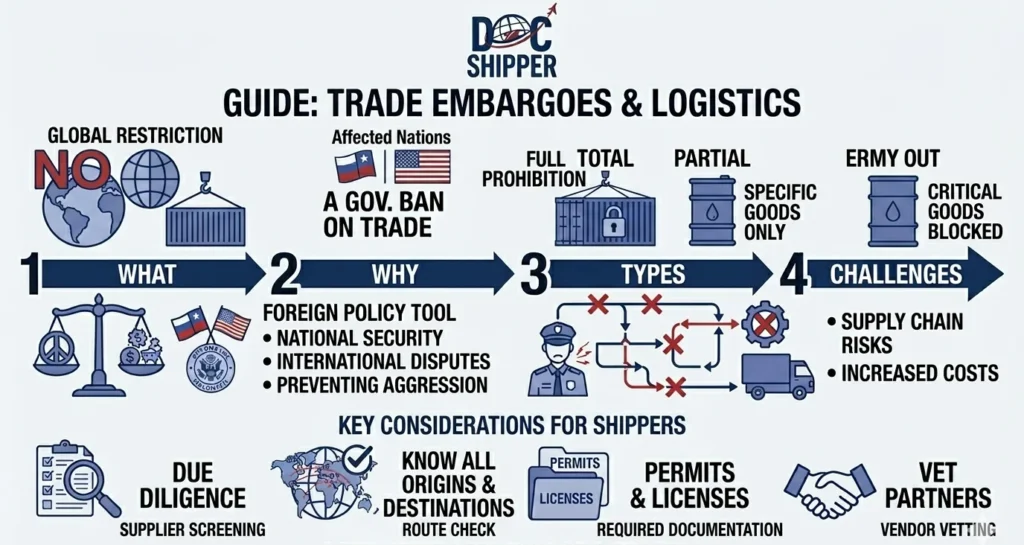
An embargo is a government-imposed prohibition on trade with specific countries, entities, or goods. It represents the most severe form of trade restriction, typically motivated by political, economic, or security concerns, and can encompass partial restrictions or complete trade bans affecting imports, exports, or both simultaneously.
Introduction
International traders often confuse embargoes with standard trade sanctions or customs restrictions. Unlike tariffs or quotas, embargoes completely prohibit commercial transactions with targeted nations or specific products. This distinction matters critically when planning shipments or establishing supply chains.
In global logistics, embargoes represent absolute red lines that customs authorities enforce rigorously. Violating embargo regulations exposes companies to severe penalties, including asset seizures, criminal prosecution, and permanent blacklisting from international trade.
Understanding embargo types and compliance requirements is essential for:
- Route planning: Avoiding prohibited transit countries or destinations
- Supplier selection: Verifying partners aren’t subject to restrictions
- Product classification: Identifying dual-use goods requiring special licenses
- Payment processing: Ensuring financial institutions can legally transfer funds
- Documentation accuracy: Declaring origin and destination truthfully
Understanding Embargo Mechanisms & Legal Implications
Embargoes operate through multiple enforcement layers. Primary embargoes prohibit direct trade between the imposing country and the target nation. Secondary embargoes extend restrictions to third-party entities conducting business with embargoed countries, creating complex compliance webs for multinational operations.
The U.S. Office of Foreign Assets Control (OFAC) maintains the most comprehensive embargo framework globally, currently targeting Cuba, Iran, North Korea, Syria, and Crimea region. European Union sanctions programs complement these restrictions with independent measures.
Comprehensive embargoes ban virtually all commercial activity, including humanitarian goods in some cases. Selective embargoes target specific sectors like arms, energy, or financial services. Arms embargoes specifically prohibit weapons and military equipment transfers, maintained by the UN Security Council against multiple countries.
Legal implications extend beyond border enforcement. Financial institutions screen transactions against embargo lists, rejecting payments involving prohibited parties. Shipping companies refuse cargo bookings to embargoed destinations. Insurance providers deny coverage for sanctioned routes.
Due diligence requirements demand constant monitoring of regulatory updates. Embargo lists change frequently based on geopolitical developments. Companies must implement screening systems checking customers, suppliers, and beneficial owners against OFAC, EU, and UN consolidated lists.
At DocShipper, we systematically verify shipment compliance with current embargo regulations before accepting bookings, preventing costly delays and legal exposure for our clients throughout the logistics chain.
Concrete Examples & Trade Impact Data
Real-world embargo scenarios demonstrate their profound impact on international supply chains. Consider these documented cases illustrating different restriction types and enforcement consequences.
Comparative Embargo Types & Scopes
| Embargo Type | Target Example | Scope | Exemptions |
|---|---|---|---|
| Comprehensive | North Korea | All trade prohibited | Limited humanitarian |
| Sectoral | Russia (energy) | Oil, gas, banking | Food, medicine |
| Arms | Myanmar | Weapons only | Civilian goods allowed |
| Technology | China (semiconductors) | Advanced chips | Consumer electronics |
Case Study: European Textile Company
A German fashion retailer unknowingly sourced cotton from a supplier using Xinjiang materials, subject to U.S. import restrictions under the Uyghur Forced Labor Prevention Act. Customs detained €2.3 million worth of shipments at entry ports. The company faced:
- Direct losses: Detained inventory valued at €2.3M
- Supply chain disruption: 14-week production halt
- Compliance costs: €180,000 for new screening systems
- Legal fees: €95,000 defending against penalty proceedings
- Reputational damage: Lost contracts worth €4.1M annually
Impact Statistics
Economic research quantifies embargo effects on targeted nations:
- Iranian oil exports declined 87% following comprehensive U.S. sanctions in 2018
- Venezuelan GDP contracted 65% between 2013-2020 partly due to sectoral embargoes
- North Korean trade volume decreased 90% since UN Security Council embargoes tightened in 2017
- Russian exports to EU fell 43% in 2022 following energy sector restrictions
- Cuba’s annual economic losses exceed $5 billion due to U.S. embargo maintained since 1962
Compliance technology requirements have created new industry standards. Companies now invest in automated screening systems cross-referencing shipment data against 20+ sanction lists simultaneously. Real-time monitoring alerts identify newly designated entities within hours of publication.
Conclusion
Embargoes fundamentally reshape international trade flows, demanding rigorous compliance frameworks and continuous monitoring. Success in global logistics requires treating embargo verification as a critical operational priority rather than administrative formality.
Need expert guidance navigating complex embargo regulations for your shipments? Contact DocShipper for comprehensive compliance support and risk-free international logistics solutions.
📚 Quiz
Test Your Knowledge: Embargoes
What distinguishes an embargo from other trade restrictions like tariffs or quotas?
A company believes it can safely transit goods through an embargoed country in sealed containers. Is this assumption correct?
Your e-commerce platform receives an order for digital software from a customer in an embargoed country. How should you handle this?
🎯 Your Result
📞 Free Quote in 24hFAQ | Embargoes: Definition, Types & Concrete Examples in International Trade
Embargoes represent complete trade prohibitions, while tariffs add costs and quotas limit quantities. Tariffs allow trade at higher prices; embargoes forbid transactions entirely. Quotas permit controlled volumes; embargoes prohibit any volume. Violating embargoes triggers criminal penalties, whereas tariff or quota violations result in financial penalties or shipment delays. The distinction matters for compliance risk assessment.
Transit depends on specific embargo terms. Some comprehensive embargoes prohibit any territorial presence, including airspace overflight or territorial waters passage. Others allow sealed transit without unloading. U.S. regulations particularly scrutinize Iranian and North Korean transit routes. Always verify current regulations with customs authorities and obtain written confirmation before routing shipments through potentially restricted zones.
Accidental violations still trigger enforcement actions. Authorities may seize goods, impose civil penalties reaching millions of dollars, and initiate criminal investigations. Companies face export privilege denial, preventing future international trade. Documentation proving genuine mistake may reduce penalties but doesn't eliminate consequences. Implement pre-shipment screening systems to prevent accidental violations before goods leave your facility.
Not automatically. Most embargoes include humanitarian exemptions for medicine, food, and medical equipment, but require special licensing procedures. Applications undergo government review confirming end-use purposes. Some comprehensive embargoes severely restrict even humanitarian trade. Cuba, Iran, and Syria embargoes maintain complex humanitarian licensing frameworks requiring specialized compliance expertise and advance approval before shipment.
Embargo designations update continuously. OFAC publishes changes weekly or following geopolitical events. EU sanctions update monthly with emergency additions possible anytime. UN Security Council embargo modifications occur irregularly based on international consensus. Companies need real-time monitoring systems checking updates daily. Manual list reviews become impractical given designation frequency and complexity across multiple jurisdictions.
Embargoes encompass services extensively. Consulting, engineering, software development, financial services, insurance, and transportation to embargoed countries typically face restrictions. Digital services including cloud computing and software downloads fall under jurisdiction. Even technical support or training provided remotely may violate comprehensive embargoes. Service providers need equivalent compliance frameworks as goods exporters.
Ownership percentage determines restrictions. U.S. regulations generally prohibit transactions with entities 50% or more owned by blocked persons. Lower ownership percentages require case-by-case analysis. EU regulations examine control mechanisms beyond ownership percentages. Companies must investigate beneficial ownership structures thoroughly, documenting due diligence efforts. Complex corporate structures demand legal expertise determining embargo applicability accurately.
Digital commerce faces identical embargo restrictions as physical goods. Software downloads, digital content, online services, and electronic payments to embargoed countries violate regulations. E-commerce platforms must implement geoblocking preventing purchases from restricted jurisdictions. Payment processors screen transactions against embargo lists. Cloud service providers verify customer locations. Digital business models require sophisticated compliance technology matching physical trade standards.
Compliance documentation includes pre-shipment screening records, denied party searches, transaction approval workflows, employee training certificates, and policy acknowledgment forms. Maintain customer due diligence files, beneficial ownership research, and sanction list version histories. Document decision-making processes for borderline cases. Auditors expect comprehensive paper trails demonstrating systematic compliance efforts, not just final approval stamps. Retention periods typically span five years minimum.
Free trade zones don't override embargo prohibitions. While these zones offer customs duty benefits and simplified procedures, embargoed goods remain prohibited regardless of zone status. Authorities monitor free trade zone activities specifically for embargo evasion attempts. Some jurisdictions impose enhanced scrutiny on zone operations involving sensitive countries. Geographic location within special zones doesn't create legal loopholes for prohibited transactions.
License applications require detailed transaction descriptions, end-user information, product specifications, and intended use justifications. Submit applications to relevant authority (OFAC, EU Commission, etc.) with supporting documentation. Processing times range from weeks to months depending on sensitivity. Many applications face denial without explanation. Engaging experienced trade compliance attorneys significantly improves approval likelihood. Maintain constant communication with licensing authorities throughout review processes.
New embargoes generally apply immediately to future transactions, potentially invalidating existing contracts. Most jurisdictions provide brief wind-down periods for completing in-progress shipments. Long-term contracts may include force majeure clauses addressing regulatory changes. However, embargoes typically constitute unforeseen circumstances excusing performance obligations. Companies should negotiate sanction change provisions in international contracts, allocating compliance risk appropriately between parties to protect business interests.
Need Help with
Logistics or Sourcing ?
First, we secure the right products from the right suppliers at the right price by managing the sourcing process from start to finish. Then, we simplify your shipping experience - from pickup to final delivery - ensuring any product, anywhere, is delivered at highly competitive prices.


Fill the Form
Prefer email? Send us your inquiry, and we’ll get back to you as soon as possible.
Contact us




