


In short ⚡
End-of-Life Inventory refers to goods that have reached the conclusion of their market viability due to obsolescence, deterioration, or discontinued production. Managing this inventory requires strategic disposal methods, regulatory compliance, and financial mitigation to minimize losses in international supply chains.Introduction
Many businesses struggle with products that no longer sell, accumulating warehouse costs while blocking cash flow. End-of-life inventory represents a critical challenge in import-export operations, where outdated stock can lead to significant financial losses and logistical complications.
In international trade, managing obsolete inventory involves complex decisions about disposal, liquidation, or recycling across different regulatory jurisdictions. Understanding when and how to address end-of-life goods prevents capital from remaining trapped in unsellable products.
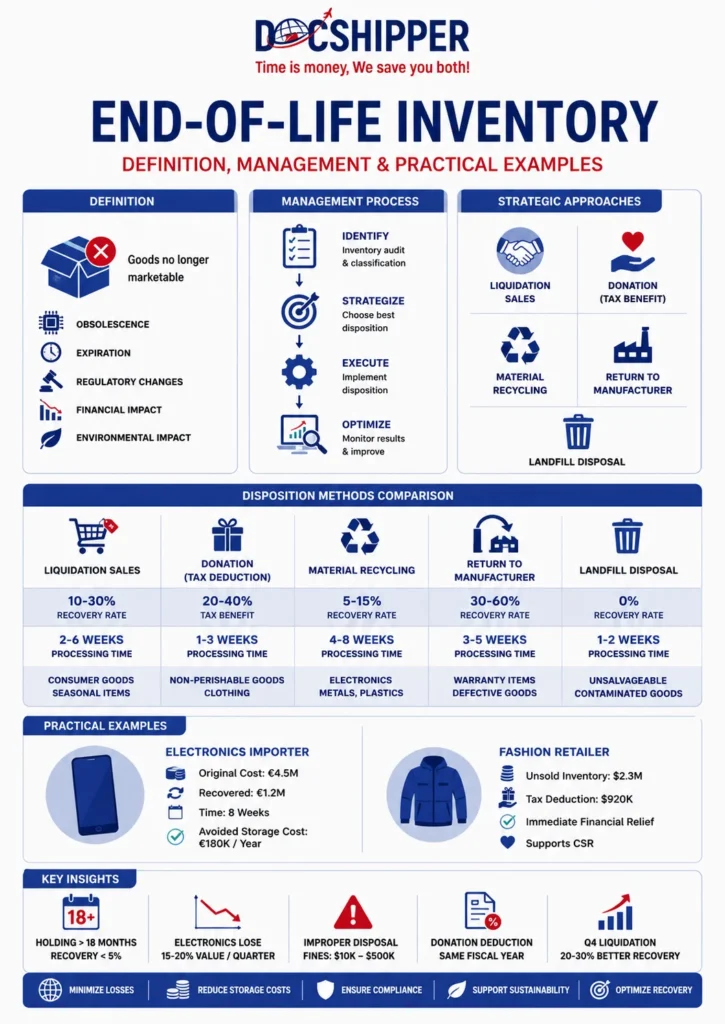
- Product obsolescence: Technology advancements or fashion trends render items unmarketable
- Expiration concerns: Perishable or time-sensitive goods reaching their end date
- Regulatory changes: New compliance standards making existing stock illegal to sell
- Financial impact: Storage costs accumulating while inventory value depreciates
- Environmental considerations: Proper disposal methods required for specific materials
Mechanisms & Strategic Implications
End-of-life inventory management involves multiple strategic approaches depending on product type, condition, and market circumstances. The identification phase requires systematic inventory audits to classify goods based on turnover rates, condition assessments, and market demand forecasts.
Companies must implement disposition strategies that maximize recovery value while minimizing carrying costs. These include liquidation sales, donations for tax benefits, recycling programs, or complete disposal. Each option carries different financial implications and regulatory requirements, particularly in cross-border contexts.
The customs implications of end-of-life inventory are particularly complex for international traders. Goods marked for destruction may still require export documentation, while recycling materials often face different tariff classifications. According to World Customs Organization guidelines, proper classification prevents unnecessary duties on obsolete goods.
Financial accounting requires writing down inventory value through obsolescence reserves or direct write-offs. Generally Accepted Accounting Principles mandate lower-of-cost-or-market valuation, forcing businesses to recognize losses when inventory value declines below purchase cost. This impacts financial statements and tax positions significantly.
At DocShipper, we assist clients in navigating the complex documentation requirements for end-of-life inventory disposal, ensuring compliance with both origin and destination country regulations while optimizing recovery value through our global network of liquidation partners.
Environmental regulations add another layer of complexity, particularly for electronics, chemicals, or hazardous materials. The Basel Convention restricts transboundary movement of hazardous waste, requiring specific permits and disposal certifications. Non-compliance can result in severe penalties and shipment rejections at borders.
Practical Examples & Data
Understanding end-of-life inventory management through concrete scenarios helps businesses make informed decisions. The following examples illustrate different approaches based on industry and product characteristics.
| Disposition Method | Typical Recovery Rate | Processing Time | Best For |
|---|---|---|---|
| Liquidation Sales | 10-30% of cost | 2-6 weeks | Consumer goods, seasonal items |
| Donation (Tax Deduction) | 20-40% tax benefit | 1-3 weeks | Non-perishable goods, clothing |
| Material Recycling | 5-15% of cost | 4-8 weeks | Electronics, metals, plastics |
| Return to Manufacturer | 30-60% of cost | 3-5 weeks | Warranty items, defective goods |
| Landfill Disposal | 0% (cost incurred) | 1-2 weeks | Unsalvageable, contaminated goods |
Use Case: Electronics Importer — A European electronics distributor imported 50,000 units of smartphones that became obsolete when the manufacturer released a new model. Original landed cost: €4.5 million. Through liquidation channels, they recovered €1.2 million within eight weeks, avoiding an additional €180,000 in annual storage costs. The swift action prevented complete value loss and freed warehouse space for new inventory.
Use Case: Fashion Retailer — An American clothing retailer faced $2.3 million in unsold winter apparel after an unusually warm season. Rather than holding inventory for another year, they donated goods to qualified charities, obtaining a tax deduction worth approximately $920,000. This strategy provided immediate financial relief while supporting corporate social responsibility objectives.
Industry data reveals that companies holding end-of-life inventory beyond 18 months typically recover less than 5% of original cost. Early identification and action prove critical for financial preservation.
Key data points for decision-making:
- Holding cost threshold: When monthly storage exceeds potential recovery value, immediate disposition becomes optimal
- Market depreciation rate: Consumer electronics lose approximately 15-20% value quarterly after obsolescence
- Compliance costs: Improper disposal can result in fines ranging from $10,000 to $500,000 depending on material type
- Tax optimization: Donation deductions must occur in the same fiscal year for maximum benefit
- Liquidation timing: Fourth quarter typically yields 20-30% better recovery rates due to holiday purchasing patterns
Conclusion
End-of-life inventory management requires proactive identification, strategic decision-making, and regulatory compliance across international borders. Companies that implement systematic monitoring and swift disposition strategies minimize financial losses while maintaining operational efficiency.
Need assistance managing obsolete inventory or navigating cross-border disposal regulations? Contact DocShipper for expert guidance on inventory optimization and compliant disposal solutions.
📚 Quiz
Test Your Knowledge: End-of-Life Inventory
What defines inventory as "end-of-life" in international trade?
Which statement about end-of-life inventory value depreciation is CORRECT?
Your company imported electronics that became obsolete after a new model release. Storage costs are mounting. What's the most appropriate immediate action?
🎯 Your Results
📞 Free Custom Quote in 24hFAQ | End-of-Life Inventory: Definition, Management & Practical Examples
Inventory reaches end-of-life status when it becomes unsellable through normal channels due to obsolescence, expiration, damage, or regulatory changes. Financial indicators include turnover rates below industry benchmarks, declining market demand, or when holding costs exceed potential sales revenue. Accounting standards typically require classification when net realizable value falls below cost.
Customs treatment varies by destination and material type. Most countries require standard export declarations even for goods marked for destruction. Hazardous materials need special permits under Basel Convention rules. Some jurisdictions allow reduced or zero-duty classifications for verified recycling purposes. Proper documentation proving end-of-life status prevents disputes and potential duty assessments.
In many jurisdictions, businesses can claim tax deductions based on fair market value or cost basis when donating to qualified charitable organizations. US tax code allows enhanced deductions for certain product types, potentially reaching 200% of cost basis. Documentation requirements include appraisals for high-value donations, recipient acknowledgments, and proof of charitable status. Timing matters—donations must occur within the fiscal year to claim benefits.
Value depreciation accelerates significantly after obsolescence designation. Electronics typically lose 15-20% value quarterly, while fashion items can depreciate 30-40% per season. Perishable goods approach zero value as expiration dates near. Storage costs compound the problem, adding 1-3% of product value monthly. Data shows inventory held beyond 18 months post-obsolescence rarely recovers more than 5% of original cost.
Environmental regulations mandate specific disposal methods for different material categories. Electronics require certified e-waste recycling to prevent toxic material contamination. Chemicals and hazardous substances need licensed disposal facilities with tracking documentation. Extended Producer Responsibility laws in EU and other regions require manufacturers to fund proper disposal. Non-compliance results in substantial fines and potential criminal liability.
Secondary market sales depend on product type and destination regulations. Many developing markets accept older technology or fashion items at significant discounts. However, safety standards, electrical compatibility, and intellectual property considerations limit options. Some countries restrict imports of near-expiration goods. Due diligence on destination regulations prevents shipment rejections and associated losses.
Accounting standards require writing down inventory to net realizable value when it falls below cost. This involves establishing obsolescence reserves or direct write-offs through cost of goods sold. The lower-of-cost-or-market principle mandates recognition of losses when they occur, not when goods are eventually disposed. Annual financial audits scrutinize inventory valuation, making accurate obsolescence assessment critical for compliance.
Liquidation requires maintaining detailed records including original purchase documentation, inventory condition assessments, valuation reports, and disposition agreements. For international shipments, commercial invoices must accurately reflect reduced values to prevent customs disputes. Tax authorities may request evidence supporting write-down decisions. Proper documentation protects against audits and supports insurance claims if applicable.
Standard cargo and warehouse insurance typically covers physical damage or theft but excludes obsolescence losses. Some specialized policies offer obsolescence coverage with specific terms regarding time limits and depreciation schedules. Business interruption insurance may cover losses if obsolescence results from covered perils. Policy review before obsolescence occurs helps identify coverage gaps requiring additional protection.
Third-party logistics providers often offer disposition services including liquidation management, donation coordination, and recycling arrangements. Many maintain networks of secondary buyers and liquidators, potentially improving recovery rates. However, contractual terms should clearly define responsibilities for storage costs, disposal fees, and liability for improper handling. Selecting experienced providers with compliance expertise proves essential.
Prevention strategies include demand forecasting improvements, just-in-time inventory practices, and flexible supplier agreements with return options. Product lifecycle monitoring identifies obsolescence risks early, enabling proactive markdowns or returns. Technology solutions track aging inventory with automated alerts when turnover rates decline. Building clauses into supplier contracts for buyback or exchange rights provides safety nets against market shifts.
Each industry faces unique challenges. Pharmaceuticals must comply with strict disposal regulations due to controlled substance laws. Automotive parts require consideration of liability issues if defective components enter secondary markets. Food products face health department oversight for disposal methods. Fashion and consumer electronics experience faster obsolescence cycles, requiring more aggressive inventory management. Industry-specific expertise ensures compliant and cost-effective disposition strategies.
Need Help with
Logistics or Sourcing ?
First, we secure the right products from the right suppliers at the right price by managing the sourcing process from start to finish. Then, we simplify your shipping experience - from pickup to final delivery - ensuring any product, anywhere, is delivered at highly competitive prices.


Fill the Form
Prefer email? Send us your inquiry, and we’ll get back to you as soon as possible.
Contact us




