


In short ⚡
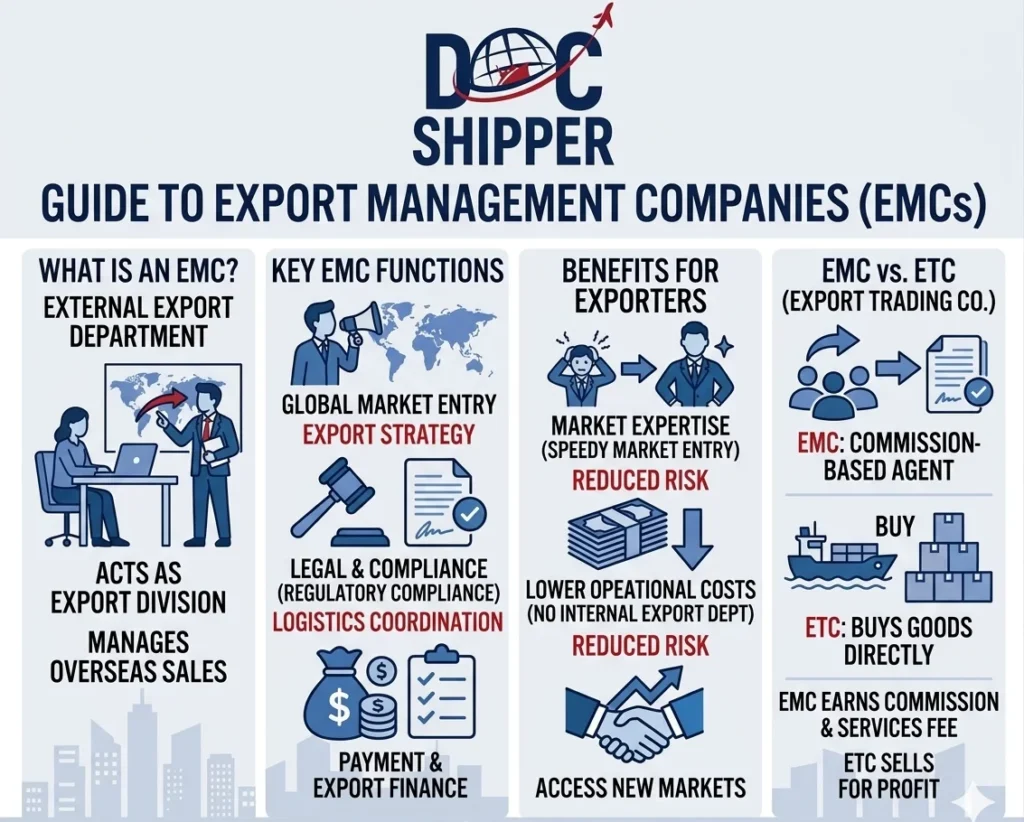
An Export Management Company (EMC) is a specialized firm that acts as the export department for domestic manufacturers, handling all international sales operations including market research, distribution channels, documentation, and compliance. EMCs enable companies to access global markets without establishing their own export infrastructure or hiring specialized personnel.
Introduction
Many manufacturers possess excellent products but lack the resources to export them successfully. Navigating foreign regulations, finding buyers abroad, and managing cross-border logistics require specialized knowledge that most domestic companies don’t have in-house.
This is where Export Management Companies become essential partners. They transform domestic manufacturers into global players by providing turnkey export solutions. For small and medium-sized enterprises, partnering with an EMC often represents the most cost-effective pathway to international expansion.
Key characteristics of Export Management Companies include:
- Market expertise: Deep knowledge of specific geographic regions and industry sectors
- Established networks: Pre-existing relationships with distributors, agents, and buyers worldwide
- Operational capability: Complete handling of documentation, shipping, compliance, and payment collection
- Risk mitigation: Assumption of export-related responsibilities including credit risk in many cases
- Performance-based model: Typically working on commission rather than fixed fees, aligning interests with client success
In-Depth Analysis & Expertise
Export Management Companies operate under two primary business models. In the agent model, the EMC works on commission, finding buyers and facilitating transactions while the manufacturer retains ownership throughout. In the distributor model, the EMC purchases products outright and resells them internationally under its own arrangements.
The contractual relationship between manufacturer and EMC requires careful structuring. Key elements include territorial exclusivity, defining which markets the EMC controls, product scope, specifying which items fall under the agreement, and performance metrics, establishing minimum sales targets or termination clauses.
From a regulatory perspective, EMCs must navigate complex compliance frameworks. According to the U.S. International Trade Administration, EMCs bear responsibility for ensuring that exports comply with all applicable regulations including export controls, sanctions, and product-specific certifications.
The value proposition of partnering with an EMC extends beyond simple market access. These firms provide market intelligence unavailable to individual manufacturers, conduct competitive analyses, adapt products to local requirements, and offer cultural expertise that prevents costly mistakes. At DocShipper, we regularly collaborate with EMCs to ensure seamless logistics execution from factory to foreign destination.
Financial arrangements vary widely but typically involve commission rates between 10-15% for manufactured goods or 7-10% for commodities. Some EMCs also charge retainer fees for exclusive representation or initial market development work. The model selected depends on product complexity, market maturity, and the level of support required.
Concrete Examples & Data
The global EMC market generates approximately $45 billion annually, with the United States accounting for roughly 35% of this activity. Small and medium-sized manufacturers represent the primary client base, with 68% of EMC clients having fewer than 250 employees.
Case Study: Industrial Equipment Manufacturer
A Michigan-based manufacturer of specialized pumps wanted to enter Asian markets but lacked export experience. By partnering with an EMC specializing in industrial equipment, they achieved the following results within 18 months:
- Entered five new markets (Japan, South Korea, Singapore, Thailand, Vietnam)
- Generated $2.3 million in export revenue with minimal internal resource allocation
- Paid 12% commission on completed sales rather than hiring full-time export staff
- Avoided compliance issues through the EMC’s regulatory expertise
- Reduced time-to-market by 60% compared to establishing their own export department
Key performance indicators distinguish successful EMC partnerships:
| Performance Metric | Industry Benchmark | Leading EMCs |
|---|---|---|
| Time to First Sale | 6-9 months | 3-5 months |
| Payment Collection Rate | 92-94% | 97-99% |
| Market Penetration (Year 2) | 2-3 countries | 4-6 countries |
| Compliance Issue Rate | 8-12% | 2-4% |
| Client Retention (3 years) | 65-70% | 80-85% |
When evaluating an EMC partnership, manufacturers should examine track records in specific markets, the depth of existing buyer relationships, financial stability, and technological capabilities for order management and reporting. At DocShipper, we work with numerous EMCs and observe that the most successful partnerships involve clear communication protocols and aligned expectations from the outset.
The cost-benefit analysis strongly favors EMCs for most small manufacturers. Building an internal export department typically requires $180,000-$250,000 in annual overhead, whereas EMC commissions only apply to successful sales, creating a variable cost structure with minimal downside risk.
Conclusion
Export Management Companies provide a strategic pathway for manufacturers seeking international growth without the capital investment and expertise required to build internal export capabilities. Their established networks, regulatory knowledge, and performance-based compensation align perfectly with the needs of small and medium-sized enterprises entering global markets.
Need guidance on international expansion or logistics coordination with your EMC partner? Contact DocShipper for comprehensive support across your entire export supply chain.
📚 Quiz
Test Your Knowledge: Export Management Company (EMC)
What is the primary role of an Export Management Company (EMC)?
In the "agent model" used by EMCs, who retains ownership of the products throughout the export process?
A Michigan-based pump manufacturer partnered with an EMC to enter Asian markets. Which result demonstrates the key advantage of using an EMC over building an internal export department?
🎯 Your Results
📞 Free Personalized QuoteFAQ | Export Management Company (EMC): Definition, Role & Concrete Examples
An Export Management Company typically represents manufacturers on a commission or agency basis, acting as their export department. An Export Trading Company (ETC) usually takes title to goods, purchasing from manufacturers and reselling internationally. EMCs focus on long-term representation of specific manufacturers, while ETCs operate more transactionally across multiple suppliers and product categories.
Most EMCs work on commission ranging from 7-15% of export sales, with manufactured goods typically commanding 10-15% and commodities 7-10%. Some EMCs charge monthly retainers of $2,000-$5,000 for exclusive representation or market development phases. The commission-based model means manufacturers only pay for successful sales, making it a low-risk entry strategy compared to building internal export departments.
EMCs excel with products that have clear differentiation, require market education, or need regulatory navigation. Industrial equipment, specialized components, consumer durables, and niche consumer goods perform well. Commodity products with intense price competition are less suitable unless the EMC has exceptional buyer relationships. Products requiring significant after-sales support may also be challenging unless the EMC has service capabilities.
Initial sales typically occur within 3-9 months depending on product complexity and target markets. Established markets with existing buyer relationships may generate orders within 60-90 days. Emerging markets requiring regulatory approvals, product adaptations, or market development may take 9-12 months. Most EMCs provide quarterly progress reports and expect to achieve measurable traction within the first year of partnership.
Yes, manufacturers commonly engage different EMCs for distinct geographic regions or product lines. For example, one EMC might cover Asia-Pacific while another handles Latin America. Clear territorial definitions in contracts prevent conflicts. However, overlapping territories create confusion and undermine EMC motivation, so exclusivity within defined regions is standard practice. Global exclusivity is rare except for highly specialized products.
Essential contract elements include territorial scope, product coverage, exclusivity terms, commission rates, payment terms, minimum performance standards, contract duration (typically 1-3 years), termination clauses, intellectual property protections, and compliance responsibilities. Performance reviews should occur quarterly or semi-annually. Well-structured contracts also address inventory management, marketing fund contributions, and transition procedures if the relationship ends.
Most EMCs coordinate logistics but outsource physical execution to freight forwarders and customs brokers. They arrange transportation, prepare documentation, ensure compliance, and track shipments. Some large EMCs maintain logistics departments, but partnerships with specialized logistics providers like DocShipper typically deliver better service and pricing. The EMC retains responsibility for ensuring goods reach customers properly while leveraging logistics expertise from dedicated providers.
EMCs leverage existing relationships built over years in specific markets, attend international trade shows, conduct targeted outreach to distributors and retailers, utilize trade databases and market intelligence, and employ multilingual sales staff familiar with local business practices. Established EMCs possess buyer networks developed through decades of market presence, which is their primary value proposition beyond simply having export knowledge.
Payment responsibility depends on the EMC's operating model. In agent arrangements, the manufacturer typically bears credit risk unless the EMC offers credit guarantee services. In distributor models where the EMC purchases goods, the manufacturer receives payment regardless of foreign buyer performance. Many EMCs utilize letters of credit, export credit insurance, or factoring services to mitigate payment risk and protect both parties.
Contracts typically include performance standards and termination provisions. Common grounds for termination include failure to meet minimum sales targets, breach of exclusivity, non-compliance with regulations, or mutual agreement. Notice periods of 60-90 days are standard. However, premature termination may require compensation if the EMC has made substantial market development investments. Well-drafted contracts specify clear performance metrics and termination procedures to avoid disputes.
EMCs add value even when manufacturers have initial international sales. They can expand into new regions, deepen penetration in existing markets, professionalize export operations, ensure regulatory compliance, and free internal resources for core competencies. Some manufacturers use EMCs for new market development while managing established markets internally. The decision depends on growth objectives, available resources, and the complexity of target markets.
Professional EMCs maintain regulatory compliance through dedicated staff, memberships in trade associations, subscription to regulatory update services, relationships with customs brokers and legal advisors, regular training programs, and specialized compliance software. Leading EMCs employ licensed customs brokers and maintain certifications demonstrating regulatory expertise. Their ability to navigate complex compliance requirements represents a core competitive advantage and primary reason manufacturers outsource export functions.
Need Help with
Logistics or Sourcing ?
First, we secure the right products from the right suppliers at the right price by managing the sourcing process from start to finish. Then, we simplify your shipping experience - from pickup to final delivery - ensuring any product, anywhere, is delivered at highly competitive prices.


Fill the Form
Prefer email? Send us your inquiry, and we’ll get back to you as soon as possible.
Contact us




:%20Definition,%20Role%20&%20Concrete%20Examples)