


In short ⚡
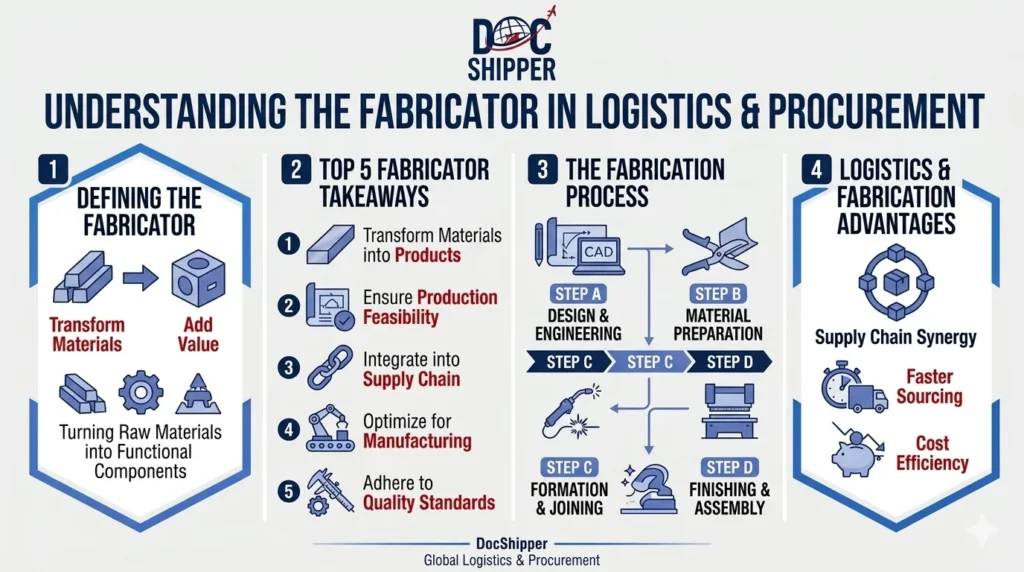
A fabricator is a company or entity that manufactures, assembles, or produces finished goods from raw materials or components. In international trade documentation, the fabricator's identity is crucial for customs compliance, origin certification, and quality traceability throughout the supply chain.
Introduction
In international trade, confusion often arises between the fabricator, the exporter, the seller, and the manufacturer. Many importers mistakenly assume these parties are identical, leading to documentation errors, customs delays, and compliance issues.
The fabricator plays a strategic role in the global supply chain. This entity directly impacts product origin determination, duty calculations, and quality control protocols. Accurate identification prevents costly errors during customs clearance and trade audits.
Key characteristics of a fabricator in logistics:
- Manufacturing Authority: Transforms raw materials into finished products through physical processes
- Documentation Responsibility: Provides certificates of origin, manufacturing statements, and quality reports
- Compliance Obligation: Must meet destination country’s product standards and safety regulations
- Traceability Function: Enables supply chain transparency from material sourcing through production
- Liability Bearer: Assumes legal responsibility for product quality and conformity declarations
In-Depth Expertise & Legal Implications
The fabricator’s identity becomes legally significant in several trade scenarios. Rules of origin require precise documentation of where substantial transformation occurred. Customs authorities worldwide distinguish between minor assembly operations and genuine manufacturing processes.
Under preferential trade agreements, the fabricator determines whether goods qualify for reduced tariffs. For example, EU-UK Trade Cooperation Agreement requires specific value-added thresholds at the fabricator level to claim origin benefits.
The manufacturer’s declaration in trade documents must accurately reflect the fabricator’s legal entity. This differs from the shipper or commercial invoice issuer. Misrepresentation can trigger anti-dumping investigations or origin fraud penalties.
In product liability cases, the fabricator bears primary responsibility for manufacturing defects. International conventions like the UN Convention on Contracts for the International Sale of Goods establish this liability framework. Insurance coverage must explicitly name the fabricator entity.
For certification compliance, third-party audits inspect the fabricator’s facilities directly. Standards like ISO 9001, FDA registration, or CE marking require the manufacturing entity’s verification. According to WTO Technical Barriers to Trade Agreement, these certifications cannot be transferred between legal entities.
At DocShipper, we systematically verify fabricator credentials against commercial invoices and packing lists. This cross-validation prevents document discrepancies that cause customs holds, ensuring your shipments clear without delays or unexpected inspection fees.
Concrete Examples & Industry Data
Understanding fabricator distinctions becomes clearer through real-world scenarios. Consider these comparative situations illustrating how fabricator identification impacts trade operations:
| Scenario | Fabricator Role | Documentation Requirement | Customs Impact |
|---|---|---|---|
| Direct Manufacturing | Factory produces and exports goods | Single certificate of origin from fabricator | Straightforward origin determination |
| Trading Company Model | Third-party manufacturer, trader exports | Fabricator’s declaration + exporter’s commercial invoice | Requires evidence of manufacturing location |
| Contract Manufacturing | Brand owner contracts production externally | Manufacturing agreement + origin declaration from actual fabricator | Complex origin verification; potential for disputes |
| Assembly Operations | Final assembly from imported components | Bills of materials showing component origins + assembly location | Substantial transformation test determines duty treatment |
Use Case: Electronics Import Scenario
A U.S. retailer imports smartphones labeled “Made in Vietnam.” Investigation reveals:
- Component Fabricators: Screens from South Korea, processors from Taiwan, batteries from China
- Assembly Fabricator: Vietnamese factory performs final assembly and quality testing
- Exporter: Hong Kong trading company handles documentation and logistics
- Brand Owner: California-based company owns intellectual property
For customs purposes, the Vietnamese assembly fabricator determines origin because substantial transformation occurred there. The certificate of origin must name this specific entity. Incorrectly listing the Hong Kong exporter would invalidate preferential duty treatment under USMCA provisions.
According to WTO Trade Statistics 2023, approximately 68% of manufactured goods involve multiple fabricators across different countries. This complexity increases documentation requirements and origin determination challenges for importers worldwide.
Industry data shows that 45% of customs delays stem from fabricator identification mismatches between certificates of origin and commercial invoices. Proper verification reduces clearance time by an average of 3-5 business days.
Conclusion
Accurate fabricator identification forms the foundation of compliant international trade operations. This seemingly simple detail determines duty calculations, origin benefits, liability assignments, and regulatory compliance across borders.
Need assistance verifying fabricator credentials or navigating complex supply chain documentation? Contact DocShipper for expert guidance on your international logistics challenges.
📚 Quiz
Test Your Knowledge: Fabricator in International Logistics
1. What is the primary defining characteristic of a fabricator in international trade?
2. In contract manufacturing arrangements, who is legally considered the fabricator for customs purposes?
3. A U.S. importer receives smartphones with components from multiple countries but final assembly in Vietnam. For preferential duty treatment under trade agreements, which entity's location determines the country of origin?
🎯 Your Result
📞 Free Quote in 24hFAQ | Fabricator: Definition, Role & Practical Examples in International Logistics
In trade terminology, these terms are often interchangeable. Both refer to the entity that produces goods through physical transformation. However, "fabricator" sometimes emphasizes the assembly or construction aspect, while "manufacturer" broadly covers any production process. For customs documentation, both terms identify the production facility's legal entity.
Yes, this is extremely common in international trade. The fabricator manufactures goods, while the exporter handles export documentation and logistics. Trading companies, freight forwarders, or brand owners often serve as exporters without being the actual fabricator. Both entities should be clearly identified in commercial invoices and certificates of origin.
Request official business registration documents, manufacturing licenses, and quality certifications from the fabricator. Cross-reference this information with certificates of origin and commercial invoices. Third-party audits or factory inspections provide additional verification. Customs authorities may also conduct supplier verification procedures directly with the fabricator.
Generally yes, but with important qualifications. The location where substantial transformation occurs typically determines origin. However, minimal processing or simple assembly may not confer origin. Rules of origin criteria—such as tariff classification changes or value-added percentages—ultimately determine whether the fabricator's location establishes country of origin for duty purposes.
Essential fabricator documents include: manufacturer's declaration or certificate, detailed product specifications, bills of materials showing component origins, quality control certificates, applicable safety or standards compliance documents (CE, FDA, etc.), and supporting evidence for origin claims. The specific requirements depend on destination country regulations and product categories.
Yes, many fabricators establish operations in free trade zones or special economic zones. These locations offer duty deferral benefits and simplified customs procedures. However, origin determination becomes more complex when goods are manufactured in such zones. Specific documentation proving local value-addition is typically required to claim preferential origin treatment.
In contract manufacturing arrangements, the actual production facility is the legal fabricator, not the brand owner who contracted the work. Customs documents must name the contract manufacturer as the fabricator. The brand owner appears as the seller or consignee. Manufacturing agreements and licensing documentation may be required to demonstrate this relationship during customs clearance.
Incorrect fabricator details can trigger customs examinations, shipment holds, or outright rejection of preferential duty claims. Penalties may include duty reassessments, fines for false declarations, or in serious cases, anti-dumping investigations. Correcting such errors requires amended documentation and often causes significant delivery delays. Accurate initial declaration prevents these costly complications.
Requirements vary by regulation and product type. For basic customs clearance, only the final fabricator who performed substantial transformation needs identification. However, for regulatory compliance (pharmaceuticals, food, etc.), due diligence programs, or free trade agreement claims, full supply chain disclosure including component fabricators may be mandatory. Always verify specific requirements for your product category and destination market.
While theoretically possible, this is uncommon due to operational specialization. Fabricators focus on production, while freight forwarders handle logistics. If the same legal entity performs both functions, documentation must clearly distinguish these separate roles. For customs purposes, the manufacturing function establishes fabricator status, regardless of any logistics services the company also provides.
Product liability insurance requires accurate fabricator identification because this entity typically bears primary manufacturing defect liability. Insurance policies must specifically name the fabricator to provide coverage. Misidentifying the fabricator can void insurance claims. Additionally, importers should verify that fabricators maintain adequate liability coverage, particularly for products entering markets with strict liability laws like the United States or European Union.
A fabricator's declaration is a formal statement where the manufacturer confirms product details, specifications, origin, and compliance with applicable standards. This document supports customs declarations and origin claims. It should include the fabricator's legal name, address, manufacturing location, product description, applicable tariff codes, and a statement of origin criteria satisfaction. Many free trade agreements have specific fabricator declaration formats that must be followed precisely.
Need Help with
Logistics or Sourcing ?
First, we secure the right products from the right suppliers at the right price by managing the sourcing process from start to finish. Then, we simplify your shipping experience - from pickup to final delivery - ensuring any product, anywhere, is delivered at highly competitive prices.


Fill the Form
Prefer email? Send us your inquiry, and we’ll get back to you as soon as possible.
Contact us




