


In short ⚡
False billing is the fraudulent practice of issuing invoices containing incorrect, inflated, or entirely fictitious charges to deceive payment from customers, insurers, or government entities. This commercial fraud represents a critical compliance risk in international trade, logistics, and customs operations, exposing businesses to financial losses, legal sanctions, and reputational damage.Introduction
In global supply chains, false billing creates cascading problems. A single fraudulent invoice can trigger customs investigations, payment disputes, and partnership breakdowns. Many importers unknowingly become victims when third-party logistics providers or suppliers manipulate documentation.
This deceptive practice impacts all stakeholders. Shippers face inflated freight charges. Customs authorities struggle with revenue collection. Legitimate businesses lose competitive advantage against fraudulent operators willing to undercut prices through false declarations.
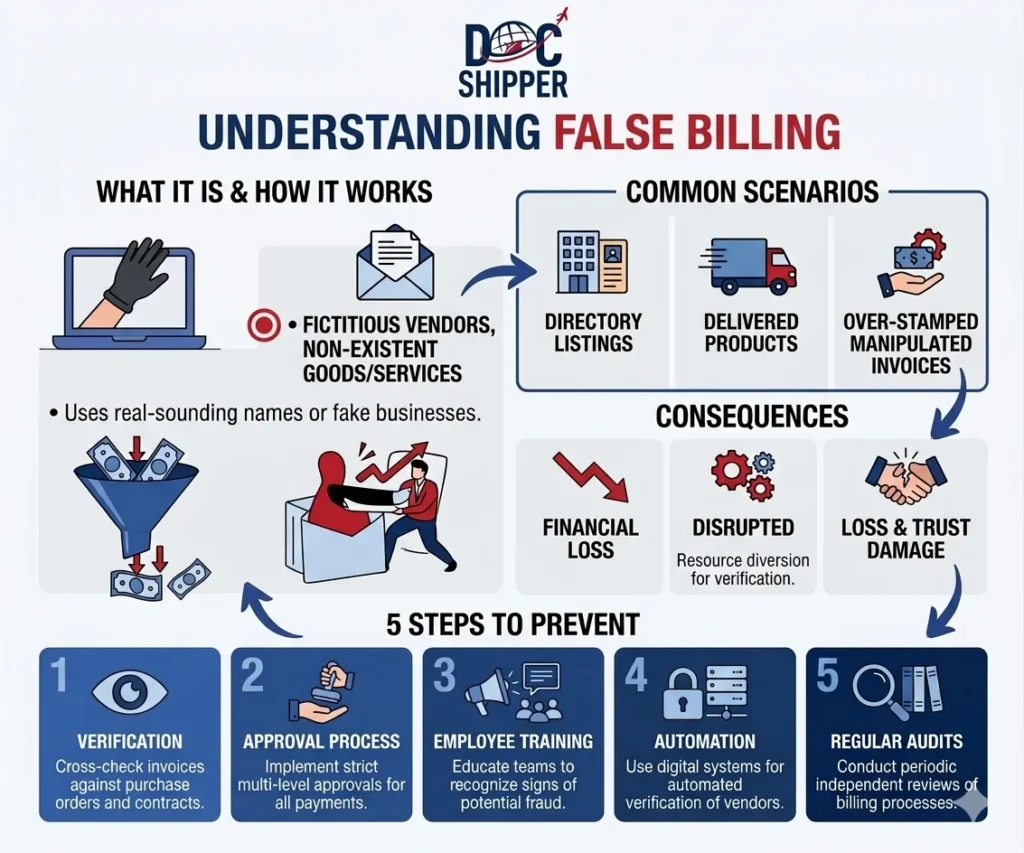
Key characteristics of false billing schemes include:
- Quantity manipulation – Declaring fewer or more units than actually shipped
- Value misrepresentation – Understating or overstating transaction prices
- Service fabrication – Charging for services never rendered
- Duplicate invoicing – Billing the same shipment multiple times
- Phantom freight – Creating charges for non-existent transportation
Mechanisms & Detection Methods
False billing operates through systematic manipulation of commercial documentation. Fraudsters exploit information asymmetry between shipping parties, customs authorities, and financial institutions. The practice typically involves collaboration between multiple actors or sophisticated document forgery.
Common execution methods include invoice splitting to avoid customs thresholds, description alteration to misclassify goods under lower tariff codes, and price manipulation through transfer pricing schemes between related entities. Some operators create entirely fictitious companies to issue fraudulent invoices without physical goods ever moving.
Detection relies on cross-referencing multiple data sources. Advanced customs systems compare invoice values against market intelligence databases, historical shipment patterns, and industry benchmarks. According to the World Trade Organization, coordinated verification programs between trading partners reduce false billing incidents by examining corresponding export and import declarations.
Modern prevention strategies employ blockchain technology for immutable transaction records, AI-powered anomaly detection analyzing pricing patterns, and mandatory third-party verification for high-value shipments. Regulatory frameworks now impose strict liability on consignees who benefit from undervalued declarations, even without direct knowledge of fraud.
At DocShipper, we implement multi-layer invoice verification protocols, cross-checking commercial invoices against packing lists, bills of lading, and supplier catalogs to ensure complete documentation accuracy before customs submission. Our compliance team systematically flags pricing discrepancies exceeding industry-standard variance thresholds.
Concrete Examples & Data
Real-world cases demonstrate the severe consequences of false billing. In 2022, European customs authorities recovered €2.3 billion in lost revenue from undervaluation schemes, primarily affecting textile and electronics imports from Asia. A single multinational retailer faced penalties exceeding $180 million for systematic invoice undervaluation across five years.
The maritime sector experiences particularly high fraud rates. A comparative analysis of false billing methods shows distinct patterns:
| Fraud Method | Detection Rate | Average Loss | Primary Sector |
|---|---|---|---|
| Value Understatement | 68% | $47,000/shipment | Consumer Electronics |
| Phantom Services | 42% | $12,500/transaction | Freight Forwarding |
| Duplicate Billing | 81% | $9,300/invoice | Warehousing |
| Quantity Manipulation | 55% | $34,200/container | Textiles & Apparel |
Use Case: Electronics Import Scheme
A European importer received invoices declaring smartphone shipments at $45 per unit when market value stood at $380. Over 18 months, this generated $2.1 million in avoided customs duties. Automated risk assessment systems flagged the discrepancy by comparing declared values against manufacturer MSRPs and wholesale databases. Post-clearance audits revealed the supplier operated through shell companies in three jurisdictions, issuing dual invoices—one truthful for accounts, one fraudulent for customs.
Industry data reveals critical prevention factors:
- Supplier verification – Background checks reduce fraud risk by 73%
- Documentation cross-checks – Comparing 3+ independent sources catches 89% of discrepancies
- Price benchmarking – Automated market comparison flags 94% of undervaluations
- Transaction monitoring – Real-time payment analysis detects 67% of phantom charges
- Third-party audits – Independent verification prevents 81% of repeat offenses
Conclusion
False billing represents a persistent threat requiring proactive vigilance across international supply chains. Combining regulatory compliance, technological verification, and partnership transparency creates effective defense against fraudulent invoicing practices.
Need expert guidance on invoice verification and customs compliance? Contact DocShipper for comprehensive documentation management services.
📚 Quiz
Test Your Knowledge: False Billing
Question 1: What fundamentally defines false billing as fraudulent rather than a simple administrative error?
Question 2: Under strict liability principles, can importers be held legally responsible for false billing even without direct knowledge of their supplier's fraudulent practices?
Question 3: A European electronics importer receives smartphone invoices at $45/unit when market value is $380/unit. Which response demonstrates proper compliance protocol?
🎯 Your Result
📞 Free Compliance Audit in 24hFAQ | False Billing: Definition, Legal Implications & Prevention Strategies
False billing involves deliberate deception with intent to defraud, while pricing errors result from unintentional mistakes. Legal systems distinguish based on pattern evidence—systematic undervaluation across multiple shipments indicates fraud, whereas isolated discrepancies suggest clerical errors. Intent becomes provable through dual invoicing, concealed true prices, or communication records showing knowledge of manipulation.
Modern customs systems employ risk-profiling algorithms analyzing declared values against historical data, market intelligence, and trading partner declarations. Red flags include prices deviating more than 15% from statistical norms, frequent use of minimum valuation thresholds, and inconsistencies between commercial invoices and transport documents. Post-clearance audits verify actual payment evidence against declared amounts.
Penalties typically include duty recovery at actual value plus interest, civil fines ranging from 100-300% of evaded amounts, criminal prosecution for executives in severe cases, and suspension of import privileges. The EU Customs Code imposes penalties up to four times the evaded duty. US regulations under 19 USC §1592 authorize fines reaching $10,000 per violation plus goods seizure.
Yes, under strict liability principles in most jurisdictions. Importers bear responsibility for declaration accuracy regardless of knowledge. The "reasonable care" standard requires documented supplier verification, pricing validation, and investigation of suspiciously low prices. Demonstrating due diligence through third-party audits and compliance programs may mitigate penalties but doesn't eliminate liability.
Fraudulent invoicing severely damages Authorized Economic Operator (AEO) status and trusted trader credentials. Companies lose expedited clearance privileges, face increased inspection rates, and encounter difficulty securing customs bonds. Recovery requires typically three years of clean compliance history, comprehensive internal reforms, and third-party certification. Lost AEO status increases average clearance time by 72 hours per shipment.
Supporting evidence includes payment records matching invoice amounts, supplier purchase orders, manufacturer certificates of origin, independent price quotations, industry pricing benchmarks, and corresponding export declarations from origin countries. Bank transfer records, letters of credit, and commercial contracts provide payment verification. Blockchain-certified transactions offer immutable proof increasingly accepted by progressive customs administrations.
Transfer pricing rules require arm's-length pricing between related parties, preventing value manipulation through artificial inter-company transactions. Tax authorities cross-reference customs values against transfer pricing documentation, flagging discrepancies. Companies must maintain contemporaneous documentation justifying related-party pricing. The OECD Base Erosion Profit Shifting (BEPS) framework coordinates international enforcement, making cross-border invoice fraud increasingly detectable.
Blockchain platforms create tamper-proof invoice trails shared across supply chain participants. AI systems analyze pricing patterns against millions of historical transactions, automatically flagging statistical anomalies. Electronic data interchange (EDI) links buyer, seller, and customs systems, ensuring consistent information. Smart contracts auto-execute payments only when verification conditions meet predetermined criteria. Biometric authentication prevents unauthorized document alterations.
Immediate voluntary disclosure to customs authorities demonstrates good faith and may reduce penalties under most jurisdictions' prior disclosure programs. Companies should conduct internal investigations documenting the fraud's scope, implement corrective action plans, and terminate relationships with fraudulent partners. Legal counsel should guide disclosure strategy. The US Customs' Voluntary Self-Disclosure program can reduce penalties by 50-75% compared to discovered violations.
Trade credit insurance may cover losses from supplier fraud, though policies often exclude intentional misrepresentation by insureds. Customs bond providers cover certain duty liabilities but typically exclude fraudulent declarations. Specialized commercial crime policies can protect against third-party invoice fraud. Cyber insurance increasingly covers electronic invoice manipulation. Policy terms vary significantly—explicit fraud coverage requires careful policy review and proper disclosure during underwriting.
FTA provisions require accurate origin declarations and product valuation, with preferential duty rates conditional on compliance. False certificates of origin combined with invoice manipulation constitute separate violations, multiplying penalties. Mutual recognition agreements between customs authorities enable cross-border verification, making fraud detection more effective. Countries may revoke FTA benefits entirely for companies with proven false billing records, eliminating competitive advantages.
Comprehensive records should include all supplier communications, price negotiations, payment authorizations, banking records, contracts with complete pricing terms, independent market research, competitive quotations, and decision documentation justifying pricing. Retain transportation documents, warehouse receipts, and inspection certificates proving physical goods movement. Most jurisdictions require five-year record retention. Digital timestamping and blockchain certification increasingly provide irrefutable authenticity proof.
Need Help with
Logistics or Sourcing ?
First, we secure the right products from the right suppliers at the right price by managing the sourcing process from start to finish. Then, we simplify your shipping experience - from pickup to final delivery - ensuring any product, anywhere, is delivered at highly competitive prices.


Fill the Form
Prefer email? Send us your inquiry, and we’ll get back to you as soon as possible.
Contact us




