


In short ⚡
Feeder service is a maritime shipping operation connecting regional ports to major transshipment hubs using smaller vessels. These services enable cargo consolidation and distribution between secondary ports and main shipping routes, optimizing global container networks through strategic port-to-hub connections.
Introduction
Many import/export professionals struggle to understand why their containers transit through multiple ports before reaching final destinations. This confusion stems from the hub-and-spoke model dominating modern maritime logistics.
Feeder services form the critical link between smaller regional ports and major container hubs. Without these connecting routes, approximately 70% of global ports would remain isolated from international shipping networks.
Key characteristics include:
- Vessel size: Typically 500-3,000 TEU capacity (compared to 10,000-24,000 TEU for mainline vessels)
- Route frequency: Weekly or bi-weekly services connecting 3-8 regional ports
- Geographic scope: Short-sea shipping within regional zones (100-1,500 nautical miles)
- Operational flexibility: Ability to access ports with draft restrictions or smaller berths
- Cost efficiency: Consolidation reducing per-container transportation costs by 30-45%
Feeder Operations & Network Expertise
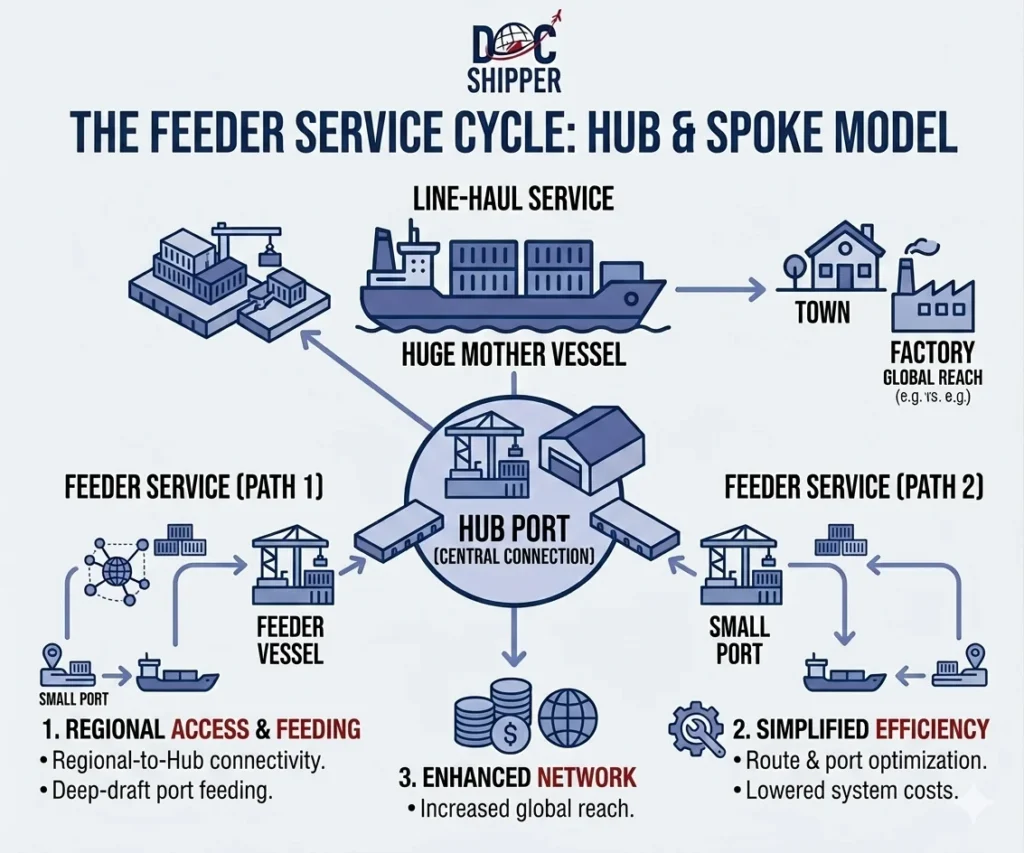
The feeder network operates through a carefully orchestrated system of transshipment hubs and spoke ports. Major hubs like Singapore, Rotterdam, and Dubai serve as consolidation centers where cargo transfers between mainline vessels and feeder ships.
Operational mechanics involve several critical components. Vessel scheduling requires precise coordination—feeder ships must arrive at hubs within specific windows to connect with mother vessels. A 24-hour delay at the hub can cascade into week-long delivery postponements.
Port infrastructure requirements differ significantly between hub and feeder ports. Hubs need deep-water berths (16+ meters draft), extensive container yards, and high-capacity cranes. Feeder ports function effectively with 10-12 meter drafts and smaller handling equipment.
The documentation process becomes more complex with feeder services. Cargo requires separate bills of lading for each leg: origin port to hub, and hub to final destination. At DocShipper, we systematically manage these multi-leg documentation requirements to prevent customs clearance delays at transshipment points.
Cost structure analysis reveals why shipping lines prefer this model. Operating one 20,000 TEU vessel on a main route costs approximately $0.08 per TEU per nautical mile. Running direct services with smaller vessels to every port would increase costs to $0.25-0.35 per TEU per mile—economically unsustainable.
According to UNCTAD’s Review of Maritime Transport, feeder services handle approximately 25% of global container movements, making them indispensable to international trade infrastructure.
Practical Examples & Industry Data
Understanding feeder services requires examining real-world applications and comparative data across different shipping scenarios.
Comparative Analysis: Direct vs. Feeder Service Routes
| Route Type | Transit Time | Cost per TEU | Service Frequency | Port Accessibility |
|---|---|---|---|---|
| Direct Mainline | 18-22 days | $1,800-2,200 | Weekly | Major hubs only |
| Feeder + Mainline | 21-28 days | $1,950-2,400 | Bi-weekly | Regional ports |
| Direct Small Vessel | 16-20 days | $3,200-4,500 | Monthly | All ports |
Use Case: Mediterranean-Northern Europe Feeder Network
A textile manufacturer in Izmir, Turkey ships 80 containers monthly to Hamburg, Germany. The shipment follows this routing:
- Leg 1: Izmir to Piraeus hub (Greece) via 1,200 TEU feeder vessel – 3 days
- Transshipment: Container transfer at Piraeus terminal – 2 days
- Leg 2: Piraeus to Hamburg via 14,000 TEU mainline vessel – 7 days
- Total transit: 12 days door-to-door
- Cost advantage: 32% cheaper than direct small-vessel service
Key Industry Statistics
Current market data reveals significant trends in feeder operations:
- Fleet composition: Approximately 2,800 feeder vessels operate globally, representing 18% of the container ship fleet
- Average vessel age: 16.2 years (older than mainline fleet average of 11.4 years)
- Regional concentration: 42% of feeder services operate in European waters, 28% in Southeast Asia
- Hub dependency: Top 20 transshipment hubs handle 78% of feeder cargo globally
- Cost efficiency: Feeder networks reduce overall supply chain costs by 15-22% for secondary port shipments
At DocShipper, we analyze feeder routing options to optimize your shipping costs and transit times, particularly for cargo moving through complex multi-port networks.
Conclusion
Feeder services remain the backbone of global container distribution, enabling cost-effective connections between regional ports and international shipping lanes. Understanding these networks is essential for optimizing import/export logistics strategies.
Need expert guidance on feeder routing or transshipment optimization? Contact DocShipper for tailored logistics solutions.
📚 Quiz
Test Your Knowledge: Feeder Service
What is the primary function of feeder service in maritime logistics?
A client claims feeder services are always slower and more expensive than direct shipping. Is this accurate?
Your cargo is shipping from a secondary Mediterranean port to Northern Europe. Which routing strategy is most cost-effective?
🎯 Your Result
📞 Free Quote in 24hFAQ | Feeder Service: Definition, Operations & Practical Examples
Feeder vessels are smaller ships (500-3,000 TEU) operating short regional routes between secondary ports and major hubs. Mainline vessels are large ocean-going ships (10,000-24,000 TEU) serving long-haul international routes between major continents. Feeder ships enable cargo from smaller ports to access global shipping networks through hub connections.
Transshipment involves transferring containers from feeder vessels to mainline ships (or vice versa) at hub ports. The process includes: vessel arrival, container discharge using port cranes, temporary storage in the terminal yard, documentation processing, and loading onto the connecting vessel. Average transshipment time ranges from 24-72 hours depending on hub efficiency and vessel schedules.
Multiple handling during transshipment does create additional touchpoints, but modern container terminals maintain strict handling protocols. Statistical data shows damage rates remain below 0.3% for feeder-transshipped cargo—comparable to direct services. Proper container securing, adequate packing, and marine insurance mitigate risks effectively. DocShipper recommends comprehensive cargo insurance for all multi-leg shipments.
Primary global feeder hubs include Singapore (world's largest with 37.2 million TEU annually), Shanghai, Busan, Rotterdam, Dubai, Colombo, Algeciras, and Piraeus. These hubs feature deep-water berths, extensive container yards, efficient customs systems, and strategic geographic positions connecting multiple feeder networks to mainline routes.
Feeder rates comprise several components: ocean freight (distance-based), terminal handling charges at origin and hub ports, transshipment fees, documentation costs, and bunker adjustment factors. Shipping lines typically quote all-inclusive rates, but understanding component breakdown helps negotiate better terms. Costs generally range $150-450 per TEU depending on route distance and service frequency.
Yes, most feeder operators provide container tracking through their websites or integrated platforms. However, visibility may temporarily decrease during transshipment periods. Modern tracking systems update container status at key milestones: feeder departure, hub arrival, transshipment completion, mainline loading, and final destination arrival. Real-time GPS tracking is less common on feeder vessels compared to mainline ships.
Connection failures (called "rolled cargo") require rebooking on the next available mainline sailing—typically 7-14 days later. Shipping lines generally don't charge additional fees for weather-related delays, but commercial delays may incur costs. Most carriers maintain buffer time (6-12 hours) in hub schedules to accommodate minor delays. Force majeure clauses in bills of lading typically protect carriers from delay liability.
Feeder networks demonstrate mixed environmental impacts. Positive factors include vessel optimization (higher capacity utilization averaging 85% vs. 70% for direct services) and reduced empty container repositioning. Negative aspects involve additional fuel consumption during transshipment and older vessel fleets with lower efficiency ratings. Overall carbon footprint per TEU-kilometer remains 18-25% lower than alternative direct small-vessel services.
Customs clearance typically occurs at the final destination port, not during transshipment. Containers remain under "customs transit" status while moving through hub ports. However, documentation must be accurate and complete before feeder departure—errors discovered at hubs can cause significant delays. Some jurisdictions require advance cargo declarations even for transshipped goods, particularly for security-sensitive destinations.
Feeder vessels accommodate standard dry containers (20ft, 40ft, 40ft HC), refrigerated containers (reefers), open-top containers, and flat racks. However, specialized cargo like out-of-gauge (OOG) shipments may face restrictions depending on vessel equipment and hub handling capabilities. Always confirm cargo specifications with your feeder operator before booking to ensure compatibility with vessel and terminal infrastructure.
Booking timelines vary by trade lane and season. Standard practice recommends 7-14 days advance booking for regular dry cargo. Peak seasons (pre-Chinese New Year, pre-Christmas) require 21-30 days notice. Reefer containers and special equipment often need 14-21 days minimum. Last-minute bookings (48-72 hours) are possible but may incur premium rates and limited routing options.
Feeder vessels, being smaller than mainline ships, are more susceptible to weather disruptions. Operators typically delay or cancel sailings when sea conditions exceed safety thresholds (wave heights above 4-5 meters, wind speeds exceeding 40 knots). Weather-related delays average 1-3 days annually for Mediterranean routes and 3-7 days for North Sea services. Shipping contracts include force majeure provisions covering weather delays without penalty.
Need Help with
Logistics or Sourcing ?
First, we secure the right products from the right suppliers at the right price by managing the sourcing process from start to finish. Then, we simplify your shipping experience - from pickup to final delivery - ensuring any product, anywhere, is delivered at highly competitive prices.


Fill the Form
Prefer email? Send us your inquiry, and we’ll get back to you as soon as possible.
Contact us




