


In short ⚡
A flatbed is an open cargo platform without sides or roof, mounted on a truck or trailer chassis. Used extensively in freight transport, it facilitates loading oversized, heavy, or irregularly shaped goods that cannot fit inside standard enclosed trailers. This versatile equipment is essential for construction, manufacturing, and industrial logistics.
Introduction
Shippers often struggle with transporting goods that exceed standard container dimensions. Oversized machinery, steel beams, or construction equipment require specialized handling solutions. The flatbed trailer solves this challenge by offering unrestricted loading space and multiple tie-down points.
In international trade and domestic distribution, flatbeds bridge the gap between manufacturing sites and construction zones. They support industries where cargo dimensions dictate transport methods rather than the reverse.
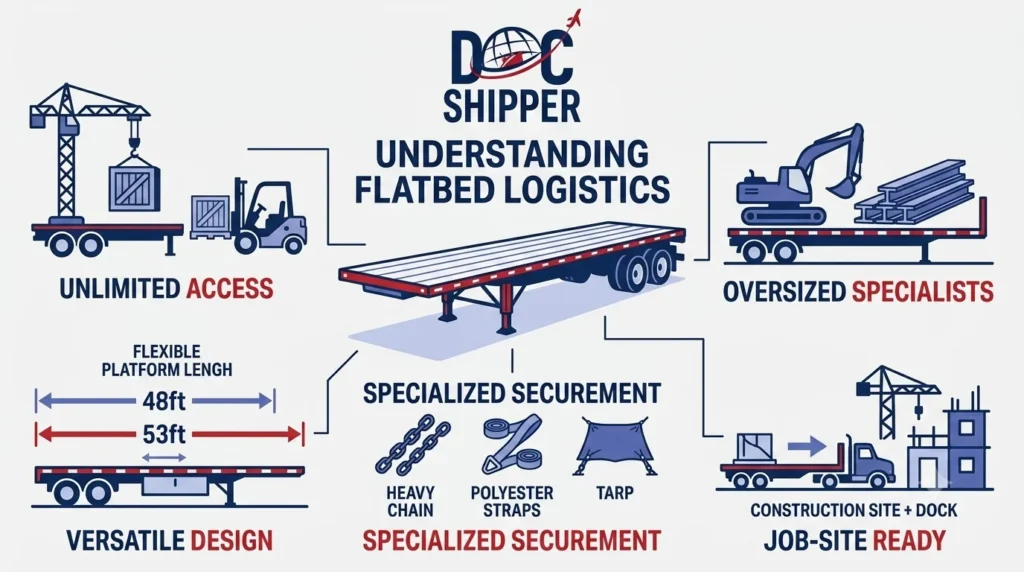
Key characteristics of flatbed transport include:
- Open platform design allowing top and side loading with cranes or forklifts
- Standard lengths ranging from 48 to 53 feet in North America, with extendable variants
- Weight capacity typically between 48,000 to 80,000 pounds depending on axle configuration
- Securement systems featuring D-rings, ratchet straps, and chains meeting DOT regulations
- Weather exposure requiring tarps or specialized covers for sensitive loads
Technical Specifications & Regulatory Framework
Flatbed operations are governed by strict dimensional and weight regulations. In the United States, the Federal Motor Carrier Safety Administration enforces standards for cargo securement under CFR Title 49, Part 393.
Standard flatbed dimensions measure 8.5 feet wide and 48-53 feet long. The deck height sits approximately 5 feet from ground level. These specifications accommodate most industrial equipment while remaining compliant with highway regulations.
Cargo securement requirements mandate a minimum of two tie-downs for articles 5 feet or shorter and one additional tie-down per 10 feet of length. Working load limits must be calculated based on cargo weight distribution. At DocShipper, we ensure all flatbed shipments meet both federal and state-specific securement standards before departure.
Permit considerations apply when loads exceed 8.5 feet width, 13.5 feet height, or 80,000 pounds gross weight. Oversize permits vary by state and require advance routing approval. Processing times range from 24 hours to several weeks depending on jurisdiction.
Specialized flatbed variants include step-deck trailers with lowered rear sections for tall cargo, double-drop trailers for extreme height constraints, and extendable flatbeds for exceptionally long items. Removable gooseneck (RGN) trailers offer ground-level loading for wheeled equipment.
International flatbed standards differ significantly from North American specifications. European flatbeds typically measure 13.6 meters (44.6 feet) with lower deck heights to accommodate roadway clearances. ISO standards govern container-compatible flatbeds for intermodal transport.
Practical Applications & Industry Data
Flatbed transport serves multiple industries with distinct loading requirements. Construction accounts for 42% of flatbed shipments, followed by manufacturing at 28% and agriculture at 15%, according to 2023 American Trucking Associations data.
Construction industry applications dominate flatbed usage. Steel I-beams measuring 60 feet require extendable trailers with pilot car escorts. Concrete forms, lumber bundles, and prefabricated building components utilize standard flatbeds with side stakes for containment.
| Cargo Type | Average Weight | Typical Dimensions | Flatbed Type |
|---|---|---|---|
| Steel Coils | 20,000-45,000 lbs | 72″ diameter × 60″ width | Standard with coil racks |
| Construction Equipment | 15,000-70,000 lbs | Varies by machinery | RGN or step-deck |
| Lumber Bundles | 40,000-48,000 lbs | 48′ length × 4′ width | Standard with stakes |
| Wind Turbine Blades | 25,000-35,000 lbs | 120-180 feet | Extendable multi-axle |
| Pipe Bundles | 30,000-45,000 lbs | 40-53 feet | Standard with bolsters |
Use Case: Heavy Machinery Transport
A manufacturer needs to ship a 55,000-pound CNC milling machine from Michigan to Texas. The equipment measures 18 feet long, 9 feet wide, and 11 feet tall. This requires a step-deck flatbed to maintain legal height limits. Total transport cost includes base rate ($3.50 per mile × 1,200 miles = $4,200), overwidth permit fees ($150-300 per state), and specialized loading equipment rental ($800). Total shipment cost: approximately $5,500-5,800 with 4-day transit time including permit processing.
Seasonal demand fluctuations significantly impact flatbed availability. Spring and summer months see capacity utilization rates exceeding 95% due to construction activity. Winter rates typically drop 15-20% as outdoor projects decline. Strategic shippers book flatbed capacity 2-3 weeks advance during peak seasons.
Cost comparison analysis reveals flatbed rates average 10-15% higher than dry van transport due to specialized handling requirements and reduced backhaul opportunities. However, flatbeds eliminate dimensional restrictions that would otherwise require expensive LTL or specialized carrier solutions.
Loading best practices include weight distribution centered over axles, securing cargo within the first 10 feet of travel, and using edge protectors on straps contacting sharp corners. DocShipper coordinates all loading operations to prevent damage and ensure compliance with carrier specifications.
Conclusion
Flatbed transport remains indispensable for oversized and heavy cargo across construction, manufacturing, and industrial sectors. Understanding dimensional limits, securement requirements, and regulatory frameworks ensures compliant and cost-effective shipping solutions.
Need expert assistance with flatbed logistics planning? Contact DocShipper for customized transport solutions tailored to your cargo specifications.
📚 Quiz
Test Your Knowledge: Flatbed Transport
What is the primary defining characteristic of a flatbed trailer?
According to federal regulations, what is the minimum number of tie-downs required for cargo measuring 15 feet in length?
A manufacturer needs to ship a machine measuring 9.5 feet wide. Which statement is correct?
🎯 Your Result
📞 Free Personalized QuoteFAQ | Flatbed: Definition, Uses & Practical Examples in Logistics
Standard flatbed trailers have a legal gross weight limit of 80,000 pounds in the United States, including the trailer's own weight (typically 15,000-18,000 pounds). Actual cargo capacity ranges from 48,000 to 65,000 pounds depending on tractor and trailer configuration. Heavier loads require specialized multi-axle trailers and overweight permits.
Irregularly shaped items require custom securement strategies using chains, straps, and blocking materials. Each tie-down must have a working load limit of at least 50% of the cargo weight being secured. Use dunnage lumber to prevent shifting, wrap sharp edges with protective materials, and document all securement points with photographs before transit.
A step-deck (also called drop-deck) trailer features a lowered rear deck approximately 3 feet below the front deck. This design reduces overall cargo height by 2-3 feet, allowing transport of taller items while remaining under the 13.5-foot legal height limit. Step-decks cost 5-10% more than standard flatbeds but eliminate overheight permit requirements for many loads.
Weather protection depends on cargo sensitivity. Steel, machinery, and equipment typically require tarping to prevent rust and corrosion. Treated lumber may ship uncovered. Tarping services add $100-300 to shipping costs depending on load size. Some carriers include basic tarping, while others charge separately. Always specify protection requirements when booking transport.
Standard flatbed bookings require 7-10 days notice during normal periods. Peak construction season (April-September) demands 14-21 days advance booking. Specialized equipment like RGN or multi-axle trailers may need 3-4 weeks lead time. Last-minute bookings incur premium rates of 20-40% above standard pricing.
Oversize permits are required when loads exceed 8.5 feet width, 13.5 feet height, 53 feet length, or 80,000 pounds weight. Each state issues its own permits with varying fees ($20-200 per state) and processing times (24 hours to 2 weeks). Super loads exceeding 12 feet width require route surveys and pilot car escorts.
Yes, flatbed chassis specifically designed for containers transport 20-foot, 40-foot, and 45-foot ISO containers. These skeletal trailers feature twist-lock mechanisms matching container corner castings. Container-on-flatbed (COFC) transport bridges ports to inland destinations lacking rail access. Standard flatbeds without container locks cannot legally haul containers on public roads.
Flatbeds accommodate forklifts (side loading), overhead cranes (top loading), and ramps (roll-on/roll-off). The deck height of 5 feet requires equipment with sufficient lift capacity. Some trailers feature removable side stakes or headboards. RGN trailers detach at the gooseneck, creating a ground-level ramp for self-propelled machinery.
Flatbed rates typically run 10-15% higher than dry van rates due to specialized handling and limited backhaul opportunities. National average flatbed rates range from $2.50-4.00 per mile depending on lane, season, and cargo. Oversized loads requiring permits add $500-2,000 to base costs. However, flatbeds eliminate dimensional surcharges charged by LTL carriers.
Construction leads flatbed utilization at 42% of shipments, transporting steel beams, lumber, and building materials. Manufacturing accounts for 28%, moving machinery and industrial equipment. Agriculture uses 15% for tractors and farm implements. Energy sector wind turbines and oil equipment comprise 8%. The remaining 7% covers miscellaneous oversized freight across various industries.
Federal bridge formula regulations mandate weight distribution across axle groups. No single axle can exceed 20,000 pounds, and tandem axles are limited to 34,000 pounds. Cargo must be centered over the trailer's axles with weight balanced side-to-side within 5% variance. Improper distribution causes handling issues and potential citations during roadside inspections.
Standard documentation includes bill of lading, commercial invoice, and packing list. Oversize loads require state-specific permits listing dimensions and weight. International shipments need customs declarations and potentially dangerous goods certificates if hauling machinery with fuel or hydraulic fluids. Photographic documentation of cargo securement protects against damage claims.
Need Help with
Logistics or Sourcing ?
First, we secure the right products from the right suppliers at the right price by managing the sourcing process from start to finish. Then, we simplify your shipping experience - from pickup to final delivery - ensuring any product, anywhere, is delivered at highly competitive prices.


Fill the Form
Prefer email? Send us your inquiry, and we’ll get back to you as soon as possible.
Contact us




