


In short ⚡
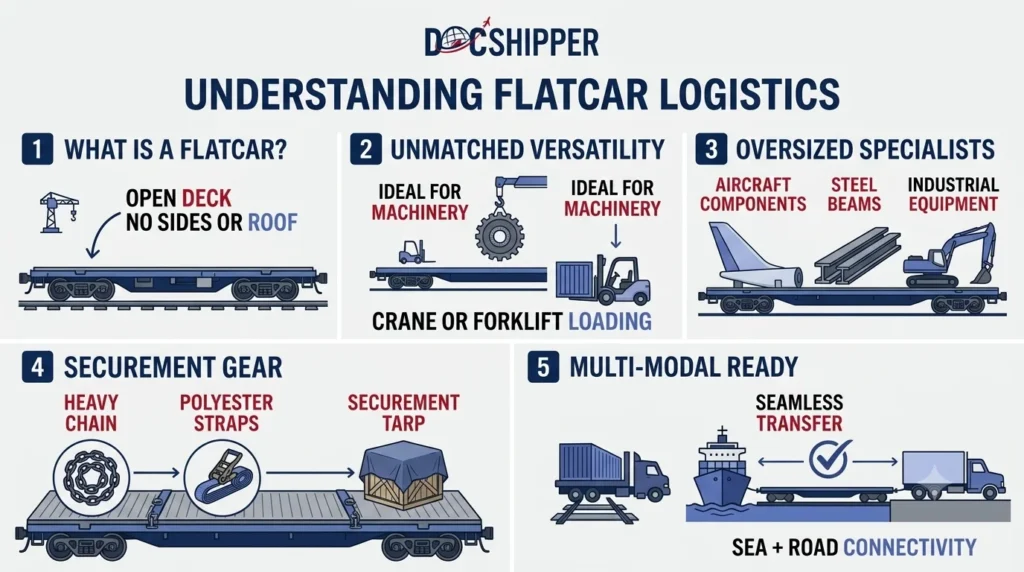
A flatcar is a specialized railcar with an open, flat deck without sides or roof, designed to transport oversized, heavy, or irregularly shaped cargo that cannot fit in standard enclosed freight cars. Extensively used in intermodal and industrial logistics, flatcars facilitate the movement of construction equipment, steel coils, containers, machinery, and other bulky freight across rail networks.
Introduction
Many importers and freight forwarders struggle to understand which rail equipment suits oversized cargo. Flatcars solve this challenge by offering an adaptable platform for shipments that exceed the dimensional constraints of boxcars or containers.
In international and domestic supply chains, flatcars serve as the backbone for transporting heavy industrial goods, construction materials, and intermodal containers. Their versatility makes them indispensable for projects requiring rapid deployment of large equipment or efficient cross-country rail transport.
Key characteristics include:
- Open deck design: No walls or roof, allowing unrestricted access for loading and unloading.
- Heavy-duty construction: Reinforced frames support weights typically ranging from 70 to 315 tons.
- Versatile securement options: Equipped with tie-down points, stakes, or bulkheads for cargo stabilization.
- Intermodal compatibility: Many flatcars feature corner castings for ISO container stacking.
- Specialized variants: Depressed-center, articulated, and idler flatcars address unique transport needs.
Technical Specifications & Operating Principles
Flatcars operate under strict engineering standards governed by organizations like the Association of American Railroads (AAR). Understanding their design parameters ensures compliance and operational safety.
Load capacity varies significantly. Standard flatcars handle 70 to 100 tons, while specialized heavy-duty models accommodate up to 315 tons for industrial machinery or military equipment. The deck length typically ranges from 40 to 89 feet, though articulated flatcars can extend beyond 200 feet for wind turbine blades or bridge girders.
Securing mechanisms include recessed pockets for lumber stakes, integrated bulkheads for pipe loads, and welded or bolted anchor points meeting AAR M-930 standards. Proper lashing and blocking prevent cargo shift during transit, a critical factor in preventing derailments.
The center of gravity must remain low and centered. Improper weight distribution can cause lateral instability at speeds exceeding 40 mph. Railway operators calculate load placement using the Load-to-Rail Distance (LRD) formula to ensure safe operation on curved tracks.
Intermodal flatcars feature corner castings that lock ISO containers in place. Double-stack configurations maximize efficiency on North American rail corridors, reducing per-unit transport costs by up to 40% compared to single-tier arrangements.
At DocShipper, we coordinate with rail carriers to select the appropriate flatcar type for oversized cargo, ensuring compliance with weight restrictions and securing requirements throughout the international shipping process. Our logistics experts verify dimensional compatibility before loading to prevent costly delays.
Practical Applications & Industry Data
Flatcars dominate specific freight segments where enclosed rail equipment proves impractical. Industry data reveals their critical role in modern supply chain infrastructure.
Use Case: Wind Turbine Components Transport
A renewable energy project in Texas required moving 80-meter wind turbine blades from a Gulf Coast port to installation sites 600 miles inland. Standard flatcars were inadequate; the shipper used articulated multi-unit flatcars capable of negotiating tight curves while supporting 40-ton loads distributed across three connected platforms. Transit time: 72 hours, avoiding costly road permits and highway closures.
Comparative Data: Flatcar vs. Alternative Rail Equipment
| Criteria | Flatcar | Boxcar | Gondola Car |
|---|---|---|---|
| Max Load Capacity | 315 tons (specialized) | 100 tons | 110 tons |
| Weather Protection | None (requires tarping) | Full enclosure | Sides only |
| Loading Method | Crane, forklift, overhead access | Side doors only | Top loading |
| Ideal Cargo | Machinery, containers, vehicles | Packaged goods, pallets | Coal, scrap metal, aggregates |
| Dimensional Flexibility | High (overhang permitted with permits) | Limited to door width | Medium (height restrictions) |
Industry Statistics
- Intermodal growth: 67% of North American rail container traffic moves on flatcars, according to 2023 AAR data.
- Cost efficiency: Rail flatcar transport costs $0.03–$0.05 per ton-mile, compared to $0.20–$0.30 for trucking.
- Environmental impact: Moving freight by rail reduces greenhouse gas emissions by 75% versus highway transport (EPA estimates).
- Equipment availability: North American flatcar fleet comprises approximately 240,000 units, with utilization rates fluctuating between 85–92% during peak seasons.
- Loading time: Standard flatcar loading averages 45–60 minutes for containerized cargo; heavy machinery may require 2–4 hours with specialized rigging.
Conclusion
Flatcars remain essential for moving oversized, heavy, and irregularly shaped cargo across rail networks. Their adaptable design, cost efficiency, and intermodal capabilities make them a cornerstone of modern logistics infrastructure.
Need assistance coordinating flatcar shipments or selecting the right rail equipment for your cargo? Contact DocShipper for expert guidance on international and domestic rail freight solutions.
📚 Quiz
Test Your Knowledge: Flatcar
What is the primary defining characteristic of a flatcar?
A logistics manager needs to transport 80-meter wind turbine blades that must navigate tight rail curves. Which flatcar type is most appropriate?
According to industry data, what percentage of North American rail container traffic moves on flatcars?
🎯 Your Result
📞 Free Quote in 24hFAQ | Flatcar: Definition, Technical Specifications & Practical Use Cases
The terms are often used interchangeably. However, some railway operators distinguish platform cars as having minimal side rails or stakes, whereas flatcars are completely open. Both serve similar functions in transporting oversized cargo.
Yes. Intermodal flatcars are specifically designed with corner castings and locking mechanisms to secure ISO containers. They can accommodate 20-foot, 40-foot, and 53-foot containers in single or double-stack configurations.
Standard flatcars handle 70 to 100 tons. Specialized heavy-duty flatcars, such as depressed-center models, can support up to 315 tons for industrial machinery, transformers, or military equipment.
Cargo is secured using chains, straps, or wire rope anchored to tie-down points on the deck. Blocking and bracing materials prevent lateral movement. Loads exceeding deck dimensions require special permits and may use overhang configurations with warning flags or lights.
Cargo requiring environmental protection from weather, theft, or contamination should use boxcars or covered hoppers. Flatcars are unsuitable for bulk liquids, fine powders, or temperature-sensitive goods unless specially equipped with tarps or climate control systems.
Flatcars are built to specific track gauges (standard, narrow, or broad). International shipments may require transloading at gauge-change points or using adjustable-wheelset flatcars in regions with multiple gauge systems, such as the Spain-France border.
Articulated flatcars consist of multiple connected units sharing bogies (wheel assemblies). This design distributes weight more evenly and allows navigation of tighter curves, making them ideal for transporting extra-long loads like bridge beams or wind turbine blades.
Depressed-center flatcars feature a lowered central deck section, allowing taller cargo to remain within railway clearance limits. Common uses include transporting transformers, generators, and other high-profile industrial equipment.
Transit times depend on distance and routing. Cross-country shipments in North America average 5–7 days for 2,000 miles. Intermodal flatcar movements may include drayage delays at terminals, adding 1–2 days to total delivery time.
Yes. Cargo on flatcars faces higher exposure to weather and theft. Shippers typically purchase all-risk cargo insurance covering transit damage, with additional riders for high-value machinery or equipment. Rail carriers provide limited liability based on weight, not cargo value.
Flatcars can transport vehicles, but autorack cars (enclosed multi-level rail cars) are preferred for finished automobiles. Flatcars are suitable for construction vehicles, military equipment, or oversized vehicles that cannot fit in autoracks.
Required documents include a rail waybill, bill of lading, dimensional weight certificates, and securing diagrams. Oversized loads need special movement permits. International shipments require customs declarations, certificates of origin, and compliance with railway-specific safety standards.
Need Help with
Logistics or Sourcing ?
First, we secure the right products from the right suppliers at the right price by managing the sourcing process from start to finish. Then, we simplify your shipping experience - from pickup to final delivery - ensuring any product, anywhere, is delivered at highly competitive prices.


Fill the Form
Prefer email? Send us your inquiry, and we’ll get back to you as soon as possible.
Contact us




