


In short ⚡
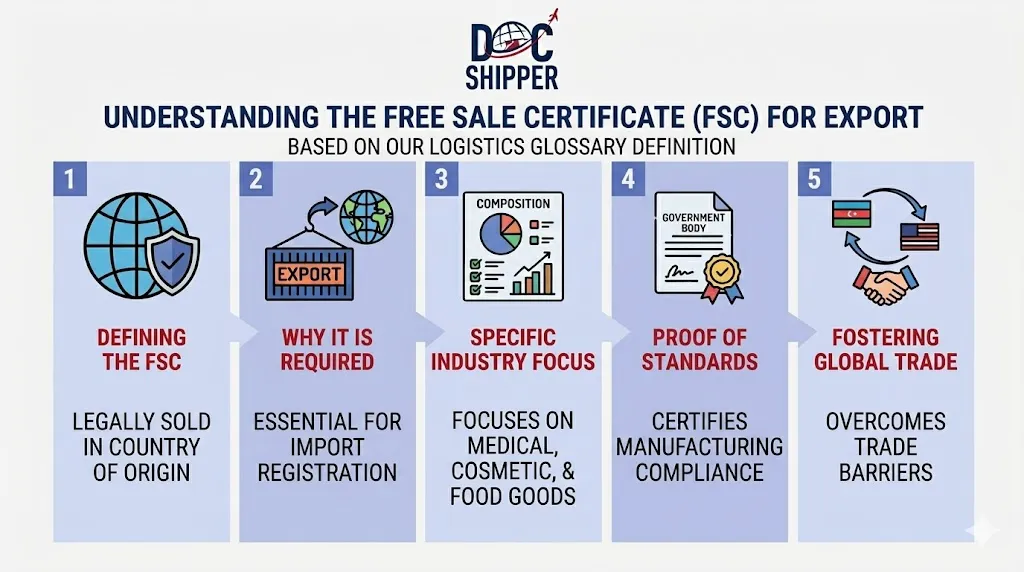
A Free Sale Certificate is an official document issued by a competent authority confirming that a product is legally sold and distributed in the country of origin without restrictions. This certificate is commonly required for exporting pharmaceuticals, cosmetics, medical devices, and food supplements to verify compliance with local regulations before market entry abroad.Introduction
International trade in regulated products faces a persistent challenge: how can importing countries verify product safety without direct access to exporting nations’ regulatory databases? Many exporters discover only at customs clearance that their shipment requires documentation they’ve never heard of, causing costly delays.
The Free Sale Certificate addresses this gap by providing internationally recognized proof of regulatory compliance. Originally developed for pharmaceutical exports, this document now serves as essential validation across multiple industries where consumer safety is paramount.
Key characteristics of Free Sale Certificates include:
- Regulatory confirmation that products meet origin country standards
- Market access facilitation for controlled substances and regulated goods
- Third-party verification from governmental or certified authorities
- Time-limited validity typically ranging from 12 to 24 months
- Product-specific issuance requiring separate certificates per item category
Regulatory Framework & Export Requirements
The Free Sale Certificate operates within complex international regulatory frameworks. Unlike general commercial documents, this certificate requires competent authority endorsement—typically health ministries, pharmaceutical boards, or designated regulatory agencies in the exporting country.
The certificate confirms unrestricted market status, meaning the product is not banned, withdrawn, or subject to special limitations in its home market. This distinction is critical: products under investigation or with conditional approval cannot obtain valid Free Sale Certificates.
For pharmaceutical exports, the World Health Organization (WHO) certification scheme provides standardized formats recognized by over 100 countries. However, requirements vary significantly by destination. Some nations accept Chamber of Commerce certification, while others demand direct governmental issuance.
The documentation process involves several verification layers. Manufacturers must demonstrate Good Manufacturing Practice (GMP) compliance, provide product registration details, and submit analytical reports proving specifications match approved formulations. For medical devices, additional ISO 13485 certification may be required before authorities issue the Free Sale Certificate.
Processing times range from 5 to 30 business days depending on jurisdiction and product complexity. At DocShipper, we coordinate directly with regulatory authorities to streamline certification timelines and ensure all supporting documentation meets specific destination country requirements.
Important distinctions exist between Free Sale Certificates and similar documents. A Certificate of Pharmaceutical Product (CPP) follows WHO standards and includes manufacturing site details, while a Free Sale Certificate may be simpler but equally valid for certain destinations. Some countries accept self-certification for cosmetics, whereas pharmaceuticals universally require governmental endorsement.
Practical Applications & Industry Data
Understanding certificate requirements across industries reveals practical implementation challenges and opportunities. The following comparison illustrates sector-specific certification patterns that exporters encounter:
| Product Category | Issuing Authority | Typical Validity | Average Processing Time |
|---|---|---|---|
| Pharmaceuticals | National Health Ministry | 24 months | 15-30 days |
| Cosmetics | Health Authority / Chamber | 12-24 months | 7-15 days |
| Medical Devices | Medical Device Agency | 24 months | 20-30 days |
| Dietary Supplements | Food Safety Authority | 12 months | 10-20 days |
| Veterinary Products | Veterinary Regulatory Body | 24 months | 15-25 days |
Use Case: European Cosmetic Exporter to UAE
A French manufacturer exporting anti-aging creams to Dubai requires Free Sale Certificates for each product SKU. The UAE’s Ministry of Health requires governmental certification—Chamber of Commerce validation is insufficient. The exporter obtains certificates from France’s ANSM (National Agency for Medicines Safety), each valid 24 months.
Documentation includes: product composition, manufacturing facility inspection reports, and proof the product is sold freely in France. Total cost per certificate: €250-400. Processing time: 12 business days. The certificates enable customs clearance and MOHAP registration in Dubai within 45 days, compared to 90+ days without proper documentation.
Industry data reveals significant variations in certification acceptance. According to 2023 trade compliance surveys, 68% of pharmaceutical shipments to Middle Eastern countries require Free Sale Certificates, while only 23% of cosmetic exports to European destinations demand such documentation. African markets show the highest requirement rate at 71% across all regulated product categories.
Key implementation points for exporters:
- Proactive certification reduces shipment delays by average 18 days
- Multi-product applications can reduce per-unit costs by 30-40%
- Digital certificates now accepted by 15+ countries, accelerating verification
- Re-certification planning prevents gaps when validity expires during transit
- Destination-specific formats may require apostille or embassy legalization
DocShipper’s regulatory compliance team maintains updated databases of destination-country requirements, ensuring exporters obtain correctly formatted certificates before shipment departure. This proactive approach eliminates the common scenario where goods arrive but cannot clear customs due to missing or improperly formatted documentation.
Conclusion
The Free Sale Certificate serves as critical verification infrastructure for international trade in regulated products, transforming complex regulatory compliance into standardized documentation. Understanding issuing authorities, validity periods, and destination requirements prevents costly delays and ensures smooth market access.
Need assistance navigating Free Sale Certificate requirements for your specific products and destinations? Contact DocShipper for expert guidance on regulatory compliance and certification coordination.
📚 Quiz
Test Your Knowledge: Free Sale Certificate
What is the primary purpose of a Free Sale Certificate?
Can manufacturers issue their own Free Sale Certificates for export shipments?
A European cosmetics exporter discovers their shipment to Dubai is held at customs due to missing documentation. What should have been obtained before shipment?
🎯 Your Result
📞 Free Quote in 24hFAQ | Free Sale Certificate: Definition, Purpose & Practical Examples
Need Help with
Logistics or Sourcing ?
First, we secure the right products from the right suppliers at the right price by managing the sourcing process from start to finish. Then, we simplify your shipping experience - from pickup to final delivery - ensuring any product, anywhere, is delivered at highly competitive prices.


Fill the Form
Prefer email? Send us your inquiry, and we’ll get back to you as soon as possible.
Contact us




