


In short ⚡
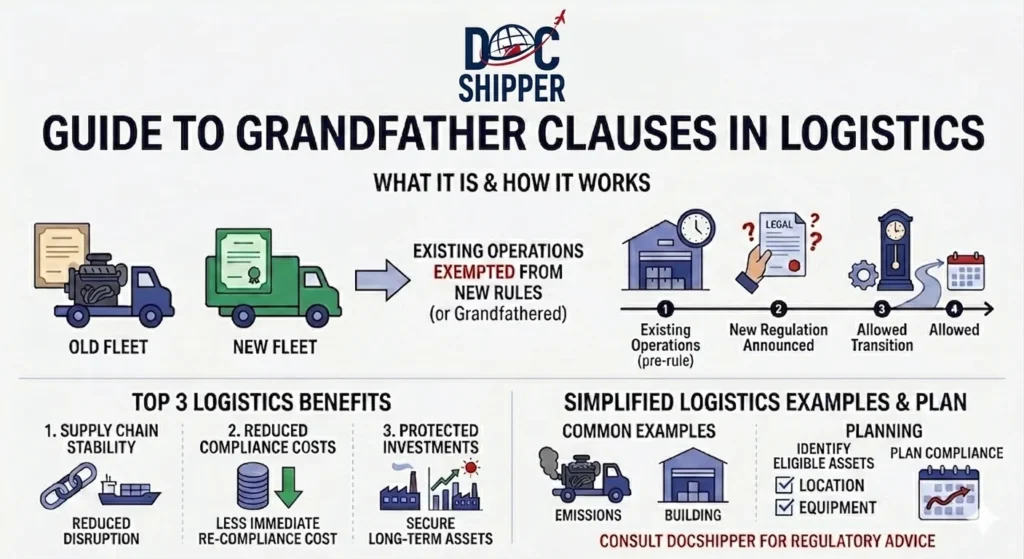
A Grandfather Clause is a regulatory provision that allows existing entities, products, or practices to continue operating under old rules when new regulations are implemented. This legal mechanism exempts previously compliant businesses from stricter requirements, preventing retroactive enforcement while gradually transitioning the market toward updated standards. In international trade, it ensures continuity during customs, safety, or environmental regulatory changes.
Introduction
When new trade regulations emerge, businesses face a critical question: do existing operations immediately fall under the new rules? The uncertainty creates massive compliance burdens and potential operational disruptions.
Grandfather clauses solve this problem by establishing transition periods. They protect investments made in good faith under previous regulations while allowing authorities to implement stricter standards progressively.
This mechanism is particularly vital in international logistics where:
- Equipment investments span decades (shipping containers, warehouse facilities)
- Multi-year contracts depend on stable regulatory frameworks
- Certification processes require substantial time and capital
- Supply chain continuity cannot tolerate sudden compliance disruptions
- Cross-border operations involve multiple jurisdictions with varying timelines
Legal Mechanisms & Trade Implications
Grandfather clauses function through temporal exemptions that distinguish between pre-existing and new market participants. Authorities typically issue these provisions when updating safety standards, environmental protocols, or customs procedures.
The scope of protection varies significantly across jurisdictions. Some clauses apply indefinitely, while others establish sunset periods requiring eventual compliance. The European Union’s REACH regulation, for example, grandfathered existing chemical substances while requiring full registration for new entries.
In customs law, preferential treatment rights often include grandfather mechanisms. When free trade agreements evolve, businesses may retain previous tariff benefits for goods already in transit or under contract. The USMCA preserved certain NAFTA provisions during its implementation phase.
The documentation burden proves critical for claiming exemptions. Companies must demonstrate pre-regulation compliance through manufacturing dates, purchase records, or certification timestamps. At DocShipper, we systematically archive compliance documentation to protect clients during regulatory transitions.
Limitations and exclusions apply when public safety concerns override continuity interests. Food safety violations, hazardous material risks, or security threats typically void grandfather protections. The WTO SPS Agreement establishes frameworks balancing trade continuity with health protection.
Practical Examples & Industry Data
Understanding how grandfather clauses operate requires examining real-world applications across different trade sectors and regulatory changes.
Case Study: IMO 2020 Sulfur Cap Regulation
When the International Maritime Organization implemented the 0.50% sulfur limit for marine fuels in 2020, vessels using scrubber technology received partial grandfathering. Ships already equipped with exhaust gas cleaning systems could continue burning high-sulfur fuel while meeting emission standards.
Financial impact breakdown:
- Scrubber-equipped vessels: Operating cost increase of 15-20% versus previous regulations
- Non-compliant vessels: Required fuel switch with 40-60% cost increase
- Retrofit investment: $2-5 million per vessel avoided through grandfathering
- Compliance timeline: Immediate versus 3-5 year transition period
Comparative Analysis: Packaging Regulations
| Jurisdiction | New Requirement | Grandfather Period | Stock Exemption |
|---|---|---|---|
| EU Single-Use Plastics Directive | Ban on certain plastic products | 18 months post-directive | Inventory manufactured before July 2021 |
| California Prop 65 | Warning label requirements | 12 months notification period | Products shipped before effective date |
| India BIS Certification | Mandatory quality marks | 6 months transition | No stock exemption |
| Australia Therapeutic Goods | Updated labeling standards | 24 months phased approach | Existing stock until exhausted |
Customs Valuation Scenario
When the U.S. updated Section 301 tariff lists on Chinese goods, exclusion processes created grandfather-like protections. Products shipped before exclusion expiration dates maintained duty-free status even if they arrived post-deadline.
Key operational considerations:
- Bill of lading date determines regulatory applicability, not arrival date
- Post-clearance audits may challenge grandfather claims years later
- Product modification can void exemption status under “substantial transformation” rules
- Documentation retention requirements extend 5-7 years minimum
- Periodic re-certification may apply even with grandfather status
DocShipper helps clients navigate these complex timelines by monitoring regulatory changes and establishing compliance documentation protocols before new rules take effect.
Conclusion
Grandfather clauses represent essential transition mechanisms balancing regulatory modernization with business continuity. Understanding their application prevents costly compliance errors while maximizing operational flexibility during regulatory changes.
Need strategic guidance on navigating upcoming regulatory transitions? Contact DocShipper for expert compliance support across all major trade jurisdictions.
📚 Quiz
Test Your Knowledge: Grandfather Clause
What is the primary purpose of a grandfather clause in international trade regulations?
A company has inventory manufactured before a new tariff regulation took effect. Which factor is MOST critical for claiming grandfather clause benefits?
A shipping company with vessels using scrubber technology received partial grandfather status under IMO 2020 sulfur regulations. They now want to modify their vessels' engine systems. What is the likely impact on their grandfather protection?
🎯 Your Result
📞 Free Quote in 24hFAQ | Grandfather Clause: Definition, Application & Concrete Examples in International Trade
A grandfather clause provides indefinite or long-term exemption for pre-existing entities from new regulations, while transitional provisions establish temporary compliance timelines requiring eventual full adherence. Grandfather clauses protect past investments; transitional provisions mandate future compliance with delayed enforcement.
Yes. Protection typically ends when significant modifications occur to the grandfathered product or operation. Substantial changes triggering new regulatory classification, ownership transfers not included in the original exemption, or deliberate non-compliance with original standards can void protection. Material alterations reset the compliance clock.
Inventory manufactured or purchased before tariff increases may qualify for previous duty rates if shipped within specified timeframes. However, customs authorities require proof of manufacture date through production records, purchase orders, or certification. Simply holding old inventory doesn't guarantee exemption—documentation proving pre-regulation status is essential for duty relief claims.
No universal recognition exists. While common in developed markets with established legal traditions, some jurisdictions apply immediate enforcement regardless of previous compliance. The WTO framework encourages reasonable transition periods but doesn't mandate specific grandfather mechanisms. Always verify local implementation when regulations change.
Critical documents include manufacturing certificates with production dates, original purchase invoices, customs entry records proving importation before regulation changes, quality certifications issued under previous standards, and maintenance logs showing continuous operation. Digital timestamping and blockchain verification increasingly support authentication in disputes.
Duration varies widely. Permanent exemptions exist for certain infrastructure investments, while consumer goods often receive 12-36 month transitions. High-risk categories like pharmaceuticals or food rarely exceed 24 months. Environmental regulations increasingly limit grandfather periods to encourage rapid modernization, particularly in emissions-sensitive sectors.
Both qualify. Service providers operating under previous licensing regimes often receive grandfather status when professional requirements change. Cross-border data transfer regulations, financial service authorizations, and professional certifications commonly include grandfather mechanisms. However, service exemptions typically require continuous operation without substantial business model changes.
Post-expiration stock faces full compliance requirements. Businesses must either destroy non-compliant inventory, export to markets accepting previous standards, or invest in bringing products into compliance. No grace periods typically apply—the deadline is absolute. Strategic inventory management during transition periods prevents costly write-offs.
Not automatically. While major agreements like USMCA included transition mechanisms, smaller bilateral modifications may apply immediately. The inclusion depends on negotiated terms, industry lobbying, and economic impact assessments. Companies should engage trade associations during FTA renegotiations to advocate for reasonable transition periods.
Regulatory exemption doesn't eliminate liability exposure. Products compliant under old standards but defective under new safety knowledge may still trigger lawsuits. Courts increasingly apply modern safety expectations regardless of grandfather status. Manufacturers must balance cost savings from exemptions against potential liability risks.
Yes, and sometimes strategically advantageous. Early compliance provides marketing benefits ("exceeds current standards"), avoids future retrofit costs, and prevents competitive disadvantages when exemptions expire. Voluntary upgrades may also qualify for government incentives or preferential procurement treatment unavailable to grandfather-protected competitors.
They balance ecological goals with economic realities. Carbon border adjustment mechanisms, single-use plastic bans, and energy efficiency standards typically grandfather existing operations while requiring new entrants to meet stricter criteria. However, environmental grandfather periods trend shorter than commercial ones, reflecting urgency around climate targets and pollution reduction.
Need Help with
Logistics or Sourcing ?
First, we secure the right products from the right suppliers at the right price by managing the sourcing process from start to finish. Then, we simplify your shipping experience - from pickup to final delivery - ensuring any product, anywhere, is delivered at highly competitive prices.


Fill the Form
Prefer email? Send us your inquiry, and we’ll get back to you as soon as possible.
Contact us




