


In short ⚡
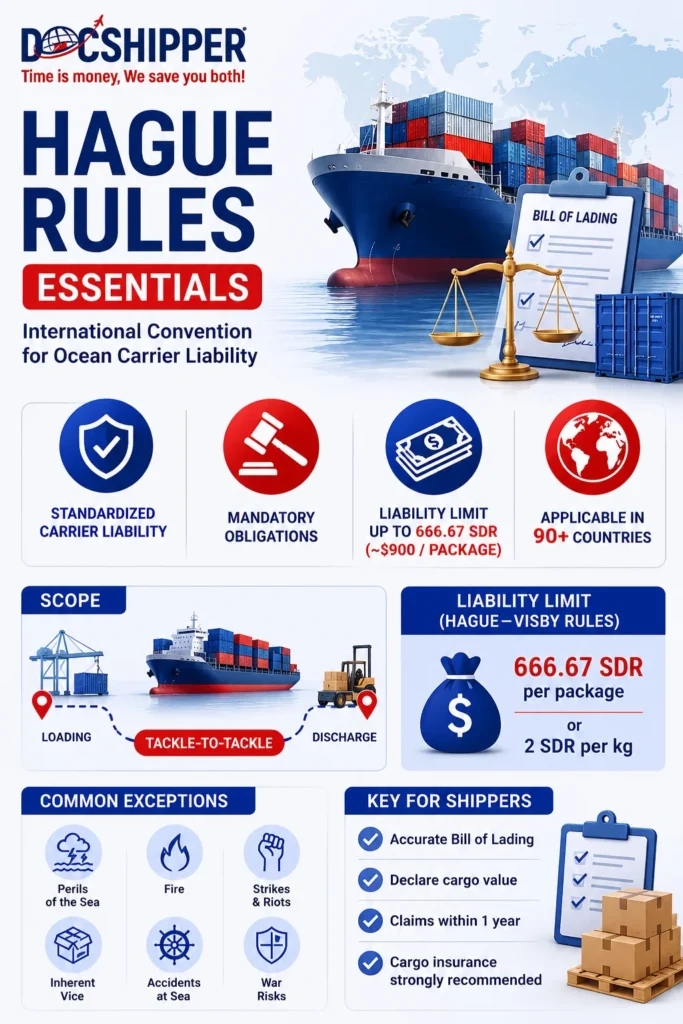
The Hague Rules are an international convention established in 1924 that standardized carrier liability for cargo damage during sea transport. Officially titled the "International Convention for the Unification of Certain Rules of Law relating to Bills of Lading," these rules established minimum obligations for ocean carriers and defined liability limits for loss or damage to goods transported under bills of lading.
Introduction
Why do some shipping claims succeed while others fail? The confusion often stems from misunderstanding which liability regime governs the cargo. Before the Hague Rules, ocean carriers faced unlimited liability in some jurisdictions and minimal responsibility in others, creating chaos in international trade.
The 1924 Brussels Convention (Hague Rules) revolutionized maritime law by establishing a balanced framework between shipper and carrier rights. Though superseded in many countries by the Hamburg Rules (1978) and Rotterdam Rules (2009), the Hague Rules—and their amended version (Hague-Visby Rules, 1968)—remain applicable in over 90 countries.
Understanding this convention is crucial for:
- Determining carrier liability limits when cargo damage occurs during ocean transport
- Identifying mandatory responsibilities carriers cannot contractually waive
- Understanding Bill of Lading clauses that reference “Hague Rules paramount”
- Calculating maximum compensation available under the convention’s financial caps
- Recognizing jurisdiction conflicts when different countries apply different rules
Legal Framework & Carrier Obligations
The Hague Rules established a duty of care framework that fundamentally altered maritime commerce. Unlike pre-1924 practice where carriers could exclude virtually all liability through bill of lading clauses, the convention imposed non-waivable obligations.
The cornerstone principle is seaworthiness. Article III mandates that carriers must exercise due diligence to make the vessel seaworthy before and at the beginning of the voyage. This includes ensuring proper manning, equipment, supplies, and cargo space fitness. Importantly, this obligation cannot be contractually eliminated or reduced.
Regarding cargo care, carriers must properly load, handle, stow, carry, keep, care for, and discharge goods (Article III, Rule 2). However—and this is critical—the Rules provide seventeen specific exceptions to liability, including perils of the sea, fire (unless caused by carrier fault), strikes, riots, and inherent vice of goods.
The financial liability cap represents another fundamental aspect. Under the original Hague Rules, carriers’ liability was limited to £100 per package or unit. The Hague-Visby amendments (1968) updated this to 666.67 Special Drawing Rights (SDR) per package or 2 SDR per kilogram, whichever is higher. As of 2024, this translates to approximately $900-$1,200 per package depending on SDR exchange rates.
A crucial limitation exists regarding temporal scope. The Hague Rules apply exclusively from loading to discharge—the “tackle-to-tackle” period. Damage occurring during inland transport, warehousing, or port storage falls outside the convention’s protection. At DocShipper, we systematically verify which liability regime applies to each shipment segment, ensuring our clients understand coverage gaps and can obtain appropriate cargo insurance.
The Rules also introduced mandatory bill of lading requirements. Article III, Rule 3 specifies that carriers must issue a bill of lading showing marks, number of packages, quantity or weight, and apparent condition of goods. This created enforceable documentation standards that remain foundational to modern documentary credit practices.
Practical Applications & Case Examples
Understanding how the Hague Rules function in real scenarios clarifies their practical impact on international trade. Consider the jurisdictional complexity alone: different countries apply different versions of these rules, creating significant variance in liability exposure.
| Jurisdiction | Applicable Regime | Liability Limit (per package) | Scope Coverage |
|---|---|---|---|
| United States | COGSA (Hague Rules based) | $500 | Tackle-to-tackle |
| UK, France, Netherlands | Hague-Visby Rules | 666.67 SDR (~$900) | Loading to discharge |
| China (export) | Hague-Visby Rules | 666.67 SDR | Port-to-port |
| Singapore | Hague-Visby Rules | 666.67 SDR or 2 SDR/kg | Tackle-to-tackle |
Case Example 1: Package Definition Dispute
A German exporter shipped machinery to Australia in a container with 15 crates. Water damage occurred during transit. The carrier argued the container constituted one “package” (liability: ~$900), while the shipper claimed each crate was a package (liability: ~$13,500). Courts applying Hague-Visby Rules typically rule that enumerated units on the bill of lading determine package count. Outcome: 15 packages recognized, higher compensation awarded.
Case Example 2: Seaworthiness Failure
Electronics valued at $250,000 were damaged when a vessel’s refrigeration system failed due to improper maintenance. Despite a “fire exception” clause in the bill of lading, the shipper successfully claimed $180,000 (actual value minus deductible) because the carrier failed the non-delegable duty to provide a seaworthy vessel. The Hague Rules’ seaworthiness requirement overrode the exception clause.
Key Practical Considerations:
- Declare high-value cargo: Hague Rules allow shippers to declare value exceeding package limits, obligating carriers to accept higher liability
- Bill of lading accuracy: Discrepancies between declared and actual cargo can void Hague Rules protections entirely
- One-year time bar: Claims must be filed within one year of delivery or scheduled delivery date
- Notice requirements: Written notice of damage must be given within 3 days (visible damage) or at delivery (concealed damage)
- Insurance necessity: Given low liability limits, comprehensive marine cargo insurance remains essential for valuable shipments
DocShipper routinely encounters scenarios where understanding these nuances prevents significant financial exposure. When managing a client’s $500,000 pharmaceutical shipment, we ensured value declaration on the bill of lading, bypassing the standard package limitation and securing appropriate carrier liability coverage.
Conclusion
The Hague Rules established the foundation of modern maritime liability law, balancing carrier and shipper interests through standardized obligations and limited financial exposure. Despite being nearly a century old, these principles continue governing billions of dollars in ocean cargo annually, making their comprehension essential for anyone involved in international goods movement.
Need expert guidance navigating maritime liability complexities or optimizing your shipping documentation? Contact DocShipper for comprehensive freight forwarding and customs compliance support.
📚 Quiz
Test Your Knowledge: Hague Rules
What is the primary scope of the Hague Rules?
Can ocean carriers contractually eliminate their seaworthiness obligations under the Hague Rules?
A container with 20 enumerated crates suffers water damage during ocean transport. Under Hague-Visby Rules, how should liability limits be calculated?
🎯 Your Results
📞 Free Quote in 24hFAQ | Hague Rules: Definition, Scope & Practical Applications in International Shipping
The Hague-Visby Rules (1968) are amendments to the original 1924 Hague Rules. Key differences include increased liability limits (from £100 to 666.67 SDR per package), addition of container clauses defining "package," and weight-based alternative limits (2 SDR/kg). The Hague-Visby version also clarified carrier liability for deck cargo and modified the burden of proof in certain damage scenarios. Approximately 30 countries apply original Hague Rules, while over 60 apply the Visby amendments.
No. The Hague Rules exclusively govern sea carriage under bills of lading. Air freight is regulated by the Montreal Convention (1999), which replaced the Warsaw Convention. Road transport in Europe follows the CMR Convention, while rail transport uses the COTIF/CIM regime. Multimodal transport may involve multiple conventions depending on the loss occurrence location, making documentation review critical.
Partially. Carriers cannot waive core obligations like seaworthiness or proper cargo care. However, they can invoke the seventeen statutory exceptions (perils of the sea, fire, etc.) and enforce liability limits. Clauses attempting to eliminate fundamental duties are void under Article III, Rule 8. Higher liability can only be established through shipper's declared value or separate agreement, not through general bill of lading terms.
The original Hague Rules didn't clearly define "package," creating decades of litigation. Hague-Visby Rules addressed this: for containerized cargo, each enumerated unit listed on the bill of lading constitutes a package. If goods are consolidated without individual enumeration, the container itself may be considered one package. US COGSA follows similar principles. Courts generally interpret "package" based on shipping industry customs and bill of lading descriptions.
Hague Rules require written notice of loss or damage within three days of delivery for visible damage. For concealed damage, notice must be given "at the time of removal of goods" or "at the latest at the time of delivery." Failure to provide timely notice creates a presumption that goods were delivered as described in the bill of lading, significantly weakening claim prospects. One-year absolute time bar applies regardless.
Absolutely. The Rotterdam Rules (2009) have only been ratified by five countries and are not yet in force. The Hamburg Rules (1978), which succeeded Hague, apply in about 34 countries but never gained widespread adoption. The vast majority of international ocean shipments remain governed by either original Hague Rules or Hague-Visby amendments, making them the practical standard for maritime liability worldwide.
It depends on your relationship to the cargo. Hague Rules create contractual obligations between the carrier and shipper. However, bill of lading holders (consignees or endorsees) acquire rights as third-party beneficiaries. Notify parties without holding the bill of lading typically cannot sue under the convention. Jurisdiction and local maritime law significantly influence standing to bring claims, particularly regarding charterers, freight forwarders, and cargo insurers exercising subrogation rights.
Under Hague-Visby: multiply the number of packages by 666.67 SDR, or multiply total weight in kilograms by 2 SDR, then use whichever amount is higher. Convert SDR to your currency using IMF exchange rates. Under US COGSA: multiply packages by $500. For the original Hague Rules: multiply by £100. If your cargo value exceeds these limits, declare higher value on the bill of lading before shipment or ensure comprehensive marine insurance coverage.
This defines the temporal scope of Hague Rules application. Coverage begins when cargo passes the ship's rail during loading (when tackle—lifting equipment—engages) and ends when it passes the ship's rail during discharge. Damage occurring during inland transport, port warehousing, or container freight station handling falls outside the convention's protection. The Hamburg and Rotterdam Rules expanded this to "port-to-port" and "door-to-door" respectively, but Hague Rules maintain the narrower scope.
This depends on several factors: port of loading, port of discharge, carrier domicile, choice of law clauses in the bill of lading, and cargo insurance terms. Generally, the law of the discharge port or the carrier's principal place of business governs. Bills of lading often contain "Hague-Visby Rules paramount" or similar clauses specifying the applicable regime. Conflicts can arise when different jurisdictions would apply different versions, requiring legal analysis of connecting factors.
No. Article IV, Rule 5 of the Hague Rules specifically denies carriers the benefit of liability limitations when loss results from "act or omission done with intent to cause damage, or recklessly and with knowledge that damage would probably result." This mirrors concepts of "actual fault or privity" in common law and "faute lourde" in civil law systems. Proving such conduct requires demonstrating conscious disregard for consequences, a high evidentiary threshold.
Marine cargo insurance typically provides "all risks" coverage far exceeding Hague Rules liability limits. When insurers pay claims, they acquire subrogation rights to pursue carriers under the applicable liability regime. The interplay creates a practical system: shippers obtain full value compensation from insurers, who then recover limited amounts from carriers under Hague Rules. This structure explains why comprehensive cargo insurance remains essential despite carrier liability—the rules provide minimal, not complete, protection.
Need Help with
Logistics or Sourcing ?
First, we secure the right products from the right suppliers at the right price by managing the sourcing process from start to finish. Then, we simplify your shipping experience - from pickup to final delivery - ensuring any product, anywhere, is delivered at highly competitive prices.


Fill the Form
Prefer email? Send us your inquiry, and we’ll get back to you as soon as possible.
Contact us




