


In short ⚡
A harbor is a sheltered body of water where ships, boats, and barges can dock safely to load and unload cargo or passengers. It provides protection from waves, currents, and weather conditions, serving as a critical node in the global supply chain. Harbors can be natural formations or artificially constructed ports equipped with terminals, warehouses, and customs facilities essential for international trade.
Introduction
Many businesses underestimate the complexity behind choosing the right harbor for their import/export operations. The difference between a deep-water port and a river harbor can impact transit times, handling costs, and even customs processing efficiency. Understanding harbor classifications is fundamental to optimizing your international logistics strategy.
Harbors serve as the primary gateways for over 80% of global merchandise trade by volume. They connect maritime shipping routes with inland transportation networks—rail, road, and air. The strategic selection of a harbor affects freight costs, delivery schedules, and compliance with international regulations.
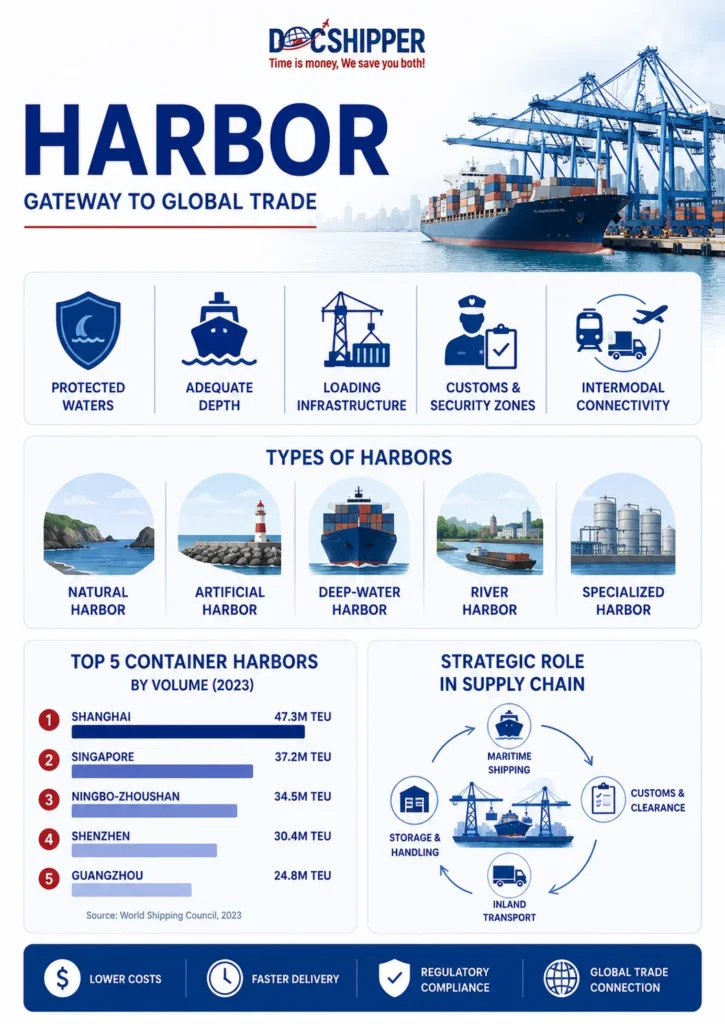
Key characteristics that define a functional harbor include:
Protected waters: Natural or artificial barriers shielding vessels from harsh sea conditions
Adequate depth: Minimum draft requirements to accommodate modern container ships and bulk carriers
Loading infrastructure: Cranes, gantries, warehouses, and refrigerated storage facilities
Customs and security zones: Designated areas for inspection, documentation processing, and duty collection
Intermodal connectivity: Direct access to highways, railways, and sometimes airports for efficient cargo distribution
Harbor Infrastructure & Operational Mechanisms
Modern harbors operate as complex ecosystems integrating physical infrastructure, regulatory frameworks, and digital management systems. The efficiency of a harbor directly impacts dwell time—the period cargo remains at the port before onward transport. Reducing dwell time minimizes storage fees and accelerates supply chain velocity.
Harbor operations involve several specialized zones. The berth area is where vessels moor alongside quays equipped with loading equipment. The container yard temporarily stores standardized shipping containers before road or rail transfer. Bulk cargo harbors feature dedicated silos and conveyor systems for commodities like grain, coal, or minerals.
From a regulatory perspective, harbors must comply with International Ship and Port Facility Security (ISPS) Code standards, ensuring protection against terrorism and smuggling. Customs authorities operate within harbor boundaries, conducting pre-clearance inspections to verify cargo declarations against physical shipments. According to the UNCTAD Review of Maritime Transport, efficient customs procedures at harbors can reduce clearance times by up to 40%.
The harbor master coordinates vessel traffic, assigns berthing slots, and enforces safety protocols. Pilotage services guide large ships through narrow channels or congested waters. Tugboats assist in maneuvering vessels into docking positions, particularly important for ships with limited maneuverability.
Environmental considerations increasingly shape harbor operations. Green harbor initiatives include shore power connections reducing shipboard emissions, wastewater treatment facilities, and noise mitigation during nighttime operations. The European Union’s Maritime Spatial Planning Directive mandates sustainable use of harbor zones to balance commercial activities with ecological preservation.
At DocShipper, we systematically evaluate harbor capabilities before routing shipments. Our logistics coordinators verify draft restrictions, available equipment, and peak congestion periods to ensure your cargo moves through the most efficient gateway. This strategic harbor selection prevents costly delays and demurrage charges.
Types of Harbors & Trade Volume Data
Harbors are classified by their geographic formation, purpose, and handling capacity. Understanding these distinctions helps importers and exporters select the optimal port for their specific cargo type and destination.
| Harbor Type | Characteristics | Typical Cargo | Example |
|---|---|---|---|
| Natural Harbor | Formed by geographic features (bays, inlets); minimal human construction | General cargo, containers | Sydney Harbor, Australia |
| Artificial Harbor | Built with breakwaters, dredging, reclaimed land | Containers, bulk, Ro-Ro | Port of Rotterdam, Netherlands |
| Deep-Water Harbor | Depth >15 meters; accommodates Ultra Large Container Vessels (ULCV) | Containers, crude oil | Port of Shanghai, China |
| River Harbor | Located on inland waterways; limited draft | Agricultural products, machinery | Port of Duisburg, Germany |
| Specialized Harbor | Purpose-built for specific cargo (LNG, grain, vehicles) | Liquefied gas, automobiles | Port of Bremerhaven, Germany |
Case Study: Container Harbor Capacity
Consider a European importer receiving 500 TEU (Twenty-foot Equivalent Units) of electronics monthly from Asia. Routing through the Port of Hamburg (Germany) versus the Port of Antwerp (Belgium) yields different cost-time profiles:
- Hamburg: Average dwell time 3.2 days, rail connectivity to Southern Germany within 18 hours, handling fee €85/TEU
- Antwerp: Average dwell time 2.8 days, superior road network to France/Netherlands, handling fee €78/TEU
For this scenario, Antwerp offers 12% lower handling costs and faster clearance, making it preferable for time-sensitive electronics despite slightly longer ocean transit from Asia.
Global Harbor Traffic Statistics
According to the World Shipping Council, the top five container harbors by volume in 2023 processed:
- Shanghai: 47.3 million TEU
- Singapore: 37.2 million TEU
- Ningbo-Zhoushan: 34.5 million TEU
- Shenzhen: 30.4 million TEU
- Guangzhou: 24.8 million TEU
These mega-harbors benefit from economies of scale, offering lower per-container costs but sometimes facing congestion during peak seasons. Secondary harbors like Felixstowe (UK) or Le Havre (France) provide alternatives with more flexible scheduling and reduced vessel queuing times.
Conclusion
Selecting the right harbor is a strategic decision that impacts the entire logistics chain—from shipping costs and transit times to customs efficiency and inland distribution. Understanding harbor types, infrastructure capabilities, and operational data empowers businesses to optimize their international trade routes.
Need expert guidance on harbor selection for your shipments? Contact DocShipper for tailored logistics solutions that align with your business objectives.
📚 Quiz
Test Your Knowledge: Harbor
What is the primary defining characteristic of a harbor?
A client claims shallow harbors are always cheaper than deep-water harbors because smaller vessels have lower operating costs. Is this interpretation correct?
Your electronics shipment from Asia to Europe faces peak season congestion. Which harbor selection strategy optimizes delivery time and cost?
🎯 Your Result
📞 Free Quote in 24hFAQ | Harbor: Definition, Types & Strategic Role in International Logistics
A harbor is the natural or artificial body of water providing shelter for vessels, while a port is the complete facility including the harbor plus infrastructure like terminals, warehouses, and customs offices. All ports have harbors, but not all harbors are developed into commercial ports.
Deep-water harbors (15+ meters) accommodate larger vessels with lower cost-per-container ratios due to economies of scale. Shallow harbors require smaller ships or lighterage (partial unloading offshore), increasing per-unit transportation costs by 15-30% depending on the route.
Dwell time measures how long cargo remains at the harbor after vessel discharge before inland transport. Shorter dwell times reduce storage fees, minimize theft/damage risks, and accelerate inventory turnover. Efficient harbors maintain dwell times under 3 days for containerized cargo.
Yes, shippers can specify the destination harbor in their booking contract. However, the choice depends on shipping line routes, vessel schedules, and inland connectivity to your final delivery point. Your freight forwarder can recommend optimal harbor selection based on total landed cost analysis.
Free Trade Zones (FTZ) within harbors allow goods to be stored, assembled, or repackaged without immediate customs duties. Duties are paid only when goods enter the domestic market. FTZ harbors benefit businesses delaying tax payments or re-exporting products without incurring import charges.
Harbors must comply with IMO (International Maritime Organization) emissions standards, wastewater discharge limits, and noise restrictions. Modern harbors invest in shore power (cold ironing) to reduce vessel emissions while docked, and some impose environmental surcharges to fund green infrastructure upgrades.
Harbor congestion occurs when vessel arrivals exceed berth capacity, causing waiting times before docking. It's common during peak shipping seasons (pre-holiday periods). Importers can mitigate congestion by scheduling shipments during off-peak months or selecting alternative harbors with available capacity.
No. Clearance speed varies based on customs staffing, digital infrastructure (single-window systems), and inspection protocols. Harbors with Authorized Economic Operator (AEO) programs and pre-arrival processing systems clear compliant shipments 40-60% faster than those relying on manual documentation review.
Hub harbors are major transshipment centers where large ocean vessels transfer containers to smaller feeder ships serving regional ports. Singapore and Rotterdam are classic hub harbors. Feeder harbors handle final delivery to secondary markets, offering closer proximity to specific inland destinations but less frequent direct international services.
Check the harbor's official website or request a capability statement from your freight forwarder. Key details include maximum vessel draft, available cranes (for containers/breakbulk), refrigerated storage (for perishables), and hazmat handling certifications (for dangerous goods). Port authorities publish annual infrastructure reports outlining these specifications.
Modern harbors implement ISPS Code requirements including perimeter fencing, CCTV surveillance, access control (ID badges), cargo scanning (X-ray/gamma ray), and security patrols. High-risk cargo undergoes 100% inspection, while trusted shippers benefit from expedited clearance under risk-based assessment programs.
Yes. Severe weather conditions like hurricanes, typhoons, or extreme fog can force harbor closures for safety reasons. Well-designed harbors with strong breakwaters minimize closures, but natural harbors exposed to open seas face higher disruption risks. Shippers should monitor weather forecasts and build buffer time into delivery schedules during storm seasons.
Need Help with
Logistics or Sourcing ?
First, we secure the right products from the right suppliers at the right price by managing the sourcing process from start to finish. Then, we simplify your shipping experience - from pickup to final delivery - ensuring any product, anywhere, is delivered at highly competitive prices.


Fill the Form
Prefer email? Send us your inquiry, and we’ll get back to you as soon as possible.
Contact us




