


In short ⚡
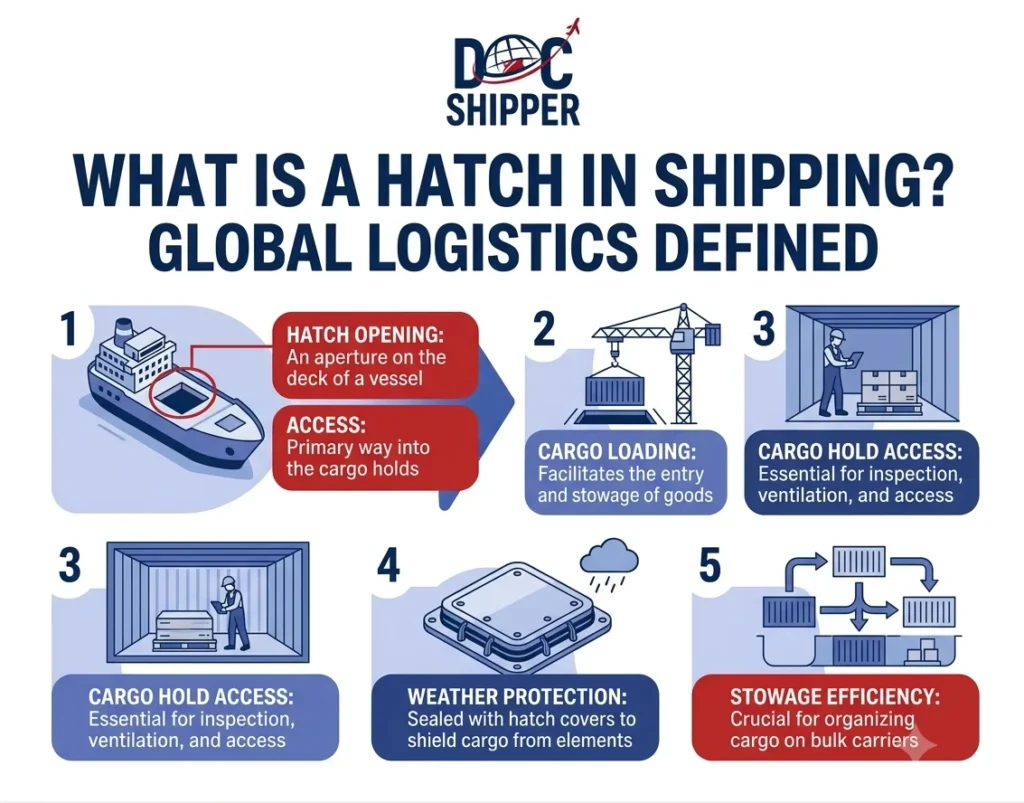
A hatch is an opening in the deck of a vessel that provides access to the cargo hold below. It serves as the primary entry point for loading and unloading goods, with removable covers that seal the opening during transit to protect cargo from weather and seawater. Hatches are critical infrastructure in maritime logistics, directly impacting loading efficiency, cargo safety, and vessel stability.Introduction
Many importers struggle to understand why vessel damage claims cite “hatch failures” or how hatch configurations affect freight rates. The hatch represents a fundamental engineering solution in maritime transport, balancing structural integrity with operational accessibility. Modern shipping relies on sophisticated hatch systems to maintain watertight compartments while enabling rapid cargo operations.
In international trade, hatch design directly influences:
- Loading speed: Port turnaround time depends on hatch dimensions and opening mechanisms
- Cargo protection: Weathertight seals prevent water ingress and contamination
- Vessel classification: Hatch specifications determine cargo types and trade routes
- Insurance premiums: Hatch condition affects coverage and claim eligibility
- Stowage planning: Hatch spacing dictates container placement and weight distribution
Understanding hatch systems helps shippers make informed decisions about vessel selection, cargo packaging, and damage prevention strategies.
Technical Design & Operational Mechanics
Hatch construction has evolved from simple wooden covers to hydraulically-operated steel assemblies with multi-layer sealing systems. The basic components include the coaming (raised edge around the opening), pontoon covers or folding panels, and compression bars that secure weathertight integrity. Classification societies like DNV set strict standards for hatch strength and watertightness.
Three primary hatch configurations dominate modern shipping:
Single-pull hatches use steel covers that slide on rails, stacking at one end of the opening. Common on bulk carriers, these systems allow full-width access for grab cranes and conveyor systems. The mechanism trades speed for simplicity, with manual dogging systems requiring crew intervention at each locking point.
Folding hatches employ hydraulic rams to lift and fold cover panels like accordion doors. Container ships favor this design because it minimizes deck obstruction during cargo operations. Modern systems feature automated sealing that applies uniform compression across gaskets, reducing human error in weatherproofing.
Pontoon hatches consist of multiple floating sections that ship’s cranes remove entirely and store elsewhere on deck. Though labor-intensive, this design provides maximum flexibility for oddly-shaped cargo like project freight or heavy machinery. Older general cargo vessels still rely on this system despite slower turnaround times.
The hatch coaming serves as the structural frame, rising 600-900mm above deck level to prevent wave overwash from entering the hold. International regulations require specific height minimums based on vessel freeboard and intended trade zones. At DocShipper, we verify coaming condition during pre-shipment inspections to identify rust damage that could compromise seal integrity.
Critical to operations is the weathertight seal, typically achieved through rubber gaskets compressed by manual cleats or hydraulic systems. The seal must withstand green water (waves breaking over the deck) and prevent cargo contamination. Regular maintenance includes gasket replacement every 3-5 years and compression testing after drydock repairs. According to UK P&I Club loss records, defective hatch covers account for approximately 18% of cargo damage claims in maritime transport.
Modern container vessels feature cell guides integrated into hatch structures, vertical rails that stabilize containers during loading and sea transit. These guides eliminate the need for lashing at lower tiers, accelerating port operations while maintaining stack stability in rough seas.
Practical Applications & Data
Hatch performance directly impacts shipping economics and cargo safety. Consider a standard Panamax container ship with seven hatches serving holds for 4,500 TEU. Each hatch measures approximately 30m x 18m, requiring 90-120 seconds to open using automated systems. Total hatch operation time per port call ranges from 15-25 minutes, representing 8-12% of overall crane downtime.
| Hatch Type | Typical Vessel | Opening Time | Maintenance Frequency | Cost per Unit |
|---|---|---|---|---|
| Single-pull steel | Handymax bulker | 3-5 minutes | Annual gasket check | $45,000-$65,000 |
| Folding hydraulic | Post-Panamax container | 90-120 seconds | Biannual hydraulic service | $120,000-$180,000 |
| Pontoon (manual) | General cargo vessel | 15-20 minutes | Quarterly hinge inspection | $25,000-$40,000 |
| Piggyback hatch | Ro-Ro/Multi-purpose | 4-6 minutes | Biannual seal replacement | $85,000-$110,000 |
Real-world scenario: A European importer received €340,000 in water-damaged electronics after a container ship encountered North Atlantic storms. Investigation revealed compression bar failure on Hatch #4, allowing seawater ingress during 48 hours of 8-meter swells. The carrier’s P&I insurer denied the claim citing improper pre-departure inspection, leaving the shipper to absorb losses.
Key lessons from this case:
- Pre-departure surveys: Independent surveyors should verify hatch seal integrity before sailing, particularly for high-value cargo
- Stowage position: Containers under suspect hatches should carry low-value or weather-resistant goods
- Marine insurance endorsements: Specific coverage for hatch-related perils requires explicit policy language
- Carrier liability limits: Standard bills of lading cap damages at $500 per package unless higher value is declared
- Photographic evidence: Document hatch condition during container stuffing and vessel loading to support potential claims
Container terminal efficiency metrics show that automated hatch systems reduce vessel dwell time by 18-22% compared to manual systems. This translates to 4-6 additional port rotations annually for a vessel on weekly Pacific service, significantly improving asset utilization and freight capacity.
At DocShipper, we coordinate with stevedores to ensure proper hatch handling procedures, particularly for oversized cargo requiring specialized securing arrangements within the hold. Our teams verify that hatch operations don’t compromise lashing points or structural integrity during multi-port loading sequences.
Conclusion
Hatches represent the critical interface between maritime and terrestrial logistics, where engineering precision meets operational efficiency. Understanding hatch systems empowers shippers to assess vessel suitability, mitigate damage risks, and optimize supply chain performance. The condition and design of these seemingly simple openings directly determine cargo safety, freight costs, and overall shipping reliability.
Need expert guidance on vessel selection or cargo protection strategies? Contact DocShipper for comprehensive logistics support tailored to your international trade requirements.
📚 Quiz
Test Your Knowledge: Hatch Systems in Shipping
What is the primary function of a hatch in maritime logistics?
According to UK P&I Club data, what percentage of cargo damage claims result from defective hatch covers?
A European importer received water-damaged electronics worth €340,000 after container ship storms. The P&I insurer denied the claim. What was the primary reason?
🎯 Your Result
📞 Free Quote in 24hFAQ | Hatch: Definition, Types & Practical Examples in Shipping
Need Help with
Logistics or Sourcing ?
First, we secure the right products from the right suppliers at the right price by managing the sourcing process from start to finish. Then, we simplify your shipping experience - from pickup to final delivery - ensuring any product, anywhere, is delivered at highly competitive prices.


Fill the Form
Prefer email? Send us your inquiry, and we’ll get back to you as soon as possible.
Contact us




