


In short ⚡
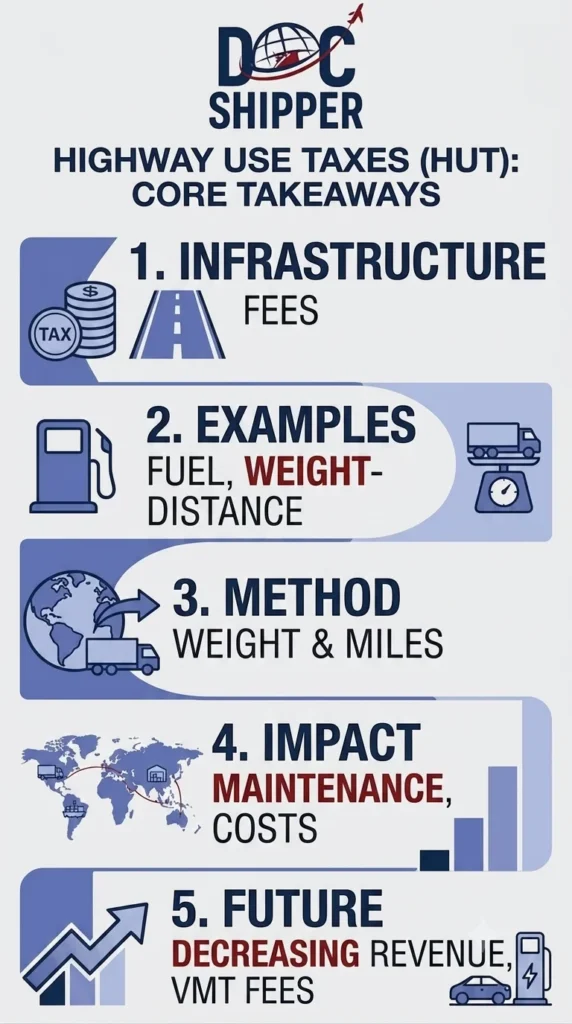
Highway Use Taxes are mandatory fees imposed on commercial vehicles operating on public highways, designed to compensate for road wear and infrastructure maintenance. These taxes vary by jurisdiction and vehicle weight, directly impacting logistics costs for freight carriers. Understanding these charges is critical for accurate transportation budgeting in international trade operations.
Introduction
Many importers and exporters underestimate the hidden costs embedded in ground transportation. Highway use taxes represent one of these overlooked expenses that can significantly affect your supply chain budget.
In international logistics, understanding jurisdictional tax requirements prevents delays and financial penalties. Commercial vehicles transporting goods across borders or states encounter multiple tax regimes, each with distinct calculation methods and compliance requirements.
Key characteristics of highway use taxes include:
- Weight-based assessment: Heavier vehicles pay proportionally higher fees
- Jurisdictional variation: Rates differ dramatically between countries, states, and provinces
- Mileage tracking: Some systems charge based on distance traveled within specific zones
- Vehicle classification: Different rates apply to trucks, tractors, and specialized carriers
- Fuel tax integration: Often combined with or offset by fuel consumption levies
Regulatory Framework & Tax Mechanisms
Highway use taxes operate under complex regulatory frameworks that vary globally. In the United States, the Heavy Vehicle Use Tax (HVUT) applies to vehicles exceeding 55,000 pounds gross weight, collected annually by the IRS. Europe employs different approaches, with countries like Germany implementing distance-based tolling systems through electronic transponders.
The International Fuel Tax Agreement (IFTA) coordinates fuel tax reporting across 48 US states and Canadian provinces. This system allows carriers to report fuel consumption and mileage collectively, simplifying compliance for cross-border operations. Carriers receive credits for fuel purchased in high-tax jurisdictions and pay additional taxes where consumption occurred in lower-tax areas.
Legal compliance requires maintaining detailed records. The IRS mandates Form 2290 submission for US operations, documenting vehicle identification numbers, weight categories, and operational months. Penalties for non-compliance range from $100 to $1,000 per violation, with potential vehicle impoundment.
Ton-mile taxes represent another calculation method, multiplying cargo weight by distance traveled. Oregon and New Mexico utilize this approach for commercial vehicles. The formula considers both payload capacity and actual usage, theoretically creating fairer infrastructure cost distribution.
Gross receipts taxes on transportation services add another layer of complexity. New Mexico applies a 5% levy on freight services, while Hawaii charges general excise taxes on shipping activities. These taxes compound with highway use fees, creating cumulative cost burdens.
At DocShipper, we systematically verify tax documentation and compliance requirements for all ground transportation legs, ensuring our clients avoid costly delays at state borders or inspection stations.
Cost Calculations & Real-World Scenarios
Understanding theoretical frameworks requires practical application. Let’s examine how highway use taxes impact real logistics operations with concrete examples and comparative data.
| Jurisdiction | Tax Type | Rate Structure | Annual Cost (80,000 lbs truck) |
|---|---|---|---|
| United States (Federal) | HVUT | $100 + $22/1,000 lbs over 55,000 | $650 |
| Germany | Distance-based toll | €0.187/km (highways) | €11,220 (60,000 km/year) |
| Oregon (USA) | Weight-Mile Tax | $0.162/mile (80,000 lbs) | $16,200 (100,000 miles/year) |
| New York State | Highway Use Tax | $0.166/mile (business miles) | $4,150 (25,000 NY miles/year) |
| Kentucky | Weight Distance Tax | $0.0285/mile (80,000 lbs) | $2,850 (100,000 miles/year) |
Use Case: Cross-Country Shipment Cost Analysis
Scenario: A logistics company transports electronics from Los Angeles to New York using an 80,000-pound tractor-trailer covering 2,800 miles.
Tax breakdown:
- Federal HVUT (annual): $650 ÷ 52 weeks = $12.50 per trip
- New Mexico gross receipts (5% on $3,500 freight charge): $175
- Oregon Weight-Mile Tax (400 miles @ $0.162/mile): $64.80
- New York Highway Use Tax (150 miles @ $0.166/mile): $24.90
- Total highway-related taxes per trip: $277.20
This represents 7.9% of the base freight charge, a significant margin impact that must be factored into pricing strategies. For companies running 100 trips annually on this route, highway use taxes alone total $27,720.
International Comparison: EU vs. North America
European carriers face substantially higher infrastructure charges. A comparable shipment from Rotterdam to Munich (approximately 850 km) incurs:
- German distance toll: €158.95
- Netherlands kilometer charge: €47.60
- Total: €206.55 ($220) versus $277 in the US example
However, European rates apply per trip rather than annually for weight-based taxes, making total annual costs higher for high-mileage operations. A European truck covering 120,000 km annually pays approximately €22,440 in highway tolls compared to $18,000-$20,000 for similar US operations when combining federal and state charges.
Conclusion
Highway use taxes constitute a substantial but manageable component of international logistics costs. Proactive compliance and strategic routing minimize financial exposure while maintaining regulatory adherence.
Need assistance navigating complex transportation tax requirements for your import/export operations? Contact DocShipper for expert guidance tailored to your specific shipping corridors and cargo profiles.
📚 Quiz
Test Your Knowledge: Highway Use Taxes
Highway Use Taxes are primarily designed to:
A common misconception about Highway Use Taxes is that:
Your company operates an 80,000-pound truck making cross-country shipments. Which approach best minimizes compliance risks?
🎯 Your Results
📞 Free Quote in 24hFAQ | Highway Use Taxes: Definition, Calculation & Practical Examples
Commercial vehicles exceeding specific weight thresholds face highway use taxes. In the US, the federal HVUT applies to vehicles over 55,000 pounds gross weight. State requirements vary—Oregon taxes vehicles above 26,000 pounds, while New York applies charges to commercial carriers regardless of weight. Agricultural and governmental vehicles often receive exemptions. Vehicle classification matters: combination trucks, truck tractors, and heavy straight trucks typically qualify, while personal vehicles and light commercial vans generally don't.
Federal HVUT calculation uses a tiered formula: $100 base fee plus $22 per 1,000 pounds over 55,000 pounds, capped at $550 additional charge (total maximum $650 for vehicles 75,000+ pounds). A 70,000-pound truck pays $100 + ($22 × 15) = $430 annually. File IRS Form 2290 by August 31st for vehicles used during July. Proration applies for vehicles first used mid-year, calculating monthly portions of the annual tax. Electronic filing through approved providers is mandatory for fleets with 25+ vehicles.
Yes, highway use taxes qualify as ordinary and necessary business expenses under IRS regulations. Report HVUT payments on Schedule C (sole proprietors), Form 1120 (corporations), or appropriate business tax returns as vehicle operating costs. Maintain Form 2290 receipts and state tax documentation for audit purposes. These deductions reduce taxable income but don't eliminate the cash flow impact. Quarterly estimated tax payments should account for highway use tax obligations to avoid underpayment penalties.
Non-compliance triggers severe penalties: $100 to $1,000 fines per violation under federal law, potential vehicle registration suspension, and possible equipment impoundment at weigh stations. The IRS assesses failure-to-file penalties of 4.5% monthly (maximum 22.5%) on unpaid HVUT amounts. States conduct roadside inspections verifying tax compliance; vehicles without proper documentation face immediate out-of-service orders. Criminal charges may apply for intentional evasion. Additionally, carriers risk losing operating authority and safety ratings, impacting insurance costs and customer relationships.
The International Fuel Tax Agreement consolidates fuel tax reporting across 48 states and Canadian provinces into a single quarterly return. Carriers track miles traveled and fuel purchased in each jurisdiction, then report through their base jurisdiction. The system calculates net tax owed by comparing fuel purchased versus consumed in each region. If you bought fuel in low-tax states but drove in high-tax states, you pay the difference; the reverse generates credits. IFTA eliminates the need for individual state fuel permits, reducing administrative burden by approximately 75% for interstate carriers.
Yes, highway use taxes apply regardless of propulsion type. Weight-based taxes like HVUT assess gross vehicle weight without fuel consideration. However, electric vehicles may face additional fees compensating for lost fuel tax revenue. Oregon's Road Usage Charge Program requires plug-in vehicles to pay per-mile fees. Some states offer temporary exemptions encouraging alternative fuel adoption, but these phase out as electric truck deployment increases. Infrastructure funding debates increasingly focus on mileage-based charging systems that apply uniformly across all vehicle types.
Strategic routing can minimize exposure to high-tax jurisdictions, but compliance remains mandatory for actual miles traveled. Avoiding Oregon's weight-mile tax by routing through Idaho adds distance costs that often exceed tax savings. Route optimization software should balance tax exposure against fuel consumption, tolls, and delivery schedules. Legal tax avoidance differs from evasion—you cannot falsify mileage logs or avoid reporting jurisdictions where you actually operated. Focus instead on operational efficiency: consolidated shipments reduce per-unit tax burden, and backhaul optimization improves overall cost structures including tax components.
Canada primarily uses fuel taxes rather than weight-distance charges for highway funding. Provincial fuel tax rates range from 9¢/liter (Yukon) to 30¢/liter (Newfoundland). Quebec imposes an additional axle tax based on vehicle configuration. The Canadian system generally results in lower direct highway taxes for heavy vehicles compared to US weight-mile states, but higher fuel costs offset this advantage. Cross-border carriers must comply with both systems: IFTA handles fuel tax coordination, while US operations require separate HVUT registration and state-specific tax accounts.
Comprehensive record-keeping requirements include: detailed mileage logs by jurisdiction (origin, destination, routes, odometer readings), fuel purchase receipts showing gallons, location, and date, vehicle registration documents, weight certificates, IFTA quarterly reports for three years, IRS Form 2290 copies and payment confirmations, and state-specific tax returns. Modern Electronic Logging Devices (ELDs) automatically capture much of this data. Retain records for at least four years—IRS and state audits commonly examine three-year periods. Digital document management systems streamline compliance while providing immediate access during roadside inspections.
Tax responsibility typically falls on the vehicle's registered owner or lessee. For vehicles rented under 60 days, rental companies usually include HVUT in their rates. Long-term leases (over 60 days) transfer responsibility to the lessee, who must file Form 2290 using the lessor's EIN and vehicle identification. State requirements vary: some exempt rental vehicles under specific durations, while others hold renters liable for mileage-based taxes. Always verify tax responsibility in lease agreements. Commercial rental companies generally provide tax documentation, but lessees should confirm compliance to avoid penalties for another party's non-payment.
Autonomous vehicle deployment may accelerate shifts toward mileage-based taxation. Current weight and fuel-based systems adequately capture autonomous truck usage, but policy discussions explore congestion pricing and time-of-day variability that automated systems could efficiently implement. Autonomous trucks' higher utilization rates (potentially 20+ hours daily operation versus 11-hour human limits) will generate proportionally more tax revenue under mileage systems. Several pilot programs test GPS-based road user charges compatible with autonomous fleet management systems. Long-term, expect integrated digital taxation platforms replacing manual reporting as autonomous operations become standard.
Highway use taxes are mandatory government levies funding general road infrastructure, collected through weight-based fees or fuel taxes. Tolls are usage-based charges for specific roads, bridges, or tunnels, often managed by authorities or private operators. You cannot avoid highway taxes if operating qualifying vehicles, but toll roads offer alternative free routes (usually). Toll revenues typically fund construction and maintenance of that specific infrastructure, while highway taxes enter general transportation budgets. Some jurisdictions credit tolls paid against highway tax obligations, but most systems operate independently. For logistics planning, both represent distinct cost categories requiring separate budgeting and route consideration.
Need Help with
Logistics or Sourcing ?
First, we secure the right products from the right suppliers at the right price by managing the sourcing process from start to finish. Then, we simplify your shipping experience - from pickup to final delivery - ensuring any product, anywhere, is delivered at highly competitive prices.


Fill the Form
Prefer email? Send us your inquiry, and we’ll get back to you as soon as possible.
Contact us




