


In short ⚡
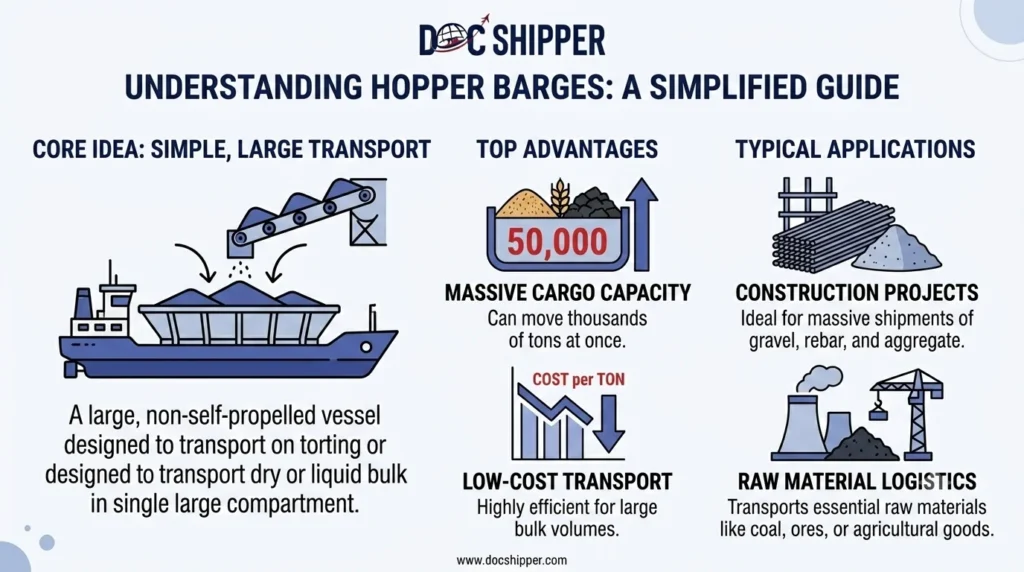
A hopper barge is a non-self-propelled flat-bottomed vessel designed with internal compartments (hoppers) that facilitate rapid loading and discharge of bulk materials such as sand, gravel, aggregates, or dredged sediments. These specialized barges feature bottom-opening doors or split-hull mechanisms, enabling gravity-based unloading directly onto riverbeds, construction sites, or designated marine areas without requiring external handling equipment.
Introduction
In international maritime logistics, confusion often arises between standard cargo barges and hopper barges. While both transport goods via waterways, only hopper barges offer self-discharging capabilities critical for time-sensitive bulk operations.
Hopper barges serve as essential vessels in coastal construction, dredging operations, and aggregate supply chains. Their ability to deposit materials precisely without port infrastructure makes them indispensable for projects in remote or shallow-water locations.
Key operational characteristics include:
- Split-hull discharge system: Hydraulic or mechanical doors enable controlled material release
- Draft optimization: Flat-bottomed design allows navigation in shallow channels (typically 8-15 feet)
- Tug dependency: Requires towboat propulsion, unlike self-propelled hopper dredgers
- Capacity range: Standard vessels hold 500 to 5,000 cubic yards of material
- Environmental compliance: Regulated discharge zones prevent ecological disruption
Technical Operations & Maritime Regulations
The hopper compartment design distinguishes these barges from conventional flat-deck vessels. Watertight bulkheads create isolated chambers, preventing cargo shift during transport and enabling staged discharge operations. Hydraulic bottom doors open symmetrically, ensuring balanced weight distribution as material exits the hull.
Loading procedures vary by application. Dredging operations utilize pipeline connections that pump sediment directly into hoppers, while aggregate suppliers employ shore-based conveyors or clamshell cranes. The overflow weir system manages water levels during hydraulic loading, allowing excess fluid to drain while retaining solid materials.
Discharge precision depends on several factors. Operators control door aperture width to regulate material flow rate, typically releasing 200-800 cubic yards per minute. GPS positioning ensures accurate placement for beach nourishment or underwater foundation work. In shallow-water zones, partial discharge reduces draft incrementally, preventing grounding.
International maritime law governs hopper barge operations through multiple frameworks. The London Convention on Dumping restricts ocean disposal of dredged materials, requiring permits for sediment placement. MARPOL Annex V prohibits discharge of plastics or non-degradable materials, necessitating pre-screening protocols for construction debris.
At DocShipper, we coordinate hopper barge logistics for clients importing construction materials to coastal projects. Our compliance team verifies discharge permits and coordinates with harbor authorities to prevent regulatory delays during bulk material delivery operations.
Safety protocols mandate stability calculations before each voyage. Uneven hopper loading creates dangerous list conditions, particularly in rough seas. The International Maritime Organization’s Intact Stability Code requires barges to maintain metacentric height (GM) above 0.35 meters when fully loaded, ensuring capsize resistance during towing operations.
Practical Applications & Industry Data
The global hopper barge fleet comprises approximately 3,200 active vessels, with highest concentrations in the Netherlands, United States, and China. These barges support diverse industries requiring efficient bulk material transport to water-accessible locations.
| Application Sector | Typical Cargo | Average Capacity | Discharge Method |
|---|---|---|---|
| Beach Nourishment | Sand (0.5-2mm grain) | 2,500 m³ | Rainbowing (controlled spray) |
| Port Dredging | Contaminated sediment | 3,800 m³ | Confined aquatic disposal |
| Infrastructure Development | Gravel/aggregates | 1,200 m³ | Direct bottom placement |
| Land Reclamation | Marine clay/silt | 4,500 m³ | Pipeline jetting |
Use Case: Singapore Port Expansion Project
The Tuas Megaport development required 405 million cubic meters of sand for land reclamation between 2015-2027. Hopper barges transported materials from approved Indonesian sources, discharging through bottom doors at designated fill zones. GPS-controlled positioning maintained placement accuracy within 5-meter tolerances, critical for sequential hydraulic fill operations.
Operational efficiency metrics demonstrate hopper barge advantages:
- Discharge time: 8-15 minutes for full 3,000 m³ load (vs. 4-6 hours for crane offloading)
- Fuel efficiency: 60% lower consumption than truck transport for equivalent tonnage over 50+ km routes
- Environmental footprint: 40% reduction in CO2 emissions compared to land-based aggregate delivery
- Cost per cubic meter: $4-$7 for water transport vs. $12-$18 for road haulage in coastal regions
- Weather dependency: Operations cease in wave heights exceeding 1.5 meters (safety threshold)
The European dredging industry utilizes specialized trailing suction hopper dredgers (TSHDs) with integrated pumps, distinct from non-powered hopper barges. These self-propelled vessels dominate North Sea maintenance dredging, where continuous operation cycles reduce project timelines by 30-40% compared to barge-based methods.
Conclusion
Hopper barges remain critical assets for maritime bulk logistics, offering unmatched efficiency in shallow-water material placement and coastal construction supply chains. Their self-discharge capabilities eliminate port infrastructure dependency while maintaining strict environmental compliance standards.
Need assistance coordinating hopper barge logistics for your import project? Contact DocShipper for expert guidance on vessel chartering, regulatory compliance, and multimodal transport planning.
📚 Quiz
Test Your Knowledge: Hopper Barge
What is the primary defining feature of a hopper barge compared to standard cargo barges?
According to international maritime law, what is required before discharging dredged materials from a hopper barge?
A coastal construction project requires transporting 3,000 m³ of sand to a shallow-water location. Which operational advantage makes hopper barges the optimal choice?
🎯 Your Result
📞 Free Quote in 24hFAQ | Hopper Barge: Definition, Operations & Practical Applications in Maritime Logistics
Hopper barges feature bottom-opening discharge systems and internal compartments designed for bulk materials, while standard barges have solid decks requiring external equipment (cranes/conveyors) for cargo removal. The split-hull mechanism enables gravity-based unloading in 8-15 minutes versus hours for conventional offloading methods.
No. International maritime law requires discharge permits under the London Convention, particularly for dredged sediments. Operators must obtain clearance from coastal states and demonstrate compliance with environmental impact assessments before releasing materials in exclusive economic zones (EEZs).
Well-maintained steel-hulled hopper barges operate for 25-40 years with proper corrosion management. Critical factors include sacrificial anode replacement every 3-5 years, bottom plate ultrasonic testing annually, and hydraulic door seal inspections after every 500 discharge cycles to prevent structural failures.
Between loads, crews perform high-pressure water washing of hopper compartments and inspect residual materials. For sensitive applications (beach sand vs. industrial aggregates), dedicated barges serve single-commodity routes. Cross-contamination protocols follow ISO 14001 environmental management standards to maintain material purity.
Generally no. Most hopper barges lack the containment systems required for IMDG Code hazardous cargoes. Exception exists for certain inert industrial byproducts (slag, fly ash) under specific permits. Transport of chemicals or toxic substances requires specialized tank barges with double-hull construction and vapor recovery systems.
Operations cease when significant wave height exceeds 1.5 meters or wind speeds surpass 25 knots. These thresholds prevent cargo shift during towing and ensure safe discharge positioning. Visibility below 500 meters also triggers suspension due to collision risks in congested waterways.
Capacity appears in cubic meters (struck capacity) or cubic yards, measuring volume to the top of hopper walls. Payload tonnage depends on material density—sand averages 1.6 tons/m³ versus 2.2 tons/m³ for gravel. Charter parties specify both volumetric and weight limits to prevent overloading beyond Plimsoll line markings.
Yes, through "rainbowing" techniques where material sprays from moving vessels for beach nourishment. This method requires specialized overflow systems and precise speed control (2-4 knots) to achieve targeted placement. Most applications use stationary discharge for accuracy, opening doors while anchored over designated zones.
Standard protection includes hull and machinery (H&M) coverage for vessel damage, third-party liability (P&I) for environmental spills, and cargo insurance for material loss. Operators in dredging sectors require pollution liability extensions covering sediment contamination incidents up to $50 million per occurrence.
Operators calculate air draft (height above waterline) and laden draft (vessel depth) before transit. Partial loading allows passage through restricted channels—loading to 60% capacity might reduce draft from 14 feet to 9 feet. Tide tables inform optimal transit windows, with many operations scheduled during high-water slack periods.
Industry benchmarks suggest 3-5% of vessel replacement value for annual maintenance. A $2 million hopper barge requires $60,000-$100,000 yearly for drydocking, hydraulic system servicing, and steel plate renewal. Unexpected door mechanism repairs can add $15,000-$30,000 if preventive maintenance schedules lapse.
Several pilot programs test remotely operated hopper barges in controlled environments. The Netherlands' Port of Rotterdam launched trials in 2022 using AI-assisted navigation for short-haul aggregate transport. Full autonomy faces regulatory hurdles under COLREGS (collision regulations), with commercial deployment unlikely before 2028 pending international maritime law updates.
Need Help with
Logistics or Sourcing ?
First, we secure the right products from the right suppliers at the right price by managing the sourcing process from start to finish. Then, we simplify your shipping experience - from pickup to final delivery - ensuring any product, anywhere, is delivered at highly competitive prices.


Fill the Form
Prefer email? Send us your inquiry, and we’ll get back to you as soon as possible.
Contact us




