


In short ⚡
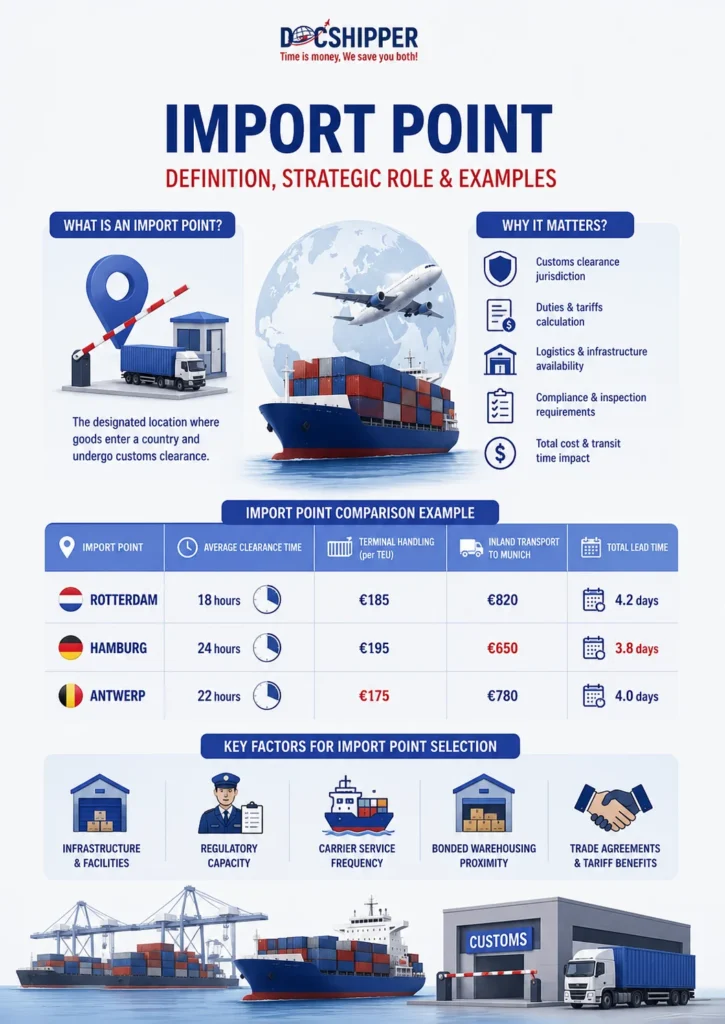
An import point is the designated geographic location or customs-controlled facility where imported goods officially enter a country's territory and undergo regulatory clearance. This critical node determines applicable duties, compliance requirements, and logistics routing for international shipments.
Introduction
Many importers mistakenly assume that any port or border crossing can serve as an entry point for goods. In reality, selecting the wrong import point can trigger unexpected costs, regulatory delays, or compliance violations.
The import point determines everything from customs jurisdiction to warehousing options and transportation costs. Understanding this concept is essential for optimizing supply chain efficiency and regulatory compliance.
- Customs clearance jurisdiction: Different facilities operate under varying regulatory authorities and processing capabilities
- Duty calculation basis: Import point location affects tariff classifications and preferential trade agreements
- Logistics infrastructure: Access to multimodal transport, warehousing, and distribution networks varies by location
- Compliance requirements: Specific commodities may require designated ports with specialized inspection facilities
- Cost implications: Terminal handling charges, inland transportation, and storage fees differ significantly between import points
Strategic Mechanisms & Regulatory Framework
Import points function as controlled entry gateways under national customs legislation. Each location operates within a legal framework that determines processing capacity, authorized commodity types, and clearance procedures.
The selection process involves analyzing five critical factors. Regulatory authorization ensures the facility can legally process your specific commodity category. Customs bonding capabilities determine whether goods can enter secured warehousing before duty payment. Infrastructure compatibility verifies handling equipment for specialized cargo. Transit connectivity evaluates onward transportation options. Operational hours affect turnaround times and demurrage risks.
International conventions like the Revised Kyoto Convention standardize customs procedures across import points globally. These frameworks establish minimum processing standards while allowing national variations.
Free zones and foreign trade zones represent specialized import points offering deferred duty payment and streamlined procedures. These facilities allow goods to enter territory without immediate customs clearance, enabling value-added activities before final importation.
At DocShipper, we systematically evaluate import point options during shipment planning to identify the most cost-effective and compliant entry route for each client’s specific requirements.
Practical Examples & Data Insights
Consider a European electronics importer receiving shipments from Asia. Choosing between Rotterdam, Hamburg, or Antwerp as the import point creates substantially different outcomes.
| Import Point | Average Clearance Time | Terminal Handling (per TEU) | Inland Transport to Munich | Total Lead Time |
|---|---|---|---|---|
| Rotterdam | 18 hours | €185 | €820 | 4.2 days |
| Hamburg | 24 hours | €195 | €650 | 3.8 days |
| Antwerp | 22 hours | €175 | €780 | 4.0 days |
This comparison reveals that Hamburg offers the shortest total transit time despite slightly longer customs processing, making it optimal for time-sensitive electronics shipments destined for southern Germany.
Use Case – Pharmaceutical Cold Chain: A US pharmaceutical company imports temperature-controlled vaccines from Switzerland. Their import point options include JFK Airport (New York) or O’Hare (Chicago).
Analysis shows JFK processes 92% of pharmaceutical imports within 6 hours due to specialized FDA inspection facilities. O’Hare averages 11 hours. For vaccines requiring continuous refrigeration, JFK’s infrastructure reduces spoilage risk by 34% despite higher handling fees.
Key decision factors for import point selection include:
- Commodity-specific infrastructure: Cold storage, hazmat handling, or livestock quarantine facilities
- Regulatory inspection capacity: FDA, USDA, or EPA on-site personnel availability
- Carrier service frequency: Direct vessel/flight connections vs. transshipment routes
- Bonded warehousing proximity: Options for deferred duty payment and inventory management
- Trade agreement utilization: Preferential tariff access through designated first ports of entry
Conclusion
The import point represents far more than a geographic entry location—it functions as a strategic decision point impacting costs, compliance, and supply chain velocity. Proper selection requires analyzing regulatory requirements, infrastructure capabilities, and total landed cost implications.
Need expert guidance on selecting the optimal import point for your shipments? Contact DocShipper for a customized logistics assessment tailored to your specific trade lanes and commodity requirements.
📚 Quiz
Test Your Knowledge: Import Point
What is the primary function of an import point in international trade?
Can specialized commodities like pharmaceuticals or agricultural products be imported through any standard port?
Your electronics shipment from Asia is destined for southern Germany. Based on the article's comparison, which import point offers the shortest total transit time?
🎯 Your Result
📞 Free Quote in 24hFAQ | Import Point: Definition, Strategic Role & Practical Examples
Changing the import point after departure is technically possible but involves significant complications. You must notify the carrier, amend customs documentation, potentially reroute the shipment, and coordinate with the new port authority. This process typically adds 3-7 days to transit time and incurs amendment fees ranging from $150-$500 depending on carrier policies. Some commodities requiring pre-clearance authorization cannot be redirected without restarting the entire approval process.
The import point determines the customs district applying tariff classifications and duty rates. While base duty rates remain consistent nationally, local interpretations of HS codes, origin verification procedures, and preferential trade agreement application can vary between ports. Additionally, merchandise processing fees and harbor maintenance taxes differ by location. Some free trade zones offer duty deferral mechanisms unavailable at standard import points.
Standard documentation includes the commercial invoice, packing list, bill of lading or airway bill specifying the destination port, and customs entry form (e.g., CBP Form 3461 in the US). Specialized commodities require additional permits—FDA prior notice for food products, USDA phytosanitary certificates for agricultural goods, or EPA declarations for chemicals. Some import points mandate pre-arrival electronic filing through systems like ACE (Automated Commercial Environment) 24-48 hours before arrival.
Yes, significant restrictions exist. Agricultural products often require entry through ports with USDA-designated Plant Protection and Quarantine facilities. Pharmaceuticals need FDA-inspected cold chain infrastructure. Hazardous materials must enter through ports certified for dangerous goods handling. Live animals require quarantine stations. The CBP publishes a list of designated ports of entry for restricted commodities, and attempting clearance at unauthorized locations results in shipment refusal and potential penalties.
Foreign Trade Zones (FTZs) operate as secured areas considered outside customs territory for tariff purposes. Goods entering an FTZ import point avoid immediate duty payment and quota restrictions. Companies can store, manufacture, or repackage products within the zone, paying duties only when merchandise formally enters domestic commerce. This mechanism reduces cash flow burdens, enables duty inversion strategies where finished goods have lower tariff rates than components, and facilitates international consolidation operations.
Misdirected shipments create complex logistical challenges. The goods must either undergo immediate exportation to the intended import point (involving export and re-import procedures) or be transported domestically under customs bond—a process called "in-bond movement." This requires filing CBP Form 7512, securing a continuous bond, and coordinating with both the arrival and destination ports. The process adds 5-10 days and costs $200-$800 in administrative fees plus potential demurrage charges if containers remain at the wrong terminal.
Marine cargo insurance policies typically specify coverage termination at the "final port of discharge" or designated import point. Changing the import point after policy issuance may create coverage gaps during inland transportation to the new location. Comprehensive policies with extended coverage clauses can be amended, but this requires immediate notification to insurers and premium adjustments. Import point changes also affect claims jurisdiction—losses occurring after the declared import point may fall outside the original policy scope.
Consolidated shipments containing goods for multiple consignees can be split at a master import point, with individual components clearing customs at different locations. This requires filing a "warehouse withdrawal for immediate exportation" and transporting goods under customs bond to secondary import points. Each destination becomes a separate entry requiring individual customs declarations. While logistically complex, this approach optimizes delivery routes when serving geographically dispersed customers from a single international shipment.
Import point selection creates audit trails that customs authorities scrutinize during compliance reviews. Repeated use of less common ports for high-value goods may trigger risk assessment protocols. Auditors examine whether import point choices align with legitimate business justifications or potentially indicate duty avoidance through "port shopping." Documentation must demonstrate that selections were based on operational efficiency, not tariff minimization. Consistent import point usage patterns with documented rationale strengthen compliance defensibility.
Modern trade platforms like ACE (Automated Commercial Environment), CHIEF (UK), or TRACES (EU) link import point designation to automated risk assessment systems. Pre-arrival electronic filing must specify the intended import point, triggering port-specific validation rules. Advanced systems use artificial intelligence to recommend optimal import points based on commodity characteristics, carrier schedules, and historical clearance times. Integration with Port Community Systems enables real-time slot booking for inspection facilities at designated import points.
Import point selection significantly impacts supply chain carbon footprints. Choosing ports with direct rail connections reduces truck mileage and emissions compared to facilities requiring long-haul road transportation. Some ports offer green incentive programs with reduced fees for vessels meeting emissions standards. The distance between import point and final destination creates measurable environmental costs—importing through a closer port, even with slightly higher fees, can reduce total carbon emissions by 15-30% on inland transportation segments while supporting corporate sustainability commitments.
Post-Brexit, UK import points now function as third-country borders requiring full customs declarations for EU goods. Importers must choose between direct UK ports (Dover, Felixstowe) or EU ports with subsequent transit under TIR Convention. Direct UK entry simplifies procedures but concentrates congestion risk. Using EU import points like Rotterdam with bonded truck transport to UK distributes clearance workload but requires dual documentation. The optimal strategy depends on commodity classification, Rules of Origin requirements, and whether goods qualify for tariff-rate quotas specific to certain UK import points.
Need Help with
Logistics or Sourcing ?
First, we secure the right products from the right suppliers at the right price by managing the sourcing process from start to finish. Then, we simplify your shipping experience - from pickup to final delivery - ensuring any product, anywhere, is delivered at highly competitive prices.


Fill the Form
Prefer email? Send us your inquiry, and we’ll get back to you as soon as possible.
Contact us




