


In short ⚡
Import refers to the commercial process of bringing goods or services into a country from abroad for resale, consumption, or production. This cross-border transaction involves customs clearance, compliance with international trade regulations, and payment of applicable duties and taxes.
Introduction
Many businesses struggle with import regulations, risking costly delays and compliance penalties. Understanding the import process is essential for companies seeking to source materials, finished products, or services internationally while maintaining profitability and legal compliance.
Import operations form the backbone of global supply chains, enabling businesses to access diverse markets, reduce production costs, and offer competitive pricing. From raw materials to consumer electronics, imports fuel economic growth and consumer choice worldwide.
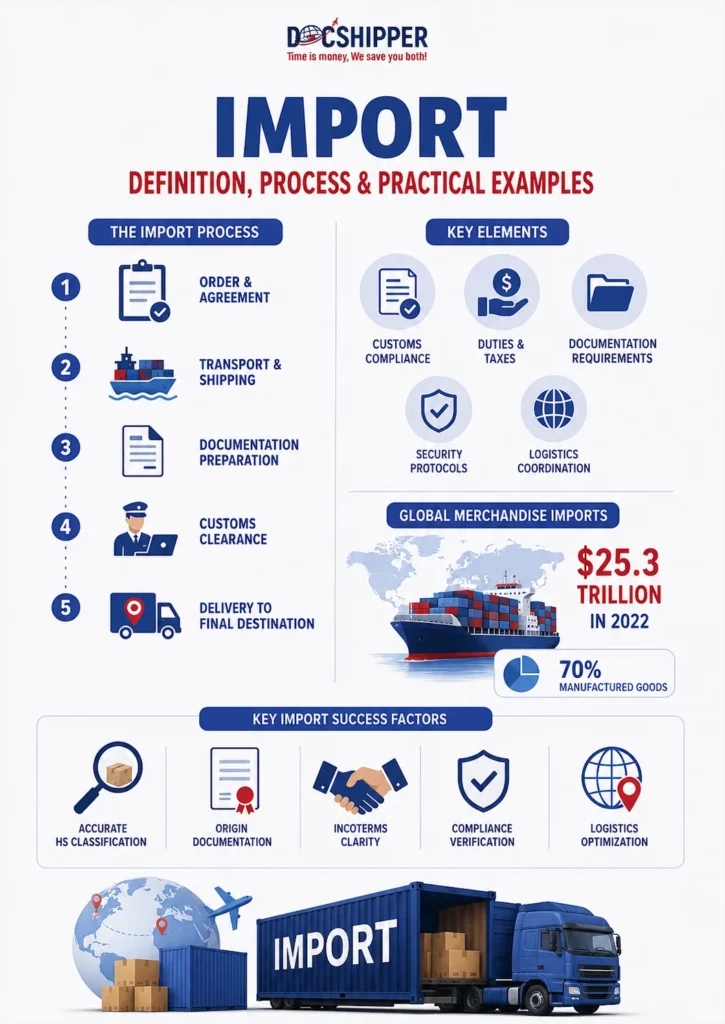
Key characteristics of import activities include:
- Customs compliance: Adherence to destination country regulations, documentation, and tariff classifications
- Duty and tax obligations: Payment of import duties, VAT, and excise taxes based on product classification
- Documentation requirements: Commercial invoices, bills of lading, certificates of origin, and import licenses
- Border security protocols: Inspections, risk assessments, and compliance with safety standards
- Logistics coordination: Transportation, warehousing, and last-mile delivery management
Import Mechanisms & Regulatory Framework
The import process operates through a structured regulatory framework governed by international agreements and national legislation. The Harmonized System (HS) developed by the World Customs Organization provides a standardized classification for over 5,000 commodity groups, ensuring consistent tariff application globally.
Every import transaction requires customs clearance, a procedure where authorities verify documentation, assess duties, and authorize entry. This involves submitting a customs declaration containing product details, value, origin, and intended use. Importers must hold an EORI number (Economic Operators Registration and Identification) in the EU or equivalent registration in other jurisdictions.
Trade agreements significantly impact import costs. Free Trade Agreements (FTAs) reduce or eliminate tariffs between partner countries, while Most Favored Nation (MFN) status ensures non-discriminatory treatment. According to World Trade Organization regulations, all WTO members must extend MFN treatment to fellow members.
Import duties calculation depends on three factors: product classification (HS code), customs value (transaction value plus shipping and insurance), and country of origin. Some products face additional measures like anti-dumping duties, countervailing duties, or safeguard measures to protect domestic industries.
Regulatory compliance extends beyond customs. Importers must ensure products meet destination country standards for safety, labeling, environmental protection, and intellectual property. At DocShipper, we systematically verify all regulatory requirements before shipment to prevent costly rejections or penalties at customs.
Practical Examples & Import Data
Import patterns vary significantly by industry and region. Global merchandise imports reached $25.3 trillion in 2022, with manufactured goods representing 70% of total volume, according to UNCTAD statistics.
Comparative Import Scenario Analysis
| Scenario | Product Type | Origin | Import Duty | Total Cost Impact |
|---|---|---|---|---|
| A | Electronics (HS 8471) | China → USA | 0% (FTA excluded) | +12% (duties + fees) |
| B | Textiles (HS 6204) | Bangladesh → EU | 0% (GSP) | +3.2% (VAT only) |
| C | Automotive Parts (HS 8708) | Japan → Canada | 0% (CPTPP) | +1.8% (logistics) |
| D | Wine (HS 2204) | France → UK | 8.5% MFN | +26% (duties + excise) |
Real-World Import Use Case
Company: Mid-sized electronics retailer in Germany
Product: 5,000 smartphone units (HS code 8517.12)
Origin: Vietnam
Transaction value: €250,000 FOB
Import cost breakdown:
- Freight and insurance: €8,500 (CIF basis required for customs valuation)
- Customs value: €258,500 (FOB + freight + insurance)
- Import duty: €0 (0% under EU-Vietnam FTA with valid Certificate of Origin)
- VAT (19%): €49,115 (on customs value)
- Customs clearance fees: €350
- Total landed cost: €307,965 (23.2% above FOB price)
This example demonstrates how preferential trade agreements significantly reduce import costs. Without the FTA, standard MFN duty rates would apply, potentially increasing total costs by 3-5%.
Key Import Success Factors
- Accurate HS classification: Prevents reclassification penalties and unexpected duty charges
- Origin documentation: Ensures eligibility for preferential tariff treatment under FTAs
- Incoterms clarity: Defines responsibility for costs, risk transfer, and insurance obligations
- Compliance verification: Product standards, certifications, and restricted goods regulations
- Logistics optimization: Consolidation, routing efficiency, and warehouse positioning
Conclusion
Import operations represent a complex but manageable process when approached with proper planning, regulatory knowledge, and logistics expertise. Understanding tariff structures, compliance requirements, and documentation standards enables businesses to minimize costs and avoid delays.
Need support navigating import regulations or optimizing your supply chain? Contact DocShipper for comprehensive import management solutions tailored to your business needs.
📚 Quiz
Test Your Knowledge: Import
What is the primary definition of "import" in international trade?
Which statement correctly describes the customs value calculation for import duties?
A German electronics retailer imports smartphones from Vietnam under the EU-Vietnam FTA. What documentation is essential to benefit from zero duty rates?
🎯 Your Result
📞 Free Quote in 24hFAQ | Import: Definition, Process & Practical Examples
Import duty is a customs tariff levied on specific goods based on their HS classification and origin, while import tax typically refers to VAT or sales tax applied to the total customs value including duties. Duties protect domestic industries; taxes generate government revenue. Both are collected at customs clearance but serve different economic purposes.
HS codes are determined through the World Customs Organization's Harmonized System nomenclature, which classifies goods by composition, function, and industry. Consult your country's customs authority database, use online classification tools, or work with a customs broker. Misclassification can result in incorrect duty rates and potential penalties, so professional verification is recommended for complex products.
Essential import documents include: commercial invoice (product details and value), bill of lading or air waybill (transportation contract), packing list (shipment contents), certificate of origin (preferential tariff eligibility), and customs declaration. Additional documents may include import licenses, sanitary certificates, conformity certificates, and insurance policies depending on product type and destination country requirements.
Most countries require business registration for commercial imports, including an EORI number in the EU or equivalent importer identification. Personal imports for non-commercial use typically have lower value thresholds and simplified procedures. However, regular commercial activity without proper registration may result in fines, customs seizure, and legal liability. Consult your customs authority for specific requirements.
Import duties are calculated on the customs value using the formula: Duty = Customs Value × Duty Rate. Customs value equals transaction price (FOB) plus international freight and insurance (CIF basis). The duty rate depends on the product's HS classification and origin country. Some goods qualify for reduced rates under trade agreements, while others face additional anti-dumping or countervailing duties.
A Certificate of Origin is an official document certifying where goods were manufactured or produced. It's crucial for determining eligibility for preferential tariff treatment under Free Trade Agreements. Without valid origin documentation, importers pay standard MFN duty rates instead of reduced FTA rates, significantly increasing costs. Certificates must be issued by authorized chambers of commerce or government agencies.
Standard customs clearance takes 1-5 business days depending on country efficiency, shipment complexity, and documentation completeness. Express clearance programs like AEO (Authorized Economic Operator) or C-TPAT can reduce processing to hours. Delays occur with incomplete documentation, inspections, restricted goods, or duty payment issues. Pre-clearance and accurate declarations minimize waiting times.
Customs may hold shipments for documentation verification, physical inspection, or compliance review. Common reasons include: incorrect declarations, missing certificates, restricted goods, valuation discrepancies, or security concerns. Importers receive notification detailing required actions—submitting additional documents, paying duties, or providing clarification. Goods may be seized if they violate import prohibitions or safety standards.
Yes, all countries maintain lists of prohibited and restricted imports. Common prohibitions include weapons, narcotics, counterfeit goods, and endangered species products. Restricted items like pharmaceuticals, food products, chemicals, and telecommunications equipment require special licenses or certifications. Importing prohibited goods results in seizure, fines, and potential criminal prosecution. Always verify country-specific regulations before shipping.
Free Trade Agreements eliminate or reduce import duties between partner countries, often lowering costs by 3-15% depending on product type. To benefit, importers must provide valid Certificates of Origin proving goods meet rules of origin requirements. FTAs also streamline customs procedures and harmonize standards. Not all products qualify—sensitive sectors like agriculture may have exclusions or quotas.
FOB (Free On Board) means the seller's responsibility ends when goods are loaded on the vessel; the buyer pays freight and insurance. CIF (Cost, Insurance, Freight) includes these costs in the seller's price. For customs purposes, most countries require CIF valuation since duties are calculated on total landed cost. Understanding Incoterms prevents disputes over cost responsibility and insurance coverage.
Import license requirements vary by product category and country. Regulated goods like pharmaceuticals, firearms, agricultural products, chemicals, and telecommunications equipment typically require licenses. Most general merchandise does not. Check your customs authority's controlled goods list and licensing requirements. Operating without required licenses results in shipment seizure, fines, and potential criminal charges for repeat violations.
Need Help with
Logistics or Sourcing ?
First, we secure the right products from the right suppliers at the right price by managing the sourcing process from start to finish. Then, we simplify your shipping experience - from pickup to final delivery - ensuring any product, anywhere, is delivered at highly competitive prices.


Fill the Form
Prefer email? Send us your inquiry, and we’ll get back to you as soon as possible.
Contact us




