


In short ⚡
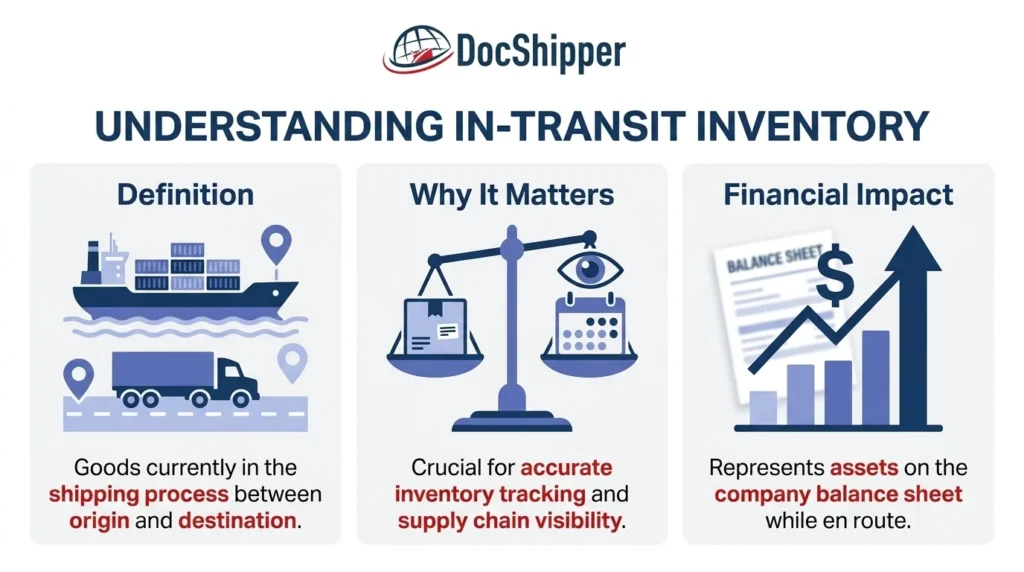
In-transit inventory refers to goods that are currently being transported between two locations within the supply chain—from supplier to warehouse, between warehouses, or from distribution center to customer. This inventory is neither at the origin nor destination point, representing a critical asset in motion that requires precise tracking and management to optimize cash flow and operational efficiency.
Introduction
Many businesses struggle with the “black hole” problem in their supply chain. Goods disappear from origin tracking systems but haven’t yet appeared in destination inventory records. This gap creates accounting challenges, stock visibility issues, and customer service complications. In-transit inventory represents a significant portion of working capital for international traders, yet it remains poorly managed by many organizations.
Understanding and controlling in-transit inventory is crucial for several reasons. It directly impacts cash flow, as money is tied up in goods that cannot yet generate revenue. It affects inventory accuracy, making demand forecasting more complex. And in today’s just-in-time manufacturing environment, knowing exactly when goods will arrive has become a competitive necessity.
Key characteristics of in-transit inventory include:
- Temporary ownership ambiguity depending on Incoterms and payment terms
- Risk exposure to damage, theft, delays, and customs complications
- Capital immobilization reducing available working capital
- Visibility challenges requiring real-time tracking systems
- Insurance implications with specific coverage requirements during transit
In-Depth Analysis & Expert Insights
In-transit inventory management involves understanding ownership transfer points defined by Incoterms. Under FOB (Free On Board), ownership typically transfers once goods are loaded onto the vessel, making the buyer responsible for in-transit inventory. With DDP (Delivered Duty Paid), the seller maintains ownership until final delivery, keeping goods on their balance sheet throughout transit.
The accounting treatment of in-transit inventory varies by organization and terms. Generally, goods are recorded as inventory once ownership transfers, even if physically in motion. This creates the need for accrual entries and careful reconciliation between purchase orders, shipping documents, and received goods. According to IFRS standards, inventory should be recognized when risks and rewards of ownership transfer, regardless of physical location.
Modern supply chains face transit time variability as a major challenge. Ocean freight can vary by 5-10 days due to weather, port congestion, or routing changes. Air freight offers more predictability but at higher cost. This variability forces companies to hold safety stock or risk stockouts, directly impacting service levels.
The concept of pipeline inventory closely relates to in-transit goods. Pipeline inventory equals the average transit time multiplied by the demand rate. For example, if a company sells 100 units daily and transit takes 30 days, the pipeline inventory averages 3,000 units. Reducing transit time directly reduces required inventory investment.
At DocShipper, we implement comprehensive tracking systems that provide real-time visibility into in-transit inventory across all transport modes. Our clients can access shipment status, estimated arrival times, and exception alerts through integrated platforms, eliminating the visibility gap that plagues traditional logistics operations.
Legal and regulatory considerations add complexity to in-transit inventory management. Customs documentation requirements vary by country, and goods may be held at borders for inspection, extending transit times unpredictably. Import duties and taxes often become payable once goods enter a country’s territory, even before final delivery. Companies must also consider insurance coverage, ensuring policies cover goods throughout the entire transit period, not just during main carriage.
Practical Examples & Data
Consider a European electronics retailer importing smartphones from China. With a 45-day ocean transit time and 10,000 units shipped monthly, the company constantly has approximately 15,000 units in transit. At $300 per unit, this represents $4.5 million in working capital tied up in pipeline inventory. By switching to a mixed modal strategy—70% ocean, 30% air—they reduced average transit to 30 days, freeing up $1.5 million in capital while maintaining service levels.
The financial impact of in-transit inventory becomes clear through carrying cost calculations. Industry standards suggest annual inventory carrying costs range from 20-30% of inventory value. This includes capital cost, storage, insurance, and obsolescence risk. For the electronics retailer above, reducing in-transit inventory by $1.5 million saves approximately $300,000-450,000 annually.
Modal Comparison: Transit Times & Inventory Impact
| Transport Mode | Average Transit Time | Cost per Unit | In-Transit Units (10k/month) | Capital Tied Up |
|---|---|---|---|---|
| Ocean Freight | 45 days | $8/unit | 15,000 | $4.5M |
| Air Freight | 5 days | $45/unit | 1,667 | $500k |
| Express Air | 2 days | $80/unit | 667 | $200k |
| Mixed Modal (70/30) | 30 days avg | $19/unit avg | 10,000 | $3M |
Another practical scenario involves pharmaceutical distribution. A medical supply company ships temperature-sensitive products from India to the United States. Their challenge wasn’t just tracking location, but maintaining cold chain integrity throughout the 22-day transit. By implementing IoT sensors providing real-time temperature data, they reduced spoilage losses from 8% to under 2%, significantly improving the effective value of in-transit inventory.
Key performance indicators for managing in-transit inventory include:
- Days in Transit: Average time from shipment to receipt
- In-Transit Inventory Value: Total value of goods currently moving
- Transit Time Variance: Standard deviation from planned transit time
- Inventory Turnover Impact: How in-transit goods affect overall turnover ratios
- Cash Conversion Cycle: Days from payment to supplier until receipt and sale
Technology solutions have transformed in-transit visibility. GPS tracking, RFID tags, and blockchain-based documentation now provide unprecedented transparency. Companies using these technologies report 40-60% improvement in arrival predictability and 25-35% reduction in safety stock requirements due to enhanced visibility.
Conclusion
In-transit inventory represents a significant yet often overlooked component of supply chain management. Effective control requires understanding ownership terms, implementing robust tracking systems, and optimizing modal choices based on total cost of ownership—not just freight rates. Companies that master in-transit inventory management gain competitive advantages through improved cash flow, better customer service, and reduced total inventory requirements.
Need expert guidance on optimizing your in-transit inventory strategy? Contact DocShipper for a comprehensive supply chain assessment and customized solutions that improve visibility while reducing costs.
📚 Quiz
Test Your Knowledge: In-Transit Inventory
What does "in-transit inventory" specifically refer to in supply chain management?
Under FOB (Free On Board) Incoterms, when does ownership of in-transit inventory typically transfer to the buyer?
A company imports 10,000 units monthly with 45-day ocean transit. Which strategy would most effectively reduce working capital tied up in pipeline inventory?
🎯 Your Result
📞 Free Personalized QuoteFAQ | In-Transit Inventory: Definition, Management & Practical Examples
In-transit inventory is goods physically moving between locations, while safety stock is extra inventory held at a location to buffer against demand variability or supply disruptions. In-transit inventory is a necessary consequence of transit time; safety stock is a strategic buffer. Both tie up capital but serve different purposes. Reducing transit time decreases required in-transit inventory without affecting safety stock needs, though better visibility into in-transit goods may allow reduced safety stock levels.
Ownership depends on the Incoterms agreed between buyer and seller. Under FOB terms, the buyer owns goods once loaded on the vessel. Under CIF, ownership typically transfers at loading, but the seller pays insurance and freight. DDP keeps ownership with the seller until final delivery. The critical point is where "risk transfers," which determines who bears responsibility for loss or damage. Always verify ownership terms in your purchase contract and ensure insurance coverage aligns with your ownership period.
In-transit inventory should be recorded as current assets on the balance sheet once ownership transfers, even if goods haven't been physically received. Companies typically use "Goods in Transit" or "Inventory in Transit" as a separate line item or note disclosure. The accounting treatment follows the ownership transfer point defined by contract terms. Upon receipt, the amount is reclassified from in-transit to regular inventory. Proper documentation—bills of lading, commercial invoices, and packing lists—supports the recorded values.
Modern solutions include GPS tracking devices providing real-time location data, RFID tags for automated scanning at checkpoints, IoT sensors monitoring environmental conditions (temperature, humidity, shock), and cloud-based transportation management systems integrating data from multiple carriers. Blockchain technology enables secure, transparent documentation sharing among all parties. API integrations connect carrier systems with ERP platforms for automatic status updates. These technologies typically reduce location uncertainty from days to hours and enable proactive exception management.
Calculate by multiplying average inventory value in transit by your annual carrying cost percentage, then dividing by 365 to get daily cost. For example: $2M average in-transit value × 25% carrying cost ÷ 365 = $1,370 per day. Components of carrying cost include capital cost (opportunity cost or interest rate), insurance, risk of obsolescence, and administrative costs. Many companies underestimate this cost, focusing only on freight rates. Total landed cost analysis should include in-transit carrying costs to make accurate modal and sourcing decisions.
Yes, through several strategies: consolidating shipments to reduce frequency while maintaining flow, optimizing routing to minimize transit time, improving demand forecasting to reduce order variability, and implementing vendor-managed inventory where suppliers maintain ownership until delivery. Near-shoring or regional sourcing reduces distance and transit time. Advanced planning systems can optimize order quantities and timing. Technology investments in visibility often pay for themselves through reduced expediting costs and better inventory planning. The key is total cost optimization, not just minimizing freight spend.
Primary risks include capital immobilization reducing financial flexibility, exposure to theft or damage during longer transit periods, obsolescence risk for fashion or technology products, exchange rate fluctuations for international shipments, regulatory changes affecting import requirements, carrier bankruptcy or service failures, and natural disasters or geopolitical events disrupting routes. Insurance mitigates some risks but doesn't eliminate opportunity costs. Companies with high in-transit inventory often struggle with cash flow and have difficulty responding quickly to market changes or supply chain disruptions.
Variability forces companies to hold additional safety stock to maintain service levels during longer-than-expected transits. If average transit is 30 days but ranges from 25-40 days, planners must prepare for the worst case. This variability effectively increases total inventory investment. Statistically, safety stock requirements increase with the standard deviation of lead time. Reducing variability through reliable carriers, better routing, or modal choices often provides more value than reducing average transit time. Predictability enables tighter planning and lower overall inventory levels.
Critical documents include the bill of lading (proof of shipment and contract of carriage), commercial invoice (describing goods and value), packing list (detailing contents), certificate of origin (for customs and duty calculations), and insurance certificate (proving coverage). For controlled goods, add permits or licenses. Digital copies should be accessible to all stakeholders. Customs documentation—such as import declarations and duty payment receipts—becomes essential once goods enter destination country territory. Electronic data interchange (EDI) or platform-based document sharing improves accessibility and reduces delays.
Customs inspections extend effective transit time unpredictably, creating planning challenges and increasing carrying costs. Goods may sit for days or weeks awaiting clearance, technically "in-transit" but unable to move. This requires companies to maintain higher safety stock or risk stockouts. Proper documentation, accurate classification codes, and pre-clearance programs (like C-TPAT in the US or AEO in Europe) reduce hold frequency and duration. Working with experienced customs brokers who understand local requirements significantly improves clearance predictability and reduces in-transit time variability.
In-transit inventory directly extends the cash-to-cash cycle—the time between paying suppliers and receiving customer payment. Longer transit times mean more days before goods can be sold and converted to cash. For example, if you pay suppliers upon shipment and transit takes 45 days, that's 45 days before you can even begin selling. Reducing transit time or negotiating payment terms that defer payment until receipt shortens this cycle, improving cash flow. Companies with long international supply chains often have cash-to-cash cycles exceeding 100 days, with in-transit inventory representing a significant component.
Yes, in-transit inventory should be included in total inventory for turnover calculations since it represents capital invested in goods intended for sale. Excluding it artificially inflates turnover ratios and masks the true efficiency of inventory management. The formula remains Cost of Goods Sold divided by Average Inventory, but Average Inventory should include all inventory forms: raw materials, work-in-process, finished goods in warehouses, and in-transit inventory. This provides a complete picture of how efficiently the company converts inventory investment into sales revenue.
Need Help with
Logistics or Sourcing ?
First, we secure the right products from the right suppliers at the right price by managing the sourcing process from start to finish. Then, we simplify your shipping experience - from pickup to final delivery - ensuring any product, anywhere, is delivered at highly competitive prices.


Fill the Form
Prefer email? Send us your inquiry, and we’ll get back to you as soon as possible.
Contact us




