


In short ⚡
The Incentive Rate is a preferential tariff reduction granted by customs authorities to encourage specific trade flows, typically between countries with bilateral or multilateral agreements. This rate lowers import duties below standard Most Favored Nation (MFN) rates, making international transactions more cost-effective for eligible businesses.
Introduction
Many importers unknowingly overpay customs duties simply because they fail to leverage available incentive rates. This oversight can cost businesses thousands of dollars annually, directly impacting profit margins in competitive international markets.
In global trade, incentive rates serve as strategic instruments governments use to promote exports, strengthen bilateral relations, or support developing economies. Understanding how to qualify for and apply these preferential tariffs is essential for any company engaged in cross-border commerce.
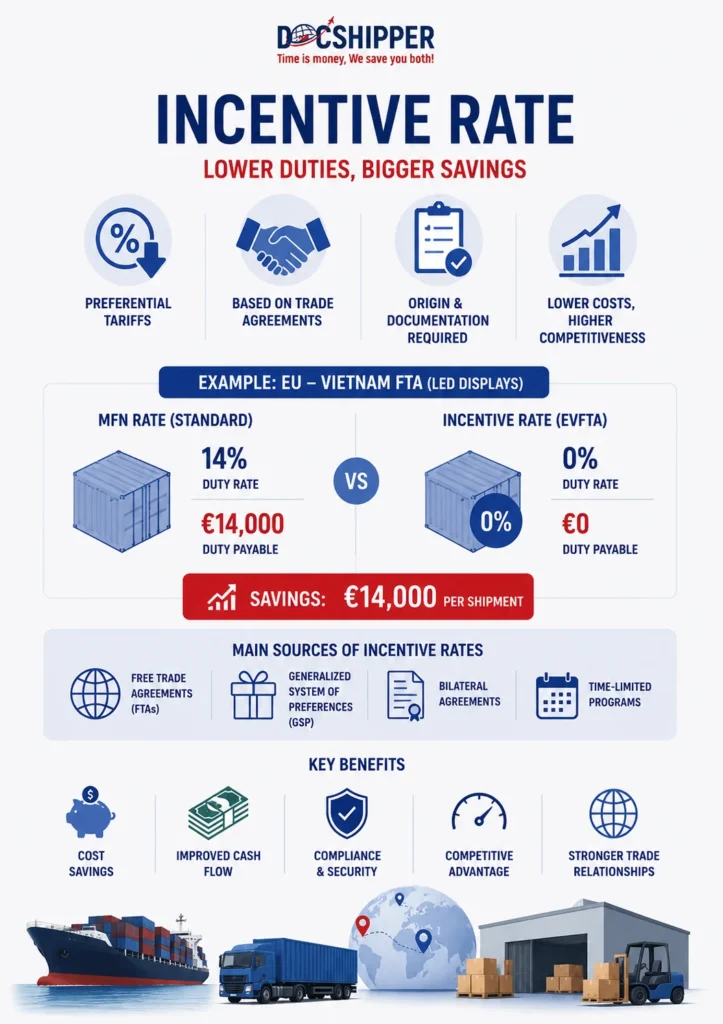
Key characteristics of incentive rates include:
- Preferential treatment: Lower duty rates compared to standard MFN tariffs
- Agreement-based: Established through Free Trade Agreements (FTAs), Generalized System of Preferences (GSP), or bilateral protocols
- Origin requirements: Goods must meet specific rules of origin to qualify
- Documentation-intensive: Certificates of origin and compliance proofs are mandatory
- Time-sensitive: Agreements may expire, change, or be suspended based on geopolitical conditions
Mechanisms & Trade Policy Expertise
Incentive rates function within a complex framework of international trade law and customs regulation. Unlike uniform MFN rates applied universally, preferential rates are conditional and require strict compliance verification.
The legal foundation rests on several pillars. First, Rules of Origin (RoO) determine whether a product genuinely originates from the beneficiary country. These rules prevent “tariff shopping” where goods are merely transshipped through preferential zones without substantial transformation. Second, direct consignment requirements mandate that goods travel directly from the origin country to the destination, with limited exceptions for logistics hubs.
Free Trade Agreements establish tariff schedules that phase out duties over agreed timelines. For instance, the USMCA (United States-Mexico-Canada Agreement) gradually eliminated tariffs on eligible products over periods ranging from immediate implementation to 15-year transitions. Each product category follows its own schedule based on industry sensitivity and negotiation outcomes.
The Generalized System of Preferences deserves special attention. Developed by UNCTAD in 1968, GSP programs allow developed nations to grant unilateral tariff preferences to developing countries without reciprocity. According to UNCTAD data, over 180 countries participate as beneficiaries, though specific product coverage varies by granting country.
Documentation requirements constitute the practical challenge. Importers must present valid Certificates of Origin (Form A for GSP, EUR.1 for EU agreements, or certified origin declarations). At DocShipper, we systematically verify these documents before shipment to prevent costly customs delays or duty reassessments. Missing or incorrect paperwork can result in denial of preferential treatment, forcing payment of full MFN rates plus potential penalties.
Finally, compliance monitoring is ongoing. Customs authorities conduct post-clearance audits, requesting production records, bills of materials, and supplier declarations to verify origin claims. Non-compliance can trigger retroactive duty collection, interest charges, and even suspension from future preferential programs.
Concrete Examples & Data
Understanding incentive rates requires examining real-world applications across different trade corridors and product categories.
Case Study: Electronics Import EU-Vietnam FTA
A French company imports LED displays from Vietnam. Under MFN rates, the standard duty is 14%. The EU-Vietnam Free Trade Agreement (EVFTA) offers a preferential rate of 0% for qualifying products. For a shipment valued at €100,000:
| Scenario | Duty Rate | Customs Duty | Savings |
|---|---|---|---|
| MFN Rate (Standard) | 14% | €14,000 | — |
| EVFTA Incentive Rate | 0% | €0 | €14,000 |
Annual import volume: 12 shipments. Total annual savings: €168,000. However, compliance costs (origin verification, certification) average €8,000 annually, yielding net savings of €160,000.
GSP Program Analysis: Textiles from Bangladesh
Bangladesh benefits from GSP status in multiple markets. A U.S. importer of garments faces these rate differentials:
- Standard MFN rate: 16.5% for woven cotton shirts (HS Code 6205.20)
- Bangladesh GSP rate: Duty-free (0%) under specific conditions
- Qualification criteria: Minimum 35% value-added in Bangladesh; direct shipment; Form A certificate
- Exclusions: Certain luxury items and politically sensitive products remain ineligible
- Monitoring requirement: Annual review by USTR for labor and human rights compliance
According to World Bank statistics, GSP programs globally save developing countries approximately $3.5 billion annually in import duties, though utilization rates vary significantly by country sophistication and administrative capacity.
CPTPP Automotive Sector Example
The Comprehensive and Progressive Agreement for Trans-Pacific Partnership (CPTPP) established complex regional value content rules for automobiles. A Japanese automaker exporting to Canada benefits from:
| Component | Requirement | Impact |
|---|---|---|
| Regional Value Content | 45% | Minimum CPTPP-origin materials/labor |
| Incentive Rate | 0% | vs. 6.1% MFN rate |
| Annual Volume (vehicles) | 50,000 | Average value: CAD 35,000/unit |
| Total Duty Savings | CAD 106.75 million/year |
These savings create competitive pricing advantages while incentivizing supply chain localization within CPTPP member states. At DocShipper, we assist automotive clients with origin certification and RVC calculations to maximize these benefits while ensuring full regulatory compliance.
Conclusion
Incentive rates represent substantial cost-saving opportunities for businesses engaged in international trade, but they demand rigorous compliance and documentation. Understanding the legal frameworks, origin rules, and procedural requirements separates successful importers from those who leave money on the table.
Need assistance navigating preferential tariff programs or optimizing your customs compliance strategy? Contact DocShipper for expert guidance tailored to your specific trade lanes and product categories.
📚 Quiz
Test Your Knowledge: Incentive Rate
What is the primary purpose of an Incentive Rate in international trade?
Which statement correctly describes how incentive rates are applied at customs clearance?
A company imports electronics from Vietnam to the EU. Under MFN rates, they pay 14% duty on €100,000 shipments. With EVFTA incentive rate (0%), what are their annual savings on 12 shipments?
🎯 Your Result
📞 Free Quote in 24hFAQ | Incentive Rate: Definition, Calculation & Concrete Examples
Most Favored Nation (MFN) rates are standard tariffs applied to all WTO members without discrimination. Incentive rates are preferential reductions granted through specific agreements (FTAs, GSP) that lower duties below MFN levels for qualifying goods. While MFN applies universally, incentive rates require origin proof and agreement eligibility.
Possibilities vary by jurisdiction. The EU allows retrospective claims within three years if proper documentation exists. The U.S. permits duty drawback claims within three years for overpaid duties. However, you must demonstrate that goods qualified at import time. Proactive application is always preferable to retroactive claims.
Minor clerical errors may be correctable through amended certificates if detected quickly. Material misrepresentations regarding origin can trigger denial of preferential treatment, assessment of full MFN duties plus interest, and potential penalties. In severe cases, customs authorities may suspend your company's eligibility for future preferential programs. Always verify accuracy before submission.
No. Free Trade Agreements typically exclude sensitive products from preferential treatment. Common exclusions include certain agricultural goods, textiles subject to quota, and products where domestic industries require protection. Each FTA contains product-specific tariff schedules detailing eligible items and phase-out timelines. Always consult the agreement's annexes for your specific HS code.
Each FTA establishes unique Rules of Origin criteria. Some use value-added thresholds (e.g., 40% regional content), others require tariff classification changes (change of tariff heading), and some mandate specific production processes. USMCA automotive rules differ substantially from CPTPP requirements. Businesses operating across multiple agreements must maintain separate compliance frameworks for each.
No. Importers must actively claim preferential treatment by submitting proper documentation (Certificate of Origin, origin declarations) and declaring the applicable FTA on customs entry forms. Failure to claim at import typically forfeits the benefit, though some jurisdictions allow post-clearance adjustments within limited timeframes. The burden of proof always rests with the importer.
Generally, direct consignment rules require goods to ship directly from origin to destination. Limited exceptions exist for logistics reasons (containerization, warehousing) if goods remain under customs control and don't undergo further processing. Any manipulation beyond standard preservation invalidates preferential treatment. Detailed transit documentation becomes essential in such scenarios.
FTAs typically include multi-year tariff phase-out schedules with annual rate reductions. GSP programs face periodic reviews (often annually) where beneficiary countries or products may be added/removed. Political changes, trade disputes, or compliance violations can trigger sudden suspensions. Businesses must monitor official customs bulletins and trade policy updates continuously to maintain compliance.
Retention requirements vary but typically span 3-5 years. Essential records include: Certificates of Origin, supplier declarations, bills of materials showing origin calculations, production records proving substantial transformation, purchase invoices, transport documents proving direct consignment, and any correspondence with certifying authorities. Digital archival systems help manage this documentation burden efficiently.
Treatment depends on circumstances. Goods exported for repair and returned may qualify for duty exemptions under specific provisions, not incentive rates. Products exported as components and re-imported as finished goods typically lose origin status unless substantial value-added occurs abroad under relevant FTA rules. U.S. 9802 provisions and similar programs worldwide address these scenarios specifically.
Yes. Post-clearance audits can extend several years after import. If authorities discover false origin claims, insufficient documentation, or non-compliance with RoO, they may issue duty assessments for the difference between incentive and MFN rates, plus interest and penalties. Repeat violations can result in criminal prosecution and permanent exclusion from preferential programs.
RVC calculations follow agreement-specific formulas, typically either transaction value method (based on invoiced prices) or net cost method (based on production costs). For automotive products under USMCA, complex "rolled-up" calculations trace origin through multi-tier supply chains. Professional customs brokers or origin specialists often handle these calculations given their complexity and audit exposure. Maintaining detailed cost accounting systems becomes essential for manufacturers claiming preferential treatment.
Need Help with
Logistics or Sourcing ?
First, we secure the right products from the right suppliers at the right price by managing the sourcing process from start to finish. Then, we simplify your shipping experience - from pickup to final delivery - ensuring any product, anywhere, is delivered at highly competitive prices.


Fill the Form
Prefer email? Send us your inquiry, and we’ll get back to you as soon as possible.
Contact us




