


In short ⚡
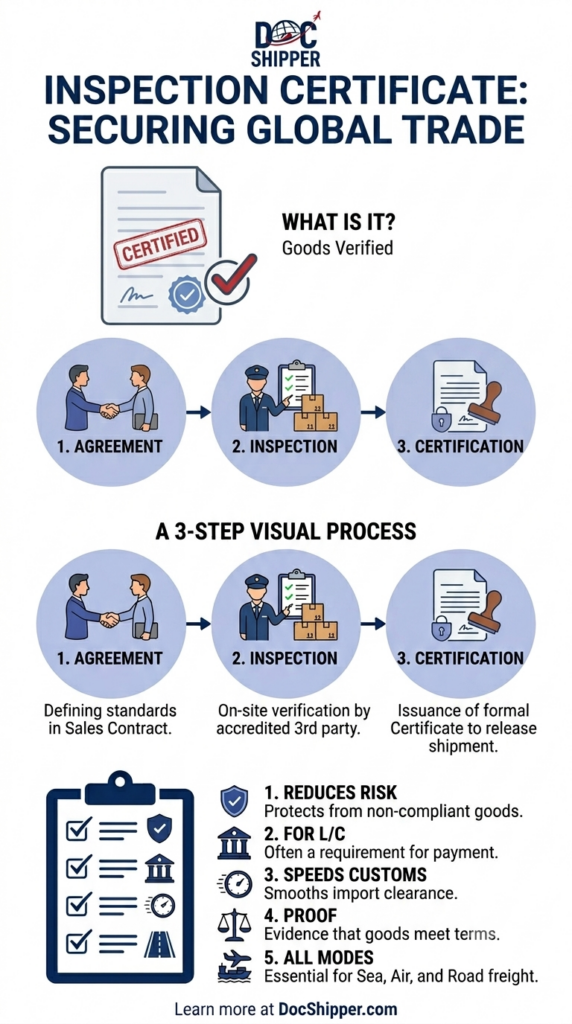
An Inspection Certificate is an official document issued by an authorized body certifying that goods have been examined and comply with specified quality, quantity, or regulatory standards before shipment. It serves as proof of conformity for customs clearance and buyer verification in international trade.
Introduction
Many importers face costly delays when customs authorities reject shipments due to missing or incorrect inspection documentation. The confusion stems from varying requirements across countries and product categories.
In international logistics, the Inspection Certificate acts as a critical checkpoint between production and delivery. It bridges the trust gap between buyer and seller while satisfying regulatory bodies worldwide.
Key characteristics of this document include:
- Independent verification: Issued by third-party inspection agencies, not by sellers
- Pre-shipment validation: Confirms goods meet contractual specifications before loading
- Customs compliance: Required by many importing countries for specific product categories
- Risk mitigation: Protects buyers from receiving defective or non-conforming goods
- Trade facilitation: Accelerates customs clearance when properly executed
Technical Framework & Regulatory Context
The legal foundation for inspection certificates varies by jurisdiction. The International Chamber of Commerce provides standardized frameworks, but each importing nation maintains specific requirements.
Pre-Shipment Inspection (PSI) programs are mandatory in countries like Bangladesh, Angola, and Indonesia. These government-mandated schemes require all imports above certain thresholds to undergo inspection before export.
The document typically verifies several critical elements. Quality conformity ensures goods match technical specifications, industry standards, or buyer requirements. Quantity verification confirms actual counts or measurements against purchase orders to prevent shipping discrepancies.
Packaging and labeling compliance becomes crucial for consumer goods, where incorrect information can trigger regulatory holds. The certificate also validates pricing accuracy in some PSI programs to prevent under-invoicing and customs fraud.
Different types serve specific purposes. A Quality Inspection Certificate focuses on manufacturing standards and defect rates. A Phytosanitary Certificate addresses plant health for agricultural products. A Fumigation Certificate proves pest treatment for wooden packaging materials.
At DocShipper, we coordinate with accredited inspection bodies like SGS, Bureau Veritas, and Intertek to ensure your certificates meet destination country requirements before shipment, preventing costly customs rejections.
Practical Applications & Data
Consider a practical scenario: A French importer orders 10,000 units of ceramic tiles from Vietnam. The Vietnamese supplier arranges pre-shipment inspection with SGS Hanoi at a cost of approximately $800-1,200 depending on inspection complexity.
The inspection process takes 4-6 hours on-site. Inspectors randomly select 5-10% of units based on AQL (Acceptable Quality Level) standards. They measure dimensions, check for cracks, verify packaging, and compare samples against approved prototypes.
Upon passing inspection, the certificate is issued within 24-48 hours. This document accompanies the commercial invoice, packing list, and bill of lading. French customs accepts the inspection certificate, allowing immediate release rather than requiring local re-inspection.
Cost-Benefit Analysis by Product Category
| Product Type | Average Inspection Cost | Typical Timeline | Rejection Prevention Value |
|---|---|---|---|
| Consumer Electronics | $600-1,500 | 1-2 days | High (safety compliance) |
| Textiles & Apparel | $400-900 | 1 day | Medium (quality assurance) |
| Machinery & Equipment | $1,200-3,000 | 2-3 days | Very High (technical specs) |
| Food Products | $800-2,000 | 1-2 days | Critical (health regulations) |
| Raw Materials | $500-1,200 | 1 day | Medium (quantity verification) |
Industry data shows that shipments with proper inspection certificates experience 67% fewer customs delays compared to those without. The average cost of a rejected shipment—including storage fees, re-inspection, and demurrage charges—ranges from $3,000 to $15,000 depending on cargo value and destination port.
Key operational considerations include:
- Timing coordination: Schedule inspection 2-3 days before planned shipment date
- Document preparation: Provide inspectors with purchase orders, technical specifications, and approved samples
- Corrective action window: Allow 24-48 hours to address minor non-conformities before final certification
- Digital accessibility: Request electronic copies for faster customs submission
- Validity period: Most certificates remain valid for 30-90 days from issue date
Conclusion
The Inspection Certificate serves as essential insurance against supply chain disruptions in international trade. Proper documentation prevents customs rejections while validating quality commitments between commercial partners.
Need expert guidance on inspection requirements for your specific shipments? Contact DocShipper for comprehensive compliance support.
📚 Quiz
Test Your Knowledge: Inspection Certificate
What is the primary purpose of an Inspection Certificate in international trade?
Who is authorized to issue an Inspection Certificate for international shipments?
A European importer receives a shipment of electronics from China. The supplier wants to reuse an Inspection Certificate from a previous shipment of identical products to save costs. Is this acceptable practice?
🎯 Your Result
📞 Free Quote in 24hFAQ | Inspection Certificate: Definition, Purpose & Practical Examples
Accredited third-party inspection agencies issue these certificates, including globally recognized firms like SGS, Bureau Veritas, Intertek, TÜV, and QIMA. Government-appointed inspection companies handle mandatory Pre-Shipment Inspection programs in certain countries. Sellers cannot self-certify; independent verification ensures credibility with customs authorities and buyers.
Not universally. Requirements depend on the destination country, product category, and shipment value. Countries with PSI programs mandate certificates for imports exceeding specific thresholds. Regulated products like food, pharmaceuticals, and electronics often require inspection regardless of value. Many buyers contractually require certificates even when not legally mandated to ensure quality control.
Costs typically range from $400 to $3,000 depending on product complexity, inspection scope, and cargo volume. Simple quantity verification of raw materials costs less than detailed quality assessments of technical equipment. Travel expenses for remote factory locations and expedited services increase fees. Most inspection agencies charge based on man-hours required plus travel costs.
The inspection agency issues a non-conformity report detailing deficiencies. Suppliers can rectify issues and request re-inspection, usually at reduced cost if addressing specific defects. Buyers may negotiate price reductions, accept partial shipments, or cancel orders depending on contract terms. Failed inspections prevent certificate issuance, blocking customs clearance at destination.
On-site inspection typically requires 4-12 hours depending on product complexity and quantity. Certificate issuance follows within 24-48 hours after successful inspection. Total timeline from inspection request to document receipt spans 3-5 business days. Rush services can expedite processing to 24 hours for additional fees, useful when shipment schedules are tight.
No. Each certificate corresponds to a specific inspection event and production batch. Different shipments require separate inspections even for identical products because manufacturing conditions vary. Validity periods typically span 30-90 days from issue date, but the certificate only covers goods physically inspected. Attempting to reuse certificates constitutes documentation fraud.
An inspection certificate verifies quality, quantity, and conformity to specifications through physical examination. A certificate of origin declares where goods were manufactured or produced, used for customs duty calculations and trade agreement benefits. Both documents serve different regulatory purposes and cannot substitute for each other in international trade documentation.
Generally no for low-value commercial samples. Most countries exempt samples under specific value thresholds from mandatory inspection requirements. However, regulated products like food samples, pharmaceuticals, or items requiring safety certifications may still need inspection regardless of quantity. Commercial samples above $500-1,000 value increasingly require documentation depending on destination country policies.
Legitimate certificates include unique reference numbers, official company stamps, and authorized signatory details. Contact the issuing inspection agency directly using contact information from their official website, not from the certificate itself. Most major inspection firms provide online verification portals where reference numbers can validate authenticity. Forged certificates constitute serious customs violations.
Standard inspection certificates require physical on-site verification. Some agencies now offer video-supervised remote inspections for simple products during exceptional circumstances, but customs acceptance varies. Desktop reviews of documentation without physical examination do not qualify as proper inspection certificates. Remote inspection services typically cost 20-30% less but carry higher customs rejection risks.
Essential elements include inspection agency name and credentials, unique certificate number, inspection date and location, shipper and consignee details, product description with quantities, inspection standards applied, test results or conformity statements, inspector name and signature, and validity period. Missing any mandatory element may render the certificate unacceptable to customs authorities.
DocShipper coordinates with accredited inspection agencies worldwide, schedules inspections aligned with production timelines, ensures certificate compliance with destination country requirements, and manages corrective actions if non-conformities arise. We integrate inspection documentation with your complete shipping paperwork, preventing customs delays and ensuring regulatory compliance throughout the logistics chain.
Need Help with
Logistics or Sourcing ?
First, we secure the right products from the right suppliers at the right price by managing the sourcing process from start to finish. Then, we simplify your shipping experience - from pickup to final delivery - ensuring any product, anywhere, is delivered at highly competitive prices.


Fill the Form
Prefer email? Send us your inquiry, and we’ll get back to you as soon as possible.
Contact us




