


In short ⚡
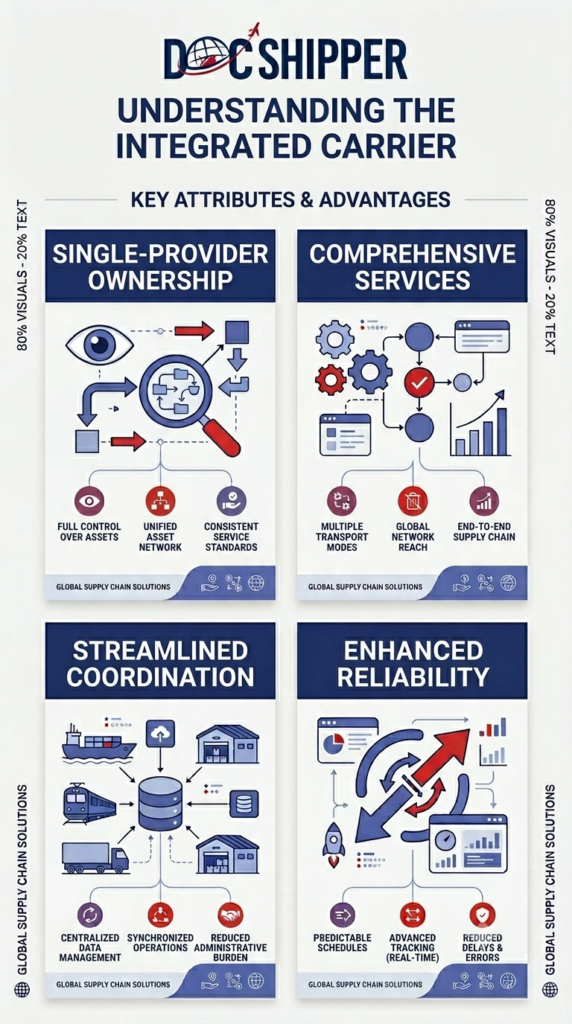
An Integrated Carrier is a logistics operator that provides end-to-end transportation services by controlling multiple stages of the supply chain—typically air freight, ground delivery, customs clearance, and tracking systems—under one corporate umbrella. Unlike traditional forwarders, integrated carriers own their aircraft, vehicles, and sorting hubs, ensuring seamless coordination from pickup to final delivery.
Introduction
Many importers struggle to coordinate shipments across air carriers, trucking companies, and customs brokers—each operating independently. This fragmentation leads to delays, communication gaps, and hidden fees. Integrated carriers eliminate these pain points by unifying all logistics functions within a single organization.
In international trade, integrated carriers have revolutionized express delivery and time-sensitive shipments. Their vertically integrated model enables predictable transit times and real-time visibility, making them the preferred choice for high-value or urgent cargo.
Key characteristics include:
- Asset ownership: They own aircraft, trucks, and warehouses rather than subcontracting.
- Global network: Proprietary sorting hubs in strategic locations worldwide.
- Technology integration: Unified IT systems for tracking, invoicing, and customs documentation.
- Express services: Guaranteed delivery windows (e.g., next-day or 48-hour options).
- Simplified invoicing: Single point of contact for all services.
In-Depth Analysis & Expertise
The integrated carrier model emerged in the 1970s when companies like FedEx pioneered hub-and-spoke networks for overnight delivery. Unlike traditional freight forwarders who negotiate space on third-party carriers, integrated carriers control capacity and schedules. This vertical integration allows them to optimize routes, reduce handling touchpoints, and maintain service consistency.
From a regulatory standpoint, integrated carriers must comply with IATA dangerous goods regulations for air transport while simultaneously meeting ground transportation rules in each country. The IATA Dangerous Goods Regulations govern how integrated carriers classify, pack, and document hazardous materials across their networks.
Operationally, integrated carriers invest heavily in automated sorting facilities where packages are scanned, sorted by destination, and loaded onto outbound flights or trucks within hours. These facilities process millions of parcels daily using conveyor systems, barcode readers, and AI-driven routing algorithms. The customs clearance function is particularly critical—most integrated carriers employ licensed customs brokers at major gateways to expedite clearance before goods reach final destinations.
A crucial advantage is intermodal flexibility. If weather disrupts air operations, integrated carriers can reroute shipments via their own ground networks without coordinating with external partners. This agility minimizes delays and protects service commitments.
At DocShipper, we frequently advise clients on whether to use integrated carriers for time-sensitive shipments or traditional forwarders for cost-sensitive bulk cargo. Our team evaluates service-level requirements and coordinates documentation to ensure seamless handoffs, especially when integrated carriers handle the last-mile delivery after ocean freight.
Practical Examples & Data
The global express delivery market, dominated by integrated carriers, was valued at $366 billion in 2023 and is projected to grow 6.5% annually. The major players—FedEx, UPS, DHL Express, and TNT—control approximately 75% of this market through their integrated networks.
Use Case: Electronics Manufacturer
A smartphone producer in Shenzhen needs to ship 5,000 units to Madrid within 48 hours for a product launch. Using an integrated carrier:
- Day 1, 09:00: Pickup at factory, immediate scanning into tracking system.
- Day 1, 18:00: Air departure from Hong Kong hub on carrier-owned 747.
- Day 2, 08:00: Arrival at European hub (Leipzig or Paris), customs pre-clearance completed.
- Day 2, 20:00: Delivery to Madrid retailer via dedicated truck fleet.
Total cost: approximately $8.50 per kg for express service vs. $2.20 per kg for standard air freight with a traditional forwarder (5-7 day transit).
Comparison: Integrated Carrier vs. Traditional Forwarder
| Criteria | Integrated Carrier | Traditional Forwarder |
|---|---|---|
| Asset Ownership | Owns aircraft, trucks, hubs | Contracts third-party carriers |
| Transit Time | 1-3 days (express) | 5-10 days (standard) |
| Cost (per kg, air) | $7-12 | $2-5 |
| Tracking Visibility | Real-time, single platform | Multiple systems, delayed updates |
| Customs Handling | Integrated clearance at hubs | Third-party brokers, variable speed |
| Best For | High-value, time-critical goods | Cost-sensitive, bulk shipments |
Key Performance Metrics:
- On-time delivery rate: Integrated carriers average 98.5% vs. 92% for mixed-mode logistics.
- Claims ratio: Damage/loss claims are 40% lower due to controlled handling.
- Customs clearance speed: Pre-clearance reduces border delays by 60-80%.
- Carbon footprint: Route optimization cuts fuel consumption by 15-20% per ton-kilometer.
- Documentation errors: Unified systems reduce paperwork mistakes by 50%.
Conclusion
Integrated carriers represent the pinnacle of logistics efficiency for time-sensitive international trade. By consolidating air transport, ground delivery, and customs services under one operational framework, they deliver unmatched reliability—albeit at premium pricing. For businesses where speed and predictability justify higher costs, integrated carriers are the strategic choice.
Need expert guidance on selecting the right carrier model for your shipments? Contact DocShipper for tailored logistics solutions.
📚 Quiz
Test Your Knowledge: Integrated Carrier
What is the defining characteristic of an integrated carrier?
How do integrated carriers handle customs clearance differently from traditional forwarders?
A pharmaceutical company needs to ship 200 kg of temperature-sensitive vaccines from Frankfurt to Singapore with guaranteed 48-hour delivery. Which service model is most appropriate?
🎯 Your Result
📞 Free Quote in 24hFAQ | Integrated Carrier: Definition, Operations & Practical Examples
An integrated carrier owns its transportation assets (aircraft, trucks, warehouses) and provides end-to-end services internally. A freight forwarder acts as an intermediary, booking space on third-party carriers and coordinating multiple vendors. Integrated carriers offer faster transit and unified tracking, while forwarders provide more flexible, cost-effective options for non-urgent cargo.
The primary integrated carriers globally are FedEx, UPS, DHL Express, and TNT (acquired by FedEx in 2016). Regional players include SF Express in China and Aramex in the Middle East. These companies operate proprietary air fleets, sorting hubs, and last-mile delivery networks across dozens of countries.
Yes, typically 2-4 times more expensive for air shipments due to premium speed and service guarantees. For a 100 kg shipment from Asia to Europe, integrated express service costs $800-1,200 vs. $200-500 for standard air freight. The premium covers guaranteed delivery windows, real-time tracking, and comprehensive insurance.
While integrated carriers excel at small parcels and palletized freight (up to 70 kg per piece), they can accommodate larger shipments through dedicated charter services or specialized divisions. However, for industrial machinery or full container loads, traditional ocean/air freight forwarders remain more cost-effective and operationally suited.
They employ in-house customs brokerage teams at major gateways who pre-clear shipments using electronic data interchange (EDI) systems. Before a flight lands, customs declarations are submitted, duties are calculated, and approvals are obtained—enabling immediate release upon arrival. This reduces clearance times from days to hours.
Common tiers include: (1) Same-day or next-flight-out for critical shipments, (2) Next-day delivery by 10:30 AM or end-of-day, (3) Two-day express, and (4) Deferred economy services (3-5 days) at lower rates. Each tier has corresponding pricing and service guarantees with refund policies for missed delivery commitments.
No, their core competency is air express and ground transportation. Some offer ocean freight forwarding through partnerships, but they don't own container ships or operate maritime services. For ocean shipments, businesses typically use dedicated freight forwarders or NVOCCs (Non-Vessel Operating Common Carriers).
Extremely reliable. Each package receives a unique barcode scanned at every touchpoint—pickup, hub sorting, customs, delivery vehicle, and final handoff. Customers access real-time GPS location, delivery photos, and signature confirmations through web portals or mobile apps, typically updated within 5-10 minutes of each event.
Yes, through volume discounts and account programs. While list rates are high, businesses shipping 20+ parcels weekly can negotiate rates 30-50% below published prices. Many integrated carriers offer online calculators and small business programs with tiered pricing based on monthly shipment volume.
Most offer money-back guarantees for express services. If a next-day shipment arrives late (excluding force majeure events like natural disasters), the customer receives a full refund of transportation charges. Claims must be filed within 15-30 days with proof of shipment date and service level purchased.
Yes. Standard express parcels are limited to 70 kg and maximum dimensions of 120 cm x 80 cm x 80 cm. Shipments exceeding these limits require freight services with surcharges. Dimensional weight pricing applies—if a package's volumetric weight (L x W x H / 5000) exceeds actual weight, the higher figure determines the shipping cost.
They follow strict IATA regulations for hazardous materials, requiring proper classification, packaging, labeling, and documentation. Shippers must declare dangerous goods during booking, and only authorized personnel can handle them. Prohibited items (explosives, radioactive materials) are rejected. Training certifications and safety audits ensure compliance across the network.
Need Help with
Logistics or Sourcing ?
First, we secure the right products from the right suppliers at the right price by managing the sourcing process from start to finish. Then, we simplify your shipping experience - from pickup to final delivery - ensuring any product, anywhere, is delivered at highly competitive prices.


Fill the Form
Prefer email? Send us your inquiry, and we’ll get back to you as soon as possible.
Contact us




