



In short ⚡
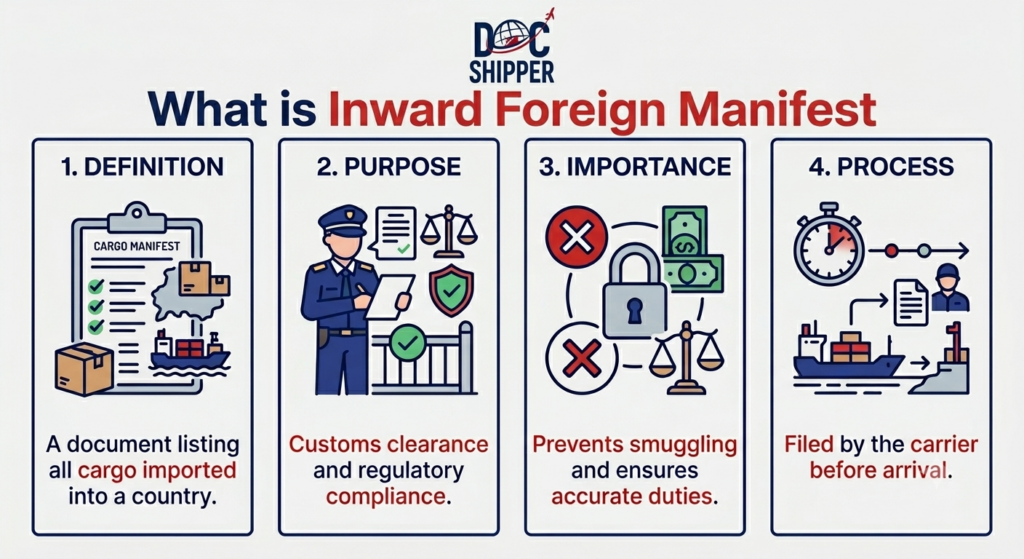
The Inward Foreign Manifest (IFM) is a mandatory customs document submitted by carriers upon arrival in a destination country, listing all cargo onboard an inbound vessel or aircraft. It serves as the primary declaration that triggers customs clearance procedures, enabling authorities to assess duties, verify compliance, and detect prohibited goods before cargo discharge.
Introduction
International shipments often face delays not due to transit issues, but because of incomplete or inaccurate manifest filing. The Inward Foreign Manifest represents the carrier’s first official communication with customs authorities, functioning as the gateway document that determines whether cargo moves smoothly or gets held for inspection.
In global trade operations, the IFM plays a critical role in supply chain visibility and border security. This document directly impacts clearance timelines, demurrage charges, and compliance risk exposure for importers and logistics providers alike.
Key characteristics of the Inward Foreign Manifest include:
- Submission timeline: Must be filed before or immediately upon vessel/aircraft arrival
- Legal responsibility: Carrier obligation, though often prepared by freight forwarders
- Information scope: Complete cargo details including shipper, consignee, goods description, weight, and value
- Customs function: Basis for risk assessment, duty calculation, and cargo tracking
- Penalty exposure: Non-compliance triggers fines ranging from $500 to $10,000 depending on jurisdiction
Regulatory Framework & Legal Requirements
The IFM operates under international customs conventions and national import regulations. Most countries base their manifest requirements on WCO Revised Kyoto Convention standards, which establish minimum data elements for cargo declarations.
The document must contain specific mandatory data fields to satisfy customs requirements. These typically include carrier identification, voyage/flight details, bill of lading numbers, consignee information, cargo description with HS codes, quantity, weight, value, and origin country. Missing or incorrect information can result in cargo holds, additional inspections, or financial penalties.
Filing deadlines vary by jurisdiction but follow common patterns. Maritime shipments typically require advance manifest submission 24 to 48 hours before arrival under security initiatives like the US 24-Hour Rule or EU ICS2 system. Air cargo manifests must be filed before takeoff or immediately upon landing, depending on flight duration and destination country regulations.
The IFM creates legal accountability for cargo accuracy. Carriers assume responsibility for the correctness of manifest data, even when information originates from shippers or forwarders. Discrepancies between the manifest and actual cargo discovered during examination can trigger investigations, fines, and potential criminal liability for smuggling or fraud.
Modern manifest systems integrate with electronic customs platforms such as the US ACE system, EU NCTS, or Singapore TradeNet. These digital environments enable real-time data validation, automated risk scoring, and direct cargo release authorization without physical document review. At DocShipper, we systematically validate all manifest data against commercial invoices and packing lists before submission, ensuring compliance and preventing costly clearance delays.
Practical Examples & Data Comparison
Understanding how manifest requirements differ across transport modes and jurisdictions helps logistics professionals prevent compliance failures. The following comparison illustrates key variations:
| Jurisdiction | Filing Deadline | Mandatory Data Elements | Penalty for Non-Compliance |
|---|---|---|---|
| United States (CBP) | 24 hours before loading | 10+2 data elements including manufacturer details | $5,000 per violation |
| European Union (ICS2) | Pre-loading for air; 4 hours before arrival for sea | ENS data including economic operator identification | €500-€10,000 depending on member state |
| Singapore (TradeNet) | Upon arrival (grace period applies) | Standard manifest plus UEN/FIN numbers | SGD 1,000 first offense |
| Australia (ICS) | 48 hours before departure from origin | Full cargo reporting including country of origin | AUD 420 per container penalty unit |
Real-world scenario: A European importer orders electronics from Shenzhen with delivery to Rotterdam. The carrier must file an ICS2 Entry Summary Declaration containing detailed product descriptions and 6-digit HS codes at least 4 hours before the vessel reaches EU waters. Failure to include the manufacturer’s EORI number results in a “Do Not Load” message, preventing cargo discharge.
The financial impact becomes apparent when examining delay costs. A single missing data element causing a 24-hour clearance delay generates approximately $500-$800 in container demurrage charges at major ports. For time-sensitive shipments like automotive parts or perishable goods, the operational disruption can cost thousands in lost production or spoilage.
Data accuracy requirements have intensified under modern security frameworks. Customs authorities now cross-reference manifest information against shipper declarations, tax records, and watchlist databases in real-time. Discrepancies of even 1% in declared values can trigger selectivity for physical examination, extending clearance from 6 hours to 3-5 days.
Technology integration demonstrates measurable compliance improvement. Companies implementing automated manifest validation systems report 67% fewer customs holds compared to manual document preparation. Electronic manifests enable instant error detection, version control, and audit trail documentation that manual processes cannot match.
At DocShipper, we leverage integrated customs software to validate every manifest submission against current regulations across 150+ countries, ensuring your cargo clears without administrative delays or compliance penalties.
Conclusion
The Inward Foreign Manifest serves as the foundational customs document that determines clearance efficiency and compliance risk. Accurate, timely filing protects against penalties while enabling smooth cargo flow through international borders.
Need expert support with manifest preparation and customs compliance? Contact DocShipper for comprehensive logistics solutions tailored to your import operations.
📚 Quiz
Test Your Knowledge: Inward Foreign Manifest (IFM)
What is the primary function of the Inward Foreign Manifest in international trade?
Who bears the legal responsibility for the accuracy of the Inward Foreign Manifest?
A European electronics importer discovers their manifest was filed 2 hours before vessel arrival instead of the required 4 hours. What is the most likely consequence?
🎯 Your Result
📞 Free Quote in 24hFAQ | Inward Foreign Manifest (IFM): Definition, Requirements & Practical Examples
The carrier (shipping line or airline) holds primary legal responsibility for IFM filing. However, this duty is often delegated to freight forwarders or customs brokers through contractual arrangements. Regardless of who physically submits the document, the carrier remains liable for accuracy and compliance with customs regulations.
Manifest discrepancies trigger various consequences depending on severity. Minor errors may require amendment filings with administrative fees. Significant omissions can result in cargo holds, physical inspections, fines ranging from $500-$10,000, and potential seizure if fraud is suspected. Repeated violations may lead to enhanced scrutiny on future shipments.
Yes, most customs authorities permit manifest amendments through official procedures. Amendments must be submitted before cargo examination begins and typically incur processing fees. The timeframe for corrections varies by jurisdiction—some systems allow changes up to 24 hours post-arrival, while others impose stricter deadlines.
The IFM is specifically a customs declaration document, while a cargo manifest is a broader commercial listing of shipment contents. A bill of lading serves as a contract of carriage and title document. The IFM extracts information from these commercial documents but adds regulatory data elements required by customs authorities for risk assessment and duty calculation.
Essential data elements include carrier identification, conveyance details (vessel/flight number), port of loading, bill of lading numbers, shipper and consignee information, cargo description with HS classification codes, quantity, weight, value, marks and numbers, container numbers, and country of origin. Electronic systems may require additional fields like manufacturer details or economic operator identifiers.
Commercial shipments generally require full IFM filing regardless of value, though some countries exempt low-value goods below de minimis thresholds (typically $800-$1,000). Personal effects and household goods follow different procedures, often using simplified passenger or household effects manifests rather than standard commercial IFM formats.
Timing requirements vary by country and transport mode. Maritime cargo typically requires 24-48 hours advance filing before arrival. Air shipments must be filed before takeoff or upon landing depending on flight duration. The US ISF (10+2) requires submission 24 hours before loading at origin port. Always verify specific requirements for your destination country.
Modern advance cargo information (ACI) systems like the US ACE or Canada ACI are electronic platforms that receive IFM data for security screening before physical arrival. The IFM provides the data content, while ACI systems represent the technical infrastructure for data transmission, validation, and risk assessment. Both work together to enable advance clearance decisions.
Yes, a single IFM typically consolidates all cargo aboard a vessel or aircraft, listing each house bill of lading or air waybill as separate line items. Master manifests summarize contents of multiple containers or freight units. However, each individual shipment must be fully detailed with complete commercial information to satisfy customs requirements.
Free trade agreements do not eliminate IFM filing requirements but may reduce duty assessments once goods clear customs. Preferential tariff treatment requires additional documentation (certificates of origin) submitted alongside or referenced in the manifest. The IFM remains mandatory for cargo tracking and security purposes regardless of duty-free status under trade agreements.
Late filing penalties vary by jurisdiction but typically range from $500-$5,000 per violation for first offenses. Repeated violations incur escalating fines and may result in cargo holds, increased inspection rates, or suspension of simplified clearance privileges. Some countries calculate penalties per container or per bill of lading, multiplying financial exposure for consolidated shipments.
Record retention requirements typically mandate 5-7 years for customs documents, though specific periods vary by country. The US requires 5 years from entry date, while the EU mandates retention for potential audits up to 10 years for certain goods. Electronic systems automatically archive manifest data, but carriers must ensure accessibility throughout the required retention period.
Need Help with
Logistics or Sourcing ?
First, we secure the right products from the right suppliers at the right price by managing the sourcing process from start to finish. Then, we simplify your shipping experience - from pickup to final delivery - ensuring any product, anywhere, is delivered at highly competitive prices.


Fill the Form
Prefer email? Send us your inquiry, and we’ll get back to you as soon as possible.
Contact us




:%20Definition,%20Requirements%20&%20Practical%20Examples)