


In short ⚡
Jidoka is a lean manufacturing principle that enables machines and operators to detect abnormalities and stop production immediately to prevent defects. Originating from Toyota's production system, this autonomation concept integrates quality control into the manufacturing process, ensuring only conforming products advance through the supply chain.
Introduction
Why do manufacturers repeatedly ship defective products despite rigorous quality checks? The answer lies in detecting problems too late in the production cycle. Traditional mass production separates quality control from manufacturing, creating costly rework loops and delivery delays.
Jidoka revolutionized this approach by embedding quality verification directly into production equipment. In international logistics, this principle extends beyond factory floors to warehousing, freight forwarding, and customs clearance operations where defects multiply costs exponentially.
Key characteristics of Jidoka include:
- Automatic defect detection through sensors and monitoring systems
- Immediate production stoppage when abnormalities occur
- Visual management using andon signals for rapid response
- Root cause analysis to prevent recurring issues
- Human-machine collaboration balancing automation with judgment
Implementation & Strategic Value
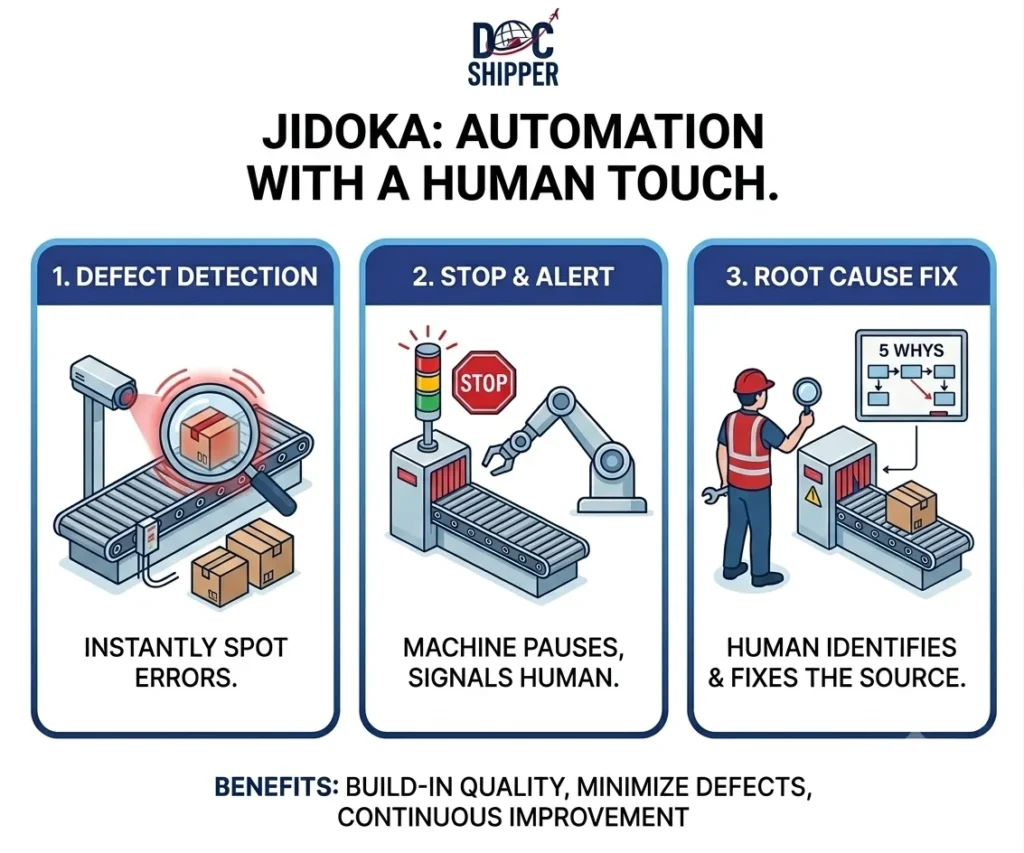
Jidoka operates on four fundamental stages: detection, stoppage, notification, and correction. Unlike full automation that continues regardless of defects, Jidoka equipment possesses “intelligence” to distinguish normal from abnormal conditions.
The detection mechanism employs sensors, limit switches, or machine vision systems monitoring parameters like dimensions, weight, temperature, or sequence completion. When readings exceed tolerance thresholds, the system triggers stoppage protocols before defective units contaminate downstream processes.
Visual management systems form the notification backbone. Andon boards display real-time production status using color codes: green for normal operation, yellow for attention needed, red for line stoppage. This transparency enables supervisors to prioritize responses and allocate resources efficiently.
The separation of human and machine work represents Jidoka’s strategic advantage. Operators no longer babysit equipment but monitor multiple stations, intervening only when machines signal problems. This multiplies workforce productivity while maintaining quality standards.
According to the ISO 9001:2015 quality management framework, integrating Jidoka principles aligns with process approach requirements and continual improvement objectives. At DocShipper, we apply these detection principles to pre-shipment inspections, catching product non-conformities before containers leave origin ports.
Poka-yoke devices complement Jidoka by preventing errors before they occur. These mistake-proofing mechanisms use physical guides, fixtures, or software constraints ensuring operations execute correctly. Combined approaches reduce defect rates to near-zero levels in world-class facilities.
Real-World Applications & Data
Manufacturing environments demonstrate Jidoka’s quantifiable impact. A European automotive supplier reduced defect rates by 73% after installing vision systems on assembly lines, detecting component misalignments invisible to human operators at production speeds.
Comparative Analysis: Traditional vs. Jidoka Systems
| Metric | Traditional Production | Jidoka Implementation | Improvement |
|---|---|---|---|
| Defect Detection Time | 2-4 hours (end-line QC) | Immediate (real-time) | 99% faster |
| Defect Rate | 2,500 PPM | 180 PPM | 93% reduction |
| Operator Productivity | 1 line per operator | 5 lines per operator | 400% increase |
| Quality Cost (% of sales) | 4.2% | 1.1% | 74% savings |
| Customer Returns | 850 units/month | 95 units/month | 89% decrease |
Logistics Application Case Study
A Southeast Asian electronics exporter implemented Jidoka principles in their consolidation warehouse. Weight verification systems automatically rejected cartons deviating more than 2% from declared values, preventing costly customs penalties.
Results after six months:
- Zero customs fines (previously $47,000 annually)
- Documentation accuracy increased to 99.7%
- Packing errors reduced by 81%
- Customer claims dropped from 23 to 3 per quarter
- Warehouse throughput improved 18% without additional labor
DocShipper integrates similar verification protocols across our warehousing network, using barcode validation and dimensional scanning to catch discrepancies before shipment consolidation begins.
Technology Evolution
Modern Jidoka implementations leverage IoT sensors, AI-powered image recognition, and predictive maintenance algorithms. A Japanese textile manufacturer deployed machine learning models analyzing vibration patterns, predicting loom failures 36 hours in advance with 94% accuracy.
Cloud-connected Jidoka systems enable global visibility for distributed operations. Quality managers monitor multiple facilities simultaneously, identifying systemic issues affecting production consistency across continents.
Conclusion
Jidoka transforms quality from inspection-based detection to prevention-focused design, eliminating defects at their source rather than discovering them downstream. This principle applies universally across manufacturing, logistics, and service operations where consistency determines competitiveness.
Need expert guidance implementing quality controls in your supply chain? Contact DocShipper for customized solutions ensuring your shipments meet specifications every time.
📚 Quiz
Test Your Knowledge: Jidoka
What is the primary defining characteristic of Jidoka compared to standard automation?
A manufacturer believes Jidoka requires expensive high-tech equipment beyond their budget. What is the correct interpretation?
A freight forwarder wants to apply Jidoka principles to their operations. Which scenario correctly demonstrates this application?
🎯 Your Result
📞 Free Custom Quote in 24hFAQ | Jidoka: Definition, Implementation & Real-World Examples
Standard automation continues operating regardless of defects, while Jidoka equipment possesses built-in intelligence to detect abnormalities and stop immediately. Traditional automation requires constant human supervision; Jidoka enables one operator to monitor multiple machines, intervening only when systems signal problems. This autonomation approach combines mechanical efficiency with human judgment.
By stopping production at the first defect, Jidoka prevents waste multiplication through subsequent processes. Early detection eliminates rework costs, material waste, and labor spent handling defective units. Operators managing multiple stations increase productivity 3-5x compared to traditional assignments. Quality costs typically drop 60-80% within the first year of proper implementation.
Absolutely. Jidoka doesn't require expensive automation. Simple poka-yoke devices—guides, fixtures, color coding—cost minimal amounts while preventing common errors. Visual management boards using whiteboards and colored magnets enable basic andon systems. Progressive implementation starts with highest-impact processes, expanding as benefits accumulate. Many SMEs achieve significant quality improvements with investments under $5,000.
Operators shift from process execution to process monitoring and improvement. When machines signal problems, workers investigate root causes and implement countermeasures rather than simply restarting equipment. This problem-solving responsibility increases engagement and surfaces improvement opportunities invisible to management. Operators become quality engineers for their stations, contributing expertise machines cannot replicate.
Pilot implementations on single production lines require 3-6 months including equipment modification, sensor installation, and operator training. Full facility deployment spans 12-24 months depending on complexity and scale. Quick wins emerge within weeks as basic error-proofing devices prevent common mistakes. Sustainable culture change establishing continuous improvement mindsets requires 2-3 years of consistent leadership reinforcement.
Service industries successfully adapt Jidoka concepts using digital workflows. Banking systems detect fraudulent transactions and freeze accounts automatically. Hospital medication dispensers verify prescriptions against patient records, alerting nurses to potential errors. Call center software flags customer service issues requiring supervisor intervention. Any process with definable standards benefits from automated abnormality detection.
Key performance indicators include defect detection rate (percentage caught before reaching customers), mean time to detection (how quickly problems surface), first-pass yield (units passing without rework), and andon activation frequency (how often lines stop). Secondary metrics track operator productivity per station monitored and quality cost as percentage of sales. Benchmark facilities achieve under 100 PPM defect rates with detection times under 5 minutes.
Jidoka provides real-time data Six Sigma projects require for root cause analysis. Automated defect detection creates precise records of failure modes, frequencies, and conditions. This data feeds DMAIC improvement cycles with factual evidence rather than estimates. Six Sigma teams use Jidoka systems to validate countermeasure effectiveness, monitoring whether implemented solutions actually prevent recurrence. Both methodologies share prevention-focused philosophies.
Cultural resistance tops the list—operators accustomed to constant activity may perceive monitoring roles as less valuable. Management must reinforce that problem-solving adds more value than repetitive tasks. Technical challenges include sensor calibration requiring precision beyond standard maintenance skills. Balancing sensitivity (catching all defects) against false positives (unnecessary stoppages) demands iterative refinement. Initial productivity dips during transition periods test leadership commitment.
Suppliers implementing Jidoka deliver more consistent quality, reducing incoming inspection requirements and enabling just-in-time deliveries. Downstream customers receive fewer defects, lowering warranty costs and strengthening brand reputation. Shared quality standards facilitate collaborative improvement programs where partners exchange best practices. Transparent defect data builds trust, transforming adversarial negotiations into cooperative problem-solving relationships.
Freight forwarders adopt Jidoka through automated documentation verification systems flagging incomplete or inconsistent shipping paperwork before customs submission. Weight and dimension scanners detect misdeclared cargo preventing penalty assessments. Container tracking alerts notify coordinators of transit delays requiring proactive customer communication. These quality gates prevent errors from escalating into costly service failures, maintaining on-time delivery performance.
Training covers three areas: technical operation of detection equipment and andon systems, problem-solving methodologies like 5 Whys and fishbone diagrams, and quality mindset emphasizing prevention over detection. Hands-on simulations using actual production scenarios build confidence responding to abnormalities. Cross-training across multiple stations develops versatility enabling flexible workforce deployment. Ongoing coaching reinforces root cause analysis discipline preventing superficial fixes.
Need Help with
Logistics or Sourcing ?
First, we secure the right products from the right suppliers at the right price by managing the sourcing process from start to finish. Then, we simplify your shipping experience - from pickup to final delivery - ensuring any product, anywhere, is delivered at highly competitive prices.


Fill the Form
Prefer email? Send us your inquiry, and we’ll get back to you as soon as possible.
Contact us




