


In short ⚡
Kanban is a visual workflow management method originating from Toyota's manufacturing system that uses cards or signals to control inventory levels and production flow. In international logistics, it enables just-in-time inventory replenishment, reducing storage costs while ensuring continuous supply chain operations through pull-based demand signaling.Introduction
Many companies struggle with the classic dilemma: maintain excessive inventory to avoid stockouts, or minimize storage to reduce costs. This balancing act becomes even more critical in international trade, where lead times span weeks and transportation costs significantly impact profitability.
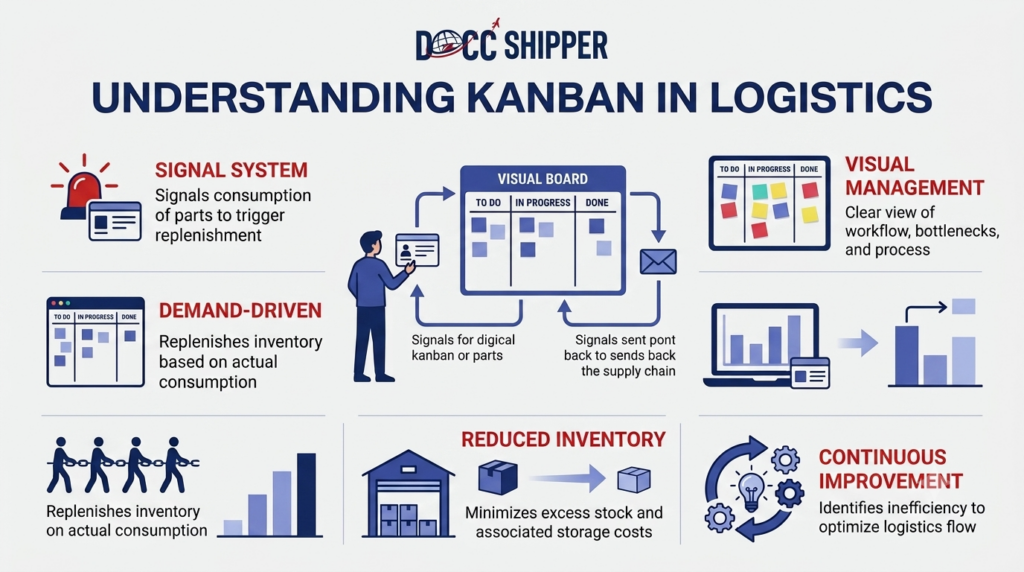
Kanban solves this challenge by creating a visual signaling system that triggers replenishment only when inventory reaches predetermined levels. Originally developed for manufacturing, this methodology has become indispensable for modern supply chain management, particularly in import/export operations.
Key characteristics of Kanban in international logistics:
- Pull-based system: Replenishment triggered by actual consumption rather than forecasts
- Visual management: Physical or digital cards representing inventory status at a glance
- Continuous flow: Minimizes work-in-progress while maintaining service levels
- Flexibility: Adaptable to various cargo types, from FCL containers to air freight pallets
- Waste reduction: Eliminates overproduction and excess inventory holding costs
Deep Dive & Logistics Expertise
The Kanban system operates on three fundamental principles: visualization of work, limitation of work-in-progress, and management of flow. In international logistics, these translate into specific operational practices that optimize the entire supply chain.
A typical Kanban implementation uses three types of cards: production Kanban (signaling manufacturing needs), transport Kanban (triggering movement between locations), and supplier Kanban (initiating orders from external vendors). For importers, the supplier Kanban becomes particularly relevant when managing overseas suppliers across multiple countries.
The calculation of Kanban quantities requires precise data: average daily demand, lead time (including international shipping), safety stock percentage, and container capacity. The formula commonly used is: Number of Kanbans = [(Daily Demand × Lead Time) + Safety Stock] ÷ Container Size. This ensures optimal reorder points aligned with shipping schedules.
From a customs and compliance perspective, Kanban systems must integrate with regulatory requirements. The Union Customs Code in Europe, for example, requires accurate inventory records that Kanban naturally supports through its tracking mechanisms. Each card movement creates an audit trail essential for customs authorities.
Advanced implementations leverage electronic Kanban (e-Kanban), replacing physical cards with digital signals transmitted via EDI or cloud platforms. This proves invaluable for international operations where suppliers and warehouses span different time zones. At DocShipper, we integrate e-Kanban systems with customs clearance platforms to automate documentation flows, reducing clearance times by up to 40%.
The methodology also addresses seasonal variations and demand spikes through dynamic Kanban sizing. Rather than fixed quantities, modern systems adjust card values based on rolling forecasts and real-time sales data, maintaining the pull philosophy while accommodating market fluctuations common in global trade.
Practical Examples & Data
Understanding Kanban’s impact requires examining real-world applications and quantitative results. Consider an electronics importer shipping from Shenzhen to Rotterdam with a 28-day average lead time and daily demand of 500 units per SKU.
Use Case: Electronics Distributor Implementation
A mid-sized distributor importing smartphone accessories implemented Kanban with these parameters: daily consumption of 500 units, 28-day ocean freight lead time, 15% safety stock, and 40-foot container capacity of 15,000 units. Calculation: [(500 × 28) + (14,000 × 0.15)] ÷ 15,000 = 1.07 containers, rounded to 2 Kanban cards per SKU.
This setup meant triggering a new container order when the first Kanban card was consumed, ensuring continuous availability while minimizing warehouse space. Results after six months: inventory holding costs reduced by 32%, stockouts decreased from 8% to 1.2%, and warehouse space requirements dropped by 40%.
| Metric | Before Kanban | After Kanban | Improvement |
|---|---|---|---|
| Average Inventory Value | $450,000 | $306,000 | 32% reduction |
| Stockout Rate | 8.0% | 1.2% | 85% reduction |
| Warehouse Space (sq.m) | 1,200 | 720 | 40% reduction |
| Order Processing Time | 4.5 days | 1.2 days | 73% reduction |
| Annual Holding Costs | $90,000 | $61,200 | $28,800 saved |
Air Freight vs. Ocean Freight Kanban Scenarios:
For high-value, low-volume products, Kanban calculations differ significantly. An automotive parts supplier using air freight from Germany to Japan with 5-day lead time requires: [(200 units/day × 5 days) + 20% safety stock] ÷ 1,000 units per pallet = 1.2 pallets, rounded to 2 Kanban cards.
Compare this to ocean freight for the same route: 35-day lead time changes the equation to: [(200 × 35) + 20% safety stock] ÷ 5,000 units per container = 1.68 containers, rounded to 2 Kanban cards. Despite similar card quantities, the ocean scenario carries significantly more inventory value, illustrating the cost-speed trade-off inherent in international logistics.
Industry data shows that companies implementing Kanban in cross-border operations achieve average inventory reductions of 25-35% while improving on-time delivery rates from 78% to 94%. These improvements translate to substantial working capital liberation—critical for SMEs managing international trade cash flow.
Conclusion
Kanban transforms inventory management from a forecasting guessing game into a demand-driven precision system, particularly valuable in the complex world of international logistics where lead times, customs procedures, and multiple stakeholders create operational challenges. By visualizing workflow and triggering replenishment based on actual consumption, companies minimize waste while maintaining service levels.
Whether you’re managing FCL shipments from Asia or consolidating LCL cargo from European suppliers, implementing Kanban principles requires expertise in both methodology and international trade mechanics. Need guidance integrating Kanban into your supply chain? Contact DocShipper for tailored logistics solutions that optimize your inventory flow across borders.
📚 Quiz
Test Your Knowledge: Kanban in International Logistics
What is the core principle that differentiates Kanban from traditional reorder point systems?
When calculating Kanban quantities for ocean freight shipments, which lead time components MUST be included?
An importer ships electronics from Shenzhen with 28-day lead time and 500 units daily demand. Their calculation shows 2.3 Kanban containers needed. What should they implement?
🎯 Your Results
📞 Free Quote in 24hFAQ | Kanban: Definition, Implementation & Practical Examples in Logistics
Traditional reorder point systems use fixed minimum quantities to trigger orders based on forecasts, often resulting in excess inventory. Kanban creates a pull system where replenishment occurs only when actual consumption reaches specific thresholds, visualized through cards or signals. This reduces overstock by 25-40% while maintaining availability, as inventory levels directly reflect real demand rather than predictions.
Use the formula: Number of Kanbans = [(Average Daily Demand × Total Lead Time in Days) + Safety Stock] ÷ Container/Package Quantity. Total lead time must include production time, international transit, customs clearance, and last-mile delivery. For ocean freight from Shanghai to Los Angeles (typical 18-day transit), add 3-5 days for customs and inland transport, resulting in a 21-26 day lead time for calculation purposes.
Yes, through dynamic Kanban sizing and buffer management. Instead of fixed card quantities, modern implementations adjust Kanban values monthly or quarterly based on rolling demand data. Implement seasonal coefficients (e.g., 1.3x for peak seasons) and use statistical process control to monitor demand variability. When coefficient of variation exceeds 0.5, consider hybrid approaches combining Kanban for stable SKUs with traditional forecasting for volatile items.
Key challenges include time zone coordination (suppliers in Asia, warehouses in Europe), varying lead time reliability by origin country, customs documentation complexity, and currency fluctuations affecting reorder economics. Electronic Kanban systems integrated with EDI solve coordination issues, while building 10-20% additional safety stock for routes with high variability (Africa, South America) maintains system stability despite unpredictable delays.
Kanban cards should trigger not just supplier orders but also customs broker notifications for pre-clearance preparation. Modern e-Kanban systems transmit shipment data directly to customs platforms, enabling brokers to prepare documentation (commercial invoices, certificates of origin, HS code classifications) before cargo arrival. This reduces clearance time from 3-5 days to 4-8 hours, critical for maintaining just-in-time flow.
Target 85-95% container utilization to balance efficiency with Kanban flexibility. Lower utilization (60-75%) wastes shipping costs, while pushing above 95% creates rigidity that undermines Kanban's responsiveness. For mixed SKU containers, use modular packaging aligned with Kanban quantities—if your calculation yields 2.3 Kanbans per container, adjust package sizes to achieve exactly 2.0 or 3.0 for cleaner triggering logic.
Review quarterly as baseline, with monthly adjustments during market volatility. Key triggers for immediate recalculation include: sustained demand changes exceeding 20%, lead time variations beyond 15% from baseline, new trade agreements affecting duties/transit times, or carrier schedule changes. Automotive and electronics sectors often implement monthly reviews due to rapid product lifecycle changes and demand fluctuations.
Partially, but complete elimination is unrealistic for international trade. Kanban typically reduces safety stock requirements by 30-50% compared to traditional systems by improving flow predictability. However, maintain safety buffers for customs delays, port congestion, and carrier reliability issues. Formula: Safety Stock = (Maximum Lead Time - Average Lead Time) × Average Daily Demand, where maximum lead time accounts for historical worst-case scenarios.
Supplier MOQs often conflict with ideal Kanban quantities calculated for pull systems. Solutions include: negotiating flexible MOQs with long-term volume commitments, consolidating multiple SKUs from single suppliers to meet MOQs while maintaining individual Kanban logic, or using freight forwarder consolidation services. When MOQ equals 3 months' supply but Kanban suggests 45 days, compromise at 60 days with more frequent monitoring.
IoT sensors, RFID tracking, and cloud platforms transform physical Kanban cards into real-time digital signals. Warehouse management systems automatically trigger supplier portals when inventory reaches reorder points, eliminating manual card handling. Blockchain integration creates immutable audit trails satisfying customs requirements across jurisdictions. AI algorithms predict lead time variations and adjust Kanban parameters dynamically, improving system responsiveness by 40-60% compared to static manual approaches.
Primary KPIs include: inventory turnover ratio (target 8-12 for most industries), stockout frequency (below 2%), average inventory value reduction (benchmark against pre-Kanban baseline), order cycle time from signal to delivery, container utilization rate, and working capital tied in inventory. Secondary metrics: Kanban card circulation time, supplier response time variability, customs clearance duration, and cost per unit delivered including all logistics elements.
Yes, but requires modified parameters prioritizing freshness over pure inventory minimization. Calculate Kanban quantities using remaining shelf life as constraint: Maximum Inventory = (Shelf Life - Lead Time - Safety Days) × Daily Demand. For produce with 21-day shelf life and 10-day air freight lead time from South America, maintain maximum 8 days' inventory (21 - 10 - 3 safety days). This often necessitates smaller, more frequent shipments despite higher per-unit logistics costs.
Need Help with
Logistics or Sourcing ?
First, we secure the right products from the right suppliers at the right price by managing the sourcing process from start to finish. Then, we simplify your shipping experience - from pickup to final delivery - ensuring any product, anywhere, is delivered at highly competitive prices.


Fill the Form
Prefer email? Send us your inquiry, and we’ll get back to you as soon as possible.
Contact us




