


In short ⚡
Kitting is a logistics process that involves assembling individual items into ready-to-ship sets or packages according to specific orders. This method optimizes warehouse operations by pre-grouping components before final assembly or distribution, reducing picking time and improving order accuracy in supply chain management.Introduction
In international trade, businesses frequently ship products requiring multiple components or accessories. Sending items separately creates confusion, delays, and increased costs. This is where kitting becomes essential.
Kitting transforms scattered inventory into organized, ready-to-use packages. This strategic approach is particularly valuable for manufacturers, e-commerce sellers, and distributors managing complex product catalogs across global markets.
Key characteristics of effective kitting operations include:
- Pre-assembly of complementary items into single SKUs before order fulfillment
- Customization capabilities allowing product variations without maintaining separate inventory
- Warehouse space optimization through consolidated storage of kit components
- Reduced picking errors by handling one kit instead of multiple individual items
- Faster order processing during peak seasons or promotional campaigns
Kitting Process & Strategic Advantages
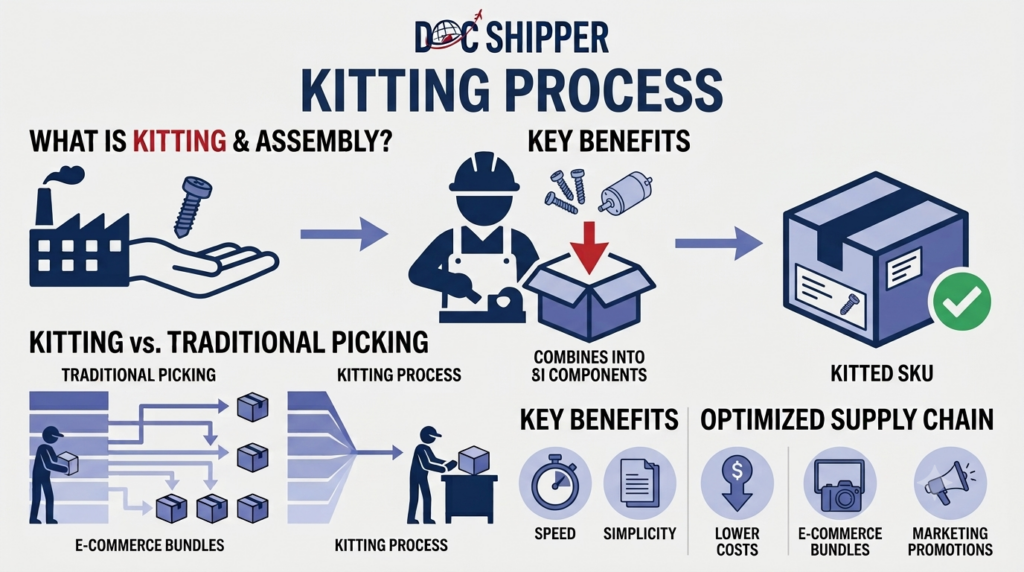
The kitting process involves several coordinated stages. First, inventory analysis identifies which items should be grouped based on order patterns. Companies analyze sales data to determine high-demand combinations.
Next comes kit definition, where businesses establish the exact components, quantities, and packaging specifications for each kit. This includes creating new SKUs in warehouse management systems to track kits as single units.
The assembly phase physically brings items together. Workers retrieve components from separate locations and combine them into designated packaging. Quality control verifies that each kit contains correct items in proper condition.
From a customs perspective, kitted products may require special documentation. When exporting kits containing items from different HS codes, proper classification becomes critical. The World Customs Organization provides guidelines on classifying assembled sets under the Harmonized System.
Strategic advantages extend beyond operational efficiency. Marketing flexibility allows companies to create promotional bundles without manufacturing new products. Inventory control improves as businesses maintain component-level stock rather than finished kit inventory.
At DocShipper, we coordinate kitting operations within our warehouse facilities, ensuring your components are properly assembled and documented before international shipment. This eliminates the risk of incomplete orders reaching overseas customers.
Practical Applications & Industry Data
Kitting applications vary significantly across industries. Understanding real-world scenarios demonstrates how this strategy delivers measurable benefits in international logistics operations.
Industry-Specific Kitting Applications
| Industry | Kit Example | Efficiency Gain |
|---|---|---|
| Electronics | Device + charger + cable + manual | 40% faster picking time |
| Cosmetics | Skincare routine sets (cleanser + toner + serum) | 25% increase in average order value |
| Industrial Equipment | Machine + accessories + spare parts + tools | 60% reduction in assembly errors |
| Subscription Boxes | Monthly curated product collections | 50% faster fulfillment cycles |
| Automotive | Maintenance kits (filters + fluids + gaskets) | 35% lower shipping costs per unit |
Case Study: E-commerce Electronics Exporter
A European smartphone accessories supplier exports to 15 countries. Previously, they shipped phone cases, screen protectors, and charging cables as separate items. Customers often received incomplete orders due to picking errors.
After implementing kitting:
- They created 12 standard kit combinations based on sales data analysis
- Order accuracy improved from 87% to 98.5%
- Warehouse labor costs decreased by 30% during peak season
- Customer satisfaction scores increased by 22 points
- Returns related to missing items dropped by 73%
The company now processes 2,400 additional orders weekly with the same warehouse staff, demonstrating kitting’s scalability advantages for growing international businesses.
Conclusion
Kitting represents a strategic logistics solution that directly impacts operational efficiency and customer satisfaction. By pre-assembling components into ready-to-ship packages, businesses reduce errors, accelerate fulfillment, and create flexible product offerings without additional manufacturing costs.
Need assistance implementing kitting solutions for your international shipments? Contact DocShipper to discuss how we can optimize your supply chain operations.
📚 Quiz
Test Your Knowledge: Kitting
What is the primary definition of kitting in logistics?
What is the key difference between kitting and bundling?
A European electronics exporter ships phone cases, screen protectors, and charging cables. They experience 13% order errors due to picking mistakes. What would kitting these items achieve?
🎯 Your Results
📞 Free Quote in 24hFAQ | Kitting: Definition, Process & Practical Examples in Logistics
Kitting involves assembling separate components into a new SKU before customer orders, creating a distinct inventory item. Bundling typically refers to grouping products at checkout or during promotions without creating new inventory records. Kitting is a warehouse operation; bundling is primarily a sales strategy.
Kitted products may require classification under a single HS code if they constitute a set for retail sale. Alternatively, each component may need individual declaration depending on customs regulations in the destination country. Proper documentation must list all kit contents with accurate values and origins to ensure smooth customs clearance.
Yes, kitting consolidates multiple items into one package, reducing dimensional weight charges and handling fees. Shipping one kit instead of three separate items can lower costs by 20-40% depending on carrier rates and destination. Additionally, consolidated packaging reduces the risk of lost or delayed partial shipments.
Effective WMS solutions for kitting include bill-of-materials (BOM) functionality, component tracking, kit assembly workflows, barcode scanning for accuracy verification, inventory deduction at component level, and reporting on kit performance. Integration with order management systems ensures real-time inventory visibility across all kit components.
Businesses analyze order history to identify frequently purchased combinations, examine product relationships (complementary items), consider marketing strategies (promotional sets), evaluate profit margins on bundled offerings, and assess warehouse capacity for storing assembled kits. Data-driven decisions based on purchasing patterns yield the highest kitting ROI.
Initial kitting implementation requires upfront labor for assembly, but overall costs typically decrease by 25-35% per order. Pre-assembled kits eliminate repeated picking trips during order fulfillment, reduce training time for seasonal workers, and minimize costly picking errors. The break-even point usually occurs within 3-6 months for high-volume operations.
Kitting works for perishables when assembly occurs close to shipment dates rather than maintaining pre-assembled stock. Just-in-time kitting allows fresh product inclusion while retaining efficiency benefits. Temperature-controlled kitting areas and first-expire-first-out (FEFO) protocols ensure product quality in food, pharmaceutical, and cosmetic applications.
Kitting improves forecasting by shifting focus to component-level planning rather than predicting demand for every kit variation. This reduces stockout risks and overstock situations. Companies maintain safety stock for individual components used across multiple kits, optimizing inventory investment and warehouse space utilization by 15-30%.
Automated kitting solutions include robotic picking systems, conveyor-based assembly lines, and automated packaging equipment. However, implementation costs range from $200,000 to $2 million depending on complexity. Automation makes sense for high-volume, standardized kits with consistent demand. Many businesses successfully use semi-automated solutions combining technology with manual quality checks.
Best practices include barcode scanning verification at each assembly step, weight validation to detect missing components, photographic documentation of completed kits, random sample inspections, standard operating procedures (SOPs) for assembly sequences, and performance tracking by individual kit assembler. These measures maintain accuracy rates above 99% in professional operations.
Kitting can complicate returns when customers want to return only one component from a set. Clear policies should specify whether partial returns are accepted and how restocking fees apply. For warranty purposes, tracking kit assembly dates helps determine coverage periods. Some companies assign unique serial numbers to kits for traceability throughout the product lifecycle.
International kit packaging must protect all components during long-distance transport, accommodate customs inspections without damage, display clear labeling in destination language, meet regulatory requirements for the strictest component (batteries, liquids, etc.), and optimize dimensional weight to control shipping costs. Sustainable packaging materials increasingly matter to global consumers and environmental regulations.
Need Help with
Logistics or Sourcing ?
First, we secure the right products from the right suppliers at the right price by managing the sourcing process from start to finish. Then, we simplify your shipping experience - from pickup to final delivery - ensuring any product, anywhere, is delivered at highly competitive prices.


Fill the Form
Prefer email? Send us your inquiry, and we’ll get back to you as soon as possible.
Contact us




