


In short ⚡
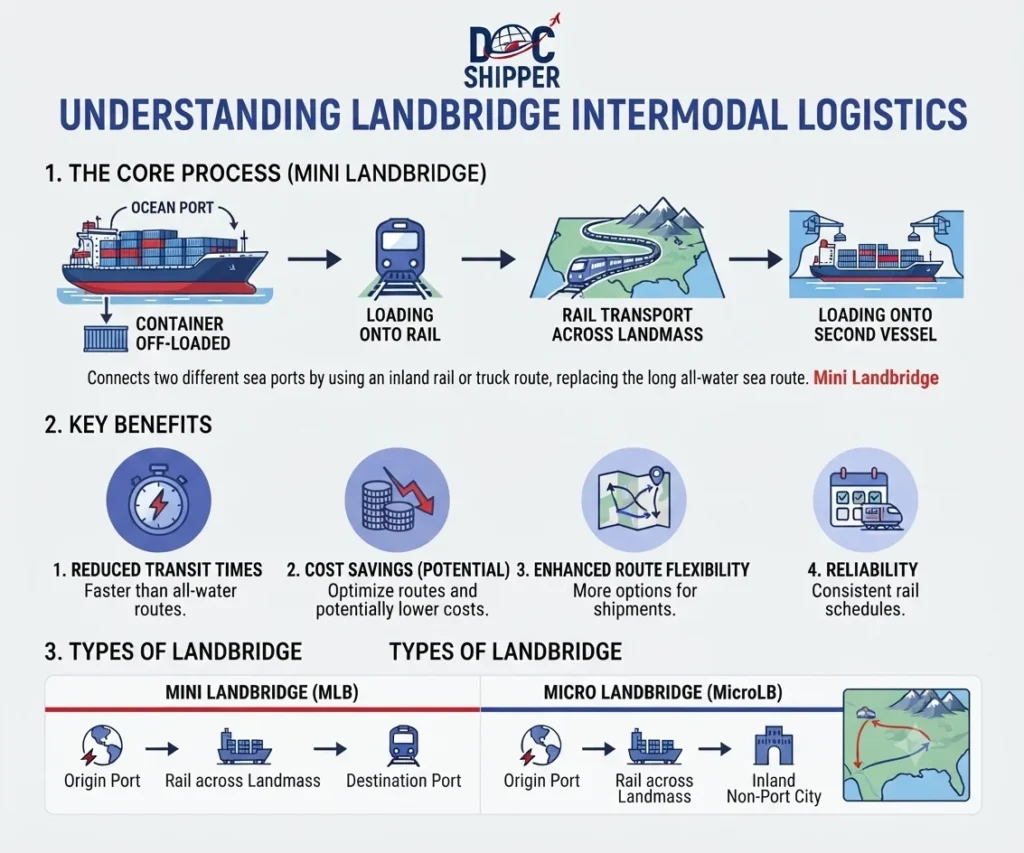
Landbridge is an intermodal logistics strategy where cargo crosses a continental landmass by rail or truck between two ocean ports, replacing maritime routes. This transcontinental shortcut reduces transit times and costs by avoiding longer sea voyages around continents, commonly used across North America, Russia, and China.
Introduction
Shippers often face a critical dilemma: choosing between longer ocean routes or faster continental crossings when moving goods between distant coastlines. The landbridge solution emerged as a strategic alternative, particularly when the Panama Canal faces congestion or when speed outweighs the cost of all-water routes.
In international trade, understanding landbridge logistics transforms how businesses approach intercontinental shipping. This routing method directly impacts delivery schedules, inventory management, and overall supply chain efficiency.
Key characteristics of landbridge operations include:
- Intermodal integration: Seamless coordination between ocean vessels, rail networks, and trucking services
- Time compression: Reduction of 7-14 days compared to all-water alternatives in specific trade lanes
- Geographic flexibility: Bypasses canal limitations and geopolitical maritime constraints
- Cost-benefit trade-offs: Higher inland transport costs balanced against time savings and inventory carrying costs
- Infrastructure dependency: Requires robust rail networks and efficient port-to-rail connections
In-Depth Analysis & Technical Mechanisms
The landbridge concept operates through three primary models, each serving distinct trade corridors and shipper requirements. The American Landbridge connects Asia-Pacific origins to East Coast U.S. destinations via West Coast ports and transcontinental rail. Cargo arrives at Los Angeles or Seattle, then travels by rail to New York or Boston, shaving 10-14 days off Panama Canal routes.
The Siberian Landbridge (Trans-Siberian Railway) links Asian manufacturing hubs with European markets through Russian territory. This 9,000-kilometer corridor offers transit times of 14-18 days between Shanghai and European destinations, competing directly with the Suez Canal maritime route that typically requires 30-35 days.
China’s New Eurasian Landbridge represents the newest iteration, connecting Lianyungang port to Rotterdam through Central Asian republics. This Belt and Road Initiative component provides political and economic alternatives to traditional sea lanes, though infrastructure maturity varies across participating nations.
Operational mechanics involve precise coordination at transshipment points where cargo transfers from vessel to rail. These intermodal terminals require specialized equipment like gantry cranes capable of handling 40-foot containers, rail infrastructure designed for double-stack container trains, and customs facilities for border crossings. At DocShipper, we systematically verify documentation compliance at these critical junctures to prevent delays that negate the time advantages landbridge routing provides.
Regulatory frameworks differ substantially from all-water shipments. Landbridge cargo crosses multiple jurisdictions, each imposing customs requirements, security protocols, and documentation standards. The U.S. requires an Automated Manifest System (AMS) filing before cargo leaves the origin port, while European destinations demand Entry Summary Declarations (ENS) under the Import Control System 2. Shippers must also navigate In-Bond procedures for cargo transiting U.S. territory without formal entry, adding administrative complexity.
The equipment positioning challenge represents a persistent operational issue. Containers accumulating at inland destinations create imbalances, requiring empty repositioning that increases costs. Smart shippers coordinate with freight forwarders to identify backhaul opportunities, converting empty returns into revenue-generating moves that offset landbridge premiums.
Concrete Examples & Comparative Data
Consider a practical scenario: 10,000 units of consumer electronics manufactured in Shenzhen destined for distribution centers in Hamburg, Germany. The shipper evaluates three routing options with distinct cost-time profiles.
| Routing Option | Transit Time | Base Cost (40′ Container) | Key Advantages |
|---|---|---|---|
| All-Water via Suez | 32-35 days | $2,800-$3,200 | Lowest freight cost, single bill of lading |
| Siberian Landbridge | 16-18 days | $4,200-$4,800 | 50% time reduction, avoids canal congestion |
| Air Freight (Comparison) | 5-7 days | $18,000-$22,000 | Maximum speed, minimal inventory exposure |
The landbridge option delivers 46% faster than maritime routing at 50% higher cost—but 78% cheaper than air freight. For high-value electronics with inventory carrying costs of $150 per day per container, the 16-day time savings translates to $2,400 in reduced carrying costs, effectively offsetting $1,000 of the landbridge premium.
Use Case: Automotive Parts Distribution
A German automotive manufacturer sources transmission components from South Korea for North American assembly plants. Using the American Landbridge via Los Angeles and Kansas City rail hub, parts arrive at Michigan facilities in 19 days versus 28 days through Panama Canal all-water service. This 9-day advantage enables the manufacturer to reduce safety stock by 32%, freeing $4.7 million in working capital across their supply chain.
Environmental considerations also factor into routing decisions. The carbon footprint of landbridge routes varies significantly:
- All-water Suez route: 0.8-1.2 kg CO2 per TEU-kilometer
- American Landbridge: 1.4-1.8 kg CO2 per TEU-kilometer (rail segment increases emissions)
- Siberian Landbridge: 1.2-1.5 kg CO2 per TEU-kilometer (diesel locomotives dominate Russian rail)
Companies prioritizing sustainability must weigh these environmental trade-offs against operational benefits. DocShipper provides carbon calculation services that quantify emissions across routing alternatives, enabling informed decisions aligned with corporate ESG commitments.
Peak season dynamics dramatically alter landbridge economics. During Chinese New Year and pre-Christmas periods, ocean freight rates surge 200-300% while landbridge premiums remain relatively stable. Savvy importers leverage this pricing inversion, shifting volumes to rail corridors when maritime capacity tightens and costs spike.
Conclusion
Landbridge logistics represents a strategic tool for shippers balancing speed, cost, and reliability across intercontinental supply chains. Understanding the operational mechanics, regulatory requirements, and financial trade-offs enables businesses to optimize routing decisions based on cargo characteristics and market conditions.
Need expert guidance on landbridge routing for your specific trade lanes? Contact DocShipper for customized logistics solutions that align with your supply chain objectives.
📚 Quiz
Test Your Knowledge: Landbridge Logistics
What is the core definition of a landbridge logistics strategy?
Which statement correctly describes landbridge economics compared to all-water shipping?
A manufacturer needs to ship high-value electronics from Shanghai to Hamburg. When would landbridge routing via Trans-Siberian Railway provide the greatest advantage?
🎯 Your Result
📞 Free Quote in 24hFAQ | Landbridge: Definition, Calculation & Concrete Examples
Landbridge routes incorporate overland transportation (rail or truck) across a continent between two ocean ports, while all-water shipping maintains maritime transport throughout the journey. Landbridge typically reduces transit time by 30-50% but increases costs by 40-70% compared to ocean-only routes. The choice depends on cargo value, time sensitivity, and inventory carrying costs.
Asia-Europe corridors via Trans-Siberian Railway, Asia-U.S. East Coast via American transcontinental rail, and increasingly Asia-Europe via China's New Eurasian Landbridge show the greatest advantages. These routes offer substantial time savings over Panama Canal and Suez Canal alternatives, particularly for medium-value manufactured goods where speed justifies premium costs.
Landbridge cargo undergoes customs processing at both the entry port and potentially at border crossings during overland transit. U.S. landbridge requires In-Bond documentation for cargo moving between ports without formal customs clearance. European landbridge through Russia demands Transit procedures under TIR Convention. Shippers must prepare documentation for multiple jurisdictions rather than single-country clearance.
Essential documents include ocean bill of lading, Automated Manifest System (AMS) filing, In-Bond application (Form 7512) for U.S. transit, rail bill of lading for inland segment, and commercial invoice. If cargo enters commerce at the inland destination, standard customs entry documents become necessary. Coordinating these documents across ocean carrier, rail operator, and customs broker requires precise timing.
Yes, landbridge operations face unique vulnerability points including rail infrastructure failures, labor strikes affecting port-to-rail connections, severe weather impacting transcontinental routes, and geopolitical tensions along international corridors like the Siberian route. Diversifying routing options and maintaining contingency plans mitigates these risks. Marine-only alternatives provide backup when landbridge disruptions occur.
Equipment imbalances critically impact landbridge efficiency. Containers accumulate at inland destinations with fewer export opportunities, creating shortages at origin ports. This forces costly empty repositioning or equipment leasing. Successful landbridge programs coordinate with carriers offering equipment guarantees and identify backhaul opportunities to balance container flows bidirectionally.
Low-value bulk commodities where freight costs represent high percentages of product value rarely justify landbridge premiums. Hazardous materials face stricter regulations across multiple jurisdictions, complicating landbridge movements. Oversized cargo exceeding rail clearance dimensions cannot use standard landbridge services. Temperature-sensitive goods requiring continuous reefer power face challenges during rail segments with limited monitoring capabilities.
Landbridge maintains more consistent transit times during peak periods because rail capacity expands more predictably than ocean vessel space. While all-water routes may add 5-10 days during autumn peaks due to port congestion and vessel delays, landbridge typically adds only 2-3 days. This reliability premium becomes particularly valuable for time-definite supply chains during holiday seasons.
Less-than-container-load (LCL) shipments can access landbridge through consolidation services, though economics become less favorable. Consolidators combine multiple shippers' cargo into full containers for the ocean and rail segments, then deconsolidate at destination. The additional handling increases costs and potentially negates time advantages. Full container loads achieve optimal landbridge value.
Standard marine cargo insurance covers ocean segments, but landbridge adds inland transit requiring rail and truck cargo coverage. Policies must address multiple carriers and jurisdictions with varying liability limits. The Carriage of Goods by Sea Act (COGSA) governs ocean liability at $500 per package, while rail operates under Carmack Amendment with different liability frameworks. Comprehensive coverage bridging these regimes prevents gaps.
Modern landbridge operations leverage GPS tracking devices on rail cars, API integrations between ocean carriers and rail operators, and blockchain documentation platforms that maintain chain-of-custody visibility. Real-time tracking reduces uncertainty inherent in multi-modal transfers. Digital platforms enable proactive exception management when delays occur at transshipment points, allowing shippers to adjust downstream logistics before disruptions cascade.
Panama Canal expansion increased vessel capacity, reducing all-water transit times and narrowing landbridge advantages. Arctic shipping routes opening due to climate change may create new maritime shortcuts. Conversely, Belt and Road infrastructure investments improve Eurasian landbridge reliability. Autonomous rail technology could reduce operating costs, enhancing landbridge economics. Shippers must continuously reassess routing strategies as these dynamics evolve.
Need Help with
Logistics or Sourcing ?
First, we secure the right products from the right suppliers at the right price by managing the sourcing process from start to finish. Then, we simplify your shipping experience - from pickup to final delivery - ensuring any product, anywhere, is delivered at highly competitive prices.


Fill the Form
Prefer email? Send us your inquiry, and we’ll get back to you as soon as possible.
Contact us




