


In short ⚡
Lanemeter (LDM) is a volumetric measurement unit representing one linear meter of cargo space on a truck's loading floor, typically 2.4 meters wide. It's a critical metric in road freight pricing and capacity planning, allowing shippers and carriers to standardize costs regardless of cargo weight or shape.
Introduction: Why Lanemeter Matters in International Logistics
When shipping goods by road across Europe or internationally, one of the most persistent challenges is standardizing freight costs across diverse cargo types. A pallet of machinery weighs vastly more than a pallet of textiles, yet both occupy floor space. This is where the lanemeter becomes indispensable.
Unlike weight-based pricing (which penalizes heavy goods) or cubic meter calculations (which ignore floor occupation), lanemeter pricing reflects the actual loading space consumed on a truck’s cargo bed. This system dominates European groupage and FTL (Full Truckload) shipments, particularly for mixed cargo scenarios.
Key characteristics of lanemeter-based logistics:
- Standard width: Assumes 2.4m truck width (Euro-standard trailers)
- Length-based billing: Charges per linear meter regardless of cargo height (up to legal limits)
- Efficiency optimization: Carriers maximize revenue by minimizing empty floor space
- Transparent pricing: Shippers calculate costs before loading, avoiding weight-related surcharges
- Stackability factor: Low-profile goods that allow vertical stacking reduce per-unit LDM costs
Understanding Lanemeter Mechanics & Pricing
The lanemeter system originated in European road transport to solve a fundamental problem: how to fairly charge for cargo that varies wildly in density. A truck’s value lies in its floor space, not its weight capacity alone. Modern semi-trailers (13.6m standard length) offer approximately 13.6 LDM of capacity when fully loaded.
Three critical factors determine lanemeter efficiency:
Stackability: Goods that can be safely stacked reduce effective LDM consumption. A 4-meter-long pallet that accepts another pallet on top consumes 4 LDM but accommodates double the volume. Conversely, fragile or irregularly shaped cargo may require protective spacing, increasing LDM requirements by 15-30%.
Loading pattern optimization: Professional freight forwarders use load planning software to minimize gaps. Poor planning can waste 1-2 LDM per shipment through inefficient pallet placement. At DocShipper, we conduct pre-loading simulations to maximize your cargo density and reduce costs by optimizing floor space utilization.
Regulatory compliance: EU regulations limit truck length (16.5m including cab) and weight (44 tons gross). When shipping dense materials like metals, weight limits are reached before floor space is exhausted. In such cases, carriers may charge a weight surcharge on top of LDM rates. The European Commission’s weight and dimension standards provide detailed specifications.
Pricing models vary by route and season:
Spot market rates: LDM prices fluctuate based on demand. During peak seasons (Q4), rates can increase 20-40%. A typical Western Europe route might cost €80-150 per LDM.
Contract rates: Shippers with regular volumes negotiate fixed LDM prices, often 15-25% below spot rates. These contracts typically require minimum monthly volumes (e.g., 40 LDM/month).
Calculation Methods & Real-World Scenarios
Understanding how to calculate lanemeters prevents costly errors. The basic formula is deceptively simple, but real-world applications require nuance.
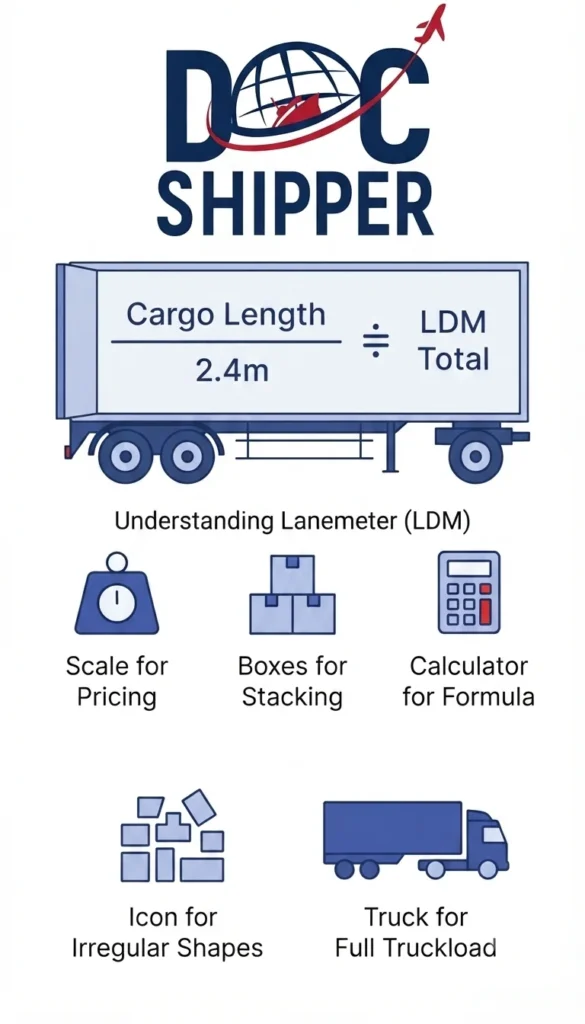
Basic Calculation: LDM = Cargo Length (in meters) ÷ Truck Width (2.4m standard). However, this assumes perfect space utilization, which rarely occurs.
| Scenario | Cargo Dimensions | LDM Consumed | Notes |
|---|---|---|---|
| Standard Euro Pallet | 1.2m × 0.8m × 1.5m (H) | 0.5 LDM | Two pallets fit side-by-side (0.8m + 0.8m = 1.6m < 2.4m width) |
| Machinery Crate | 3m × 2m × 2m (H) | 3 LDM | Width <2.4m allows efficient single-row placement |
| Bulk Textile Rolls | 8m × 1.5m × 1m (H) | 5 LDM | Rolls placed lengthwise; stackable up to 2.2m height |
| Oversized Steel Beams | 12m × 0.5m × 0.3m (H) | 12 LDM | Narrow width allows multiple beams per meter, but length dominates |
| Mixed Groupage Load | Variable (10 pallets) | 6.5 LDM | Optimized loading reduces waste; poor planning could reach 8 LDM |
Use Case: Electronics Manufacturer Shipment
A German electronics company ships 20 pallets (1.2m × 0.8m each) of components to Spain. Standard calculation: Each pallet = 0.5 LDM, total = 10 LDM. Spot rate: €120/LDM = €1,200.
However, DocShipper’s optimization revealed two pallets had fragile tops requiring 20cm spacing gaps. This increased consumption to 11 LDM. Additionally, the shipment’s 9-ton total weight triggered a €150 weight surcharge (above standard 7-ton allowance per 10 LDM). Final cost: €1,470.
By pre-identifying these factors, we renegotiated with a carrier offering better weight allowances, reducing total cost to €1,320—a 10.2% saving.
Critical Insight: Always factor in a buffer margin of 0.5-1 LDM for groupage shipments to account for loading inefficiencies and protective spacing requirements.
Conclusion
Mastering lanemeter calculations is essential for controlling road freight costs and optimizing supply chain efficiency. The difference between 10 LDM and 12 LDM on a high-volume shipment can mean thousands of euros annually.
Need expert guidance on optimizing your LDM utilization or negotiating better freight rates? Contact DocShipper for a free logistics assessment.
📚 Quiz
Test Your Knowledge: Lanemeter (LDM)
What does a lanemeter (LDM) primarily measure in road freight logistics?
A shipper believes that lanemeter pricing always provides lower costs than weight-based pricing for any cargo type. Is this assumption correct?
You're shipping 15 standard Euro pallets (1.2m × 0.8m each) from Germany to France. What strategy would minimize your LDM consumption and overall cost?
🎯 Your Result
📞 Free Quote in 24hFAQ | Lanemeter: Definition, Calculation & Practical Examples
Cubic meter (CBM) measures total cargo volume (length × width × height), while lanemeter measures only floor space occupation. LDM is more common in European road freight because trucks have fixed floor dimensions (2.4m width) but variable height capacity. A tall but narrow cargo may consume 1 CBM but only 0.5 LDM, making LDM pricing more favorable.
Yes, if cargo is stackable and stays within the 2.7m legal height limit (or 3m for refrigerated trailers). However, stacking requires securing straps and may incur additional labor charges. Fragile goods or top-heavy items may not qualify for stacking, negating potential savings.
No. While LDM dominates in Germany, Netherlands, and Scandinavia, some Southern European carriers prefer weight-based or hybrid models. Always confirm the pricing basis before booking. International shipments may mix pricing models at border crossings.
Use the cargo's maximum length as the base measurement. For L-shaped or protruding items, measure the longest straight-line distance when positioned for transport. Add 10-15% buffer for securing equipment. Professional freight forwarders use 3D load planning software for precision.
You'll need a full truckload (FTL) instead of groupage service. Some carriers offer extended trailers (mega-trailers up to 15.5 LDM), but these face restrictions in urban areas and certain countries. Oversized cargo may require special permits and escort vehicles.
Absolutely. Carriers offer discounts for regular volumes (typically 15-30% below spot rates), off-peak shipping, and flexible delivery windows. Backhaul routes (return legs with empty space) can yield 40-50% savings. Long-term contracts with minimum monthly LDM commitments unlock the best rates.
Standard LDM rates assume 1.5-2 tons per 2 LDM (roughly 750kg-1,000kg per linear meter). Heavier cargo triggers weight surcharges, typically €20-50 per excess ton. Extremely dense goods like steel may be charged by weight entirely, rendering LDM irrelevant.
Yes, in groupage shipments. However, incompatible goods (e.g., chemicals near food products) require separation barriers that consume extra space. Carriers may charge a "mixed load premium" of 5-10% for complex groupage requiring special handling or segregation.
As of 2025, short-haul routes (under 500km) average €60-90/LDM. Medium-haul (500-1,500km) ranges €100-150/LDM. Long-haul cross-border shipments can reach €180-250/LDM during peak seasons. Rates fluctuate based on fuel costs, driver shortages, and seasonal demand spikes.
No. LDM pricing covers only transportation. Customs duties, VAT, brokerage fees, and documentation charges are separate. For EU intra-community shipments, no customs apply, but non-EU imports require additional clearance services. Always request an all-inclusive quote to avoid surprises.
We provide pre-shipment load planning using advanced software to minimize wasted space. Our network includes carriers with flexible LDM minimums, allowing consolidation of smaller shipments. We also negotiate contract rates for clients with regular volumes, often securing 20-35% savings versus spot market pricing.
Typically 1-2 LDM minimum, though this varies by route. Below 1 LDM, parcel services (UPS, DHL) may be more cost-effective. Some specialized groupage networks accept as low as 0.5 LDM but charge premium rates due to handling complexity.
Need Help with
Logistics or Sourcing ?
First, we secure the right products from the right suppliers at the right price by managing the sourcing process from start to finish. Then, we simplify your shipping experience - from pickup to final delivery - ensuring any product, anywhere, is delivered at highly competitive prices.


Fill the Form
Prefer email? Send us your inquiry, and we’ll get back to you as soon as possible.
Contact us




