


In short ⚡
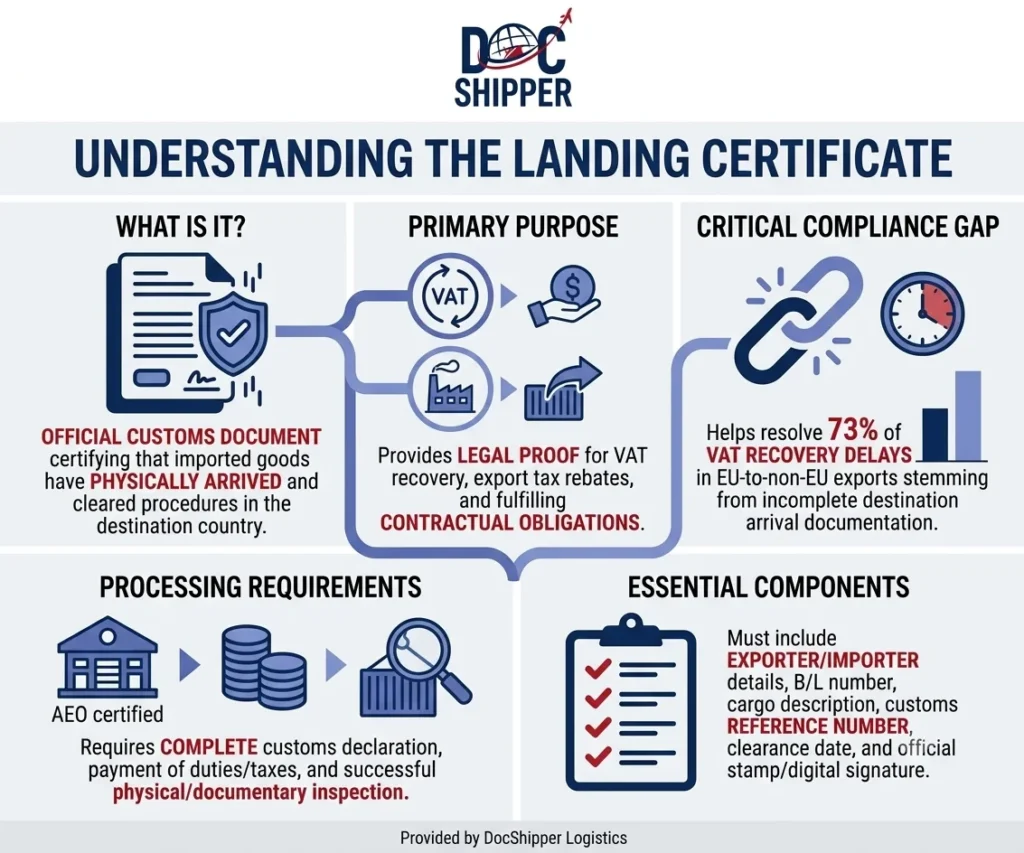
The Landing Certificate is an official document issued by customs authorities certifying that imported goods have physically arrived and cleared customs procedures in the destination country. This certificate provides proof of legal entry, enabling exporters to claim tax exemptions or fulfill contractual obligations with importers.
Introduction
International exporters frequently encounter situations where they must prove that goods reached their final destination. Without proper documentation, customs disputes and payment delays become inevitable.
The Landing Certificate addresses this challenge by providing irrefutable evidence of importation. This document plays a crucial role in VAT recovery, export tax rebates, and contractual validations between trading partners.
Key characteristics of the Landing Certificate include:
- Official issuance by destination country customs authorities
- Contains shipment details including bill of lading number and cargo description
- Certifies physical arrival and customs clearance completion
- Required for zero-rated VAT claims in many EU and non-EU countries
- Serves as legal proof in trade finance and letter of credit transactions
Understanding when and how to obtain this certificate prevents financial losses and ensures smooth customs compliance.
Legal Framework & Issuance Requirements
The Landing Certificate operates within specific regulatory frameworks that vary by destination country. The European Union’s Customs Code establishes general principles, while individual member states implement their own procedures.
To obtain a Landing Certificate, exporters must typically fulfill these five fundamental conditions:
Complete customs declaration submission: The importer must file all required import documentation with destination customs, including commercial invoice, packing list, and certificate of origin where applicable.
Payment of applicable duties and taxes: All customs duties, import VAT, and excise taxes must be settled before authorities issue the certificate. This ensures full compliance with fiscal obligations.
Physical inspection clearance: Customs may conduct physical or documentary inspections to verify cargo matches declared specifications. Any discrepancies delay certificate issuance.
Compliance with import licenses and permits: For regulated goods like pharmaceuticals or food products, relevant health and safety certifications must be validated prior to certificate approval.
Formal request by authorized party: Either the importer or exporter (with proper authorization) must specifically request the Landing Certificate from customs authorities, often through designated electronic platforms.
At DocShipper, we handle the entire Landing Certificate procurement process, liaising directly with customs authorities to ensure timely issuance. Our team monitors each clearance stage to prevent delays that could affect your VAT recovery timelines. Contact us at DocShipper Contact for assistance.
Processing times vary significantly across jurisdictions. Some countries issue digital certificates within 48 hours, while others require 10-15 business days for paper-based documentation.
Practical Cases & Industry Data
Understanding Landing Certificate applications through real-world scenarios helps clarify its practical importance in international trade operations.
Case Study: Electronics Export to Morocco
A French manufacturer exports €250,000 worth of electronic components to a Moroccan distributor under zero-rated VAT terms. The transaction requires the exporter to prove goods left EU customs territory.
| Requirement | Without Landing Certificate | With Landing Certificate |
|---|---|---|
| VAT Recovery Timeline | Tax audit triggered, 6-12 months delay | Immediate zero-rating approval |
| Documentary Evidence | Insufficient for tax authorities | Complete compliance achieved |
| Financial Impact | €50,000 VAT locked (20%) | No cash flow disruption |
| Audit Risk | High – potential penalties | Minimal – documentation complete |
The manufacturer obtained the Landing Certificate within 5 days after Moroccan customs clearance, submitting it to French tax authorities alongside export declaration. Result: zero-rated VAT approved within 72 hours.
Industry Statistics & Benchmarks:
According to international trade data, 73% of VAT recovery delays in EU-to-non-EU exports stem from incomplete destination arrival documentation. The Landing Certificate directly addresses this compliance gap.
Five critical benchmarks for Landing Certificate processing:
- Average issuance time: 3-7 business days in digitalized customs systems; 10-15 days in paper-based jurisdictions
- Cost range: €25-€150 depending on destination country and shipment complexity
- Digital adoption rate: 62% of developed markets now offer electronic Landing Certificates through customs portals
- Rejection rate: 12% due to incomplete documentation or customs duty arrears
- Audit compliance benefit: Companies maintaining Landing Certificates experience 89% fewer tax audit complications
Scenario Comparison: Letter of Credit Transaction
A German machinery exporter fulfills a $500,000 order to India under a letter of credit requiring proof of delivery. The bank stipulates Landing Certificate submission before payment release.
Timeline breakdown:
- Day 1-3: Cargo arrives Mumbai port, customs inspection conducted
- Day 4-6: Importer pays duties and submits clearance documentation
- Day 7: Indian customs issues Landing Certificate digitally
- Day 8: Certificate submitted to issuing bank in Germany
- Day 9: Payment released to exporter
Without the Landing Certificate, the bank would have rejected the document presentation, delaying payment by potentially weeks while alternative proof was arranged.
Conclusion
The Landing Certificate serves as indisputable proof of import completion, protecting exporters’ financial interests while ensuring customs compliance. Whether for VAT recovery, letter of credit transactions, or contractual obligations, this document prevents costly disputes and payment delays.
Need assistance obtaining Landing Certificates for your international shipments? Our customs specialists handle the entire process efficiently. Contact DocShipper today for expert support.
📚 Quiz
Test Your Knowledge: Landing Certificate
What is the primary purpose of a Landing Certificate in international trade?
Which statement correctly describes the relationship between Landing Certificates and VAT recovery?
A German exporter ships machinery to India under a letter of credit requiring proof of delivery. Which scenario best applies the Landing Certificate?
🎯 Your Result
📞 Free Quote in 24hFAQ | Landing Certificate: Definition, Requirements & Practical Examples
A Landing Certificate confirms goods cleared customs and entered the destination country legally, while a Certificate of Discharge proves cargo was unloaded from a vessel. The Landing Certificate has broader legal implications for tax purposes and trade compliance. Some jurisdictions use these terms interchangeably, but the Landing Certificate specifically addresses customs clearance completion rather than just physical unloading.
No. Landing Certificate availability varies by country. EU member states, Morocco, Turkey, and several Asian countries routinely issue them. Countries with advanced digital customs systems typically provide electronic versions. Before shipping, verify whether your destination country's customs authority offers this documentation. Alternative proof of importation may include stamped import declarations or customs release orders.
Processing times range from 24 hours to 15 business days depending on the destination country's customs digitalization level. Countries with electronic customs platforms issue certificates within 2-5 days. Paper-based systems may require 7-15 days. Delays often occur when importers fail to submit complete documentation or haven't paid all duties. Expedited processing is sometimes available for additional fees.
Typically, the importer must initiate the Landing Certificate request as they are the party clearing customs. However, exporters can obtain the certificate if they hold proper authorization from the importer, often through a power of attorney. Some countries allow freight forwarders with clearance authority to request certificates on behalf of either party. The requesting party must provide shipment details and proof of customs clearance completion.
Requirements vary by exporting country's tax regulations. EU member states increasingly require Landing Certificates or equivalent proof for extra-EU exports exceeding certain thresholds. The UK accepts stamped CMR documents as alternatives. France and Germany strongly prefer Landing Certificates for non-EU destinations. Without adequate proof of export, tax authorities may retroactively charge VAT, creating significant financial burden. Consult your country's VAT regulations for specific requirements.
A valid Landing Certificate must include: importer and exporter details, bill of lading or airway bill number, cargo description and quantity, customs declaration reference number, clearance date, and official customs stamp with officer signature. Electronic versions contain digital signatures and unique verification codes. Missing or incorrect information renders the certificate invalid for tax or banking purposes. Always verify completeness before submitting to authorities.
Fees vary significantly by jurisdiction, ranging from €25 to €150 per certificate. Some countries include this service in standard customs processing without additional charge. Digital certificates typically cost less than paper versions. Complex shipments requiring detailed verification may incur higher fees. Additional costs may apply for expedited processing, translations, or courier services. Budget these expenses when calculating total export costs to avoid surprises.
Yes. Tax authorities may reject Landing Certificates that lack required information, contain discrepancies with other shipping documents, or originate from non-recognized customs offices. Certificates issued after significant delays may raise audit concerns. Some jurisdictions require specific formats or additional endorsements. To minimize rejection risk, ensure the certificate matches your commercial invoice, packing list, and export declaration exactly. Maintain consistent product descriptions across all documentation.
In most jurisdictions with digital customs systems, electronic Landing Certificates hold identical legal status to paper documents. They often include enhanced security features like blockchain verification or encrypted digital signatures. However, some traditional banking institutions or smaller businesses may still prefer paper certificates. Before shipping, confirm whether your bank, tax authority, or trading partner accepts electronic versions. Keep both formats when possible for maximum flexibility.
Contact the issuing customs authority immediately to request a duplicate. Most jurisdictions allow certified copies upon payment of administrative fees. Electronic systems enable easier reissuance through customs portals. The process typically requires providing original shipment details and clearance reference numbers. Reissuance takes 3-10 business days depending on the country. To prevent complications, store Landing Certificates digitally and maintain multiple backup copies in secure cloud storage.
Landing Certificates themselves don't expire, but tax authorities impose time limits for submitting them as proof for VAT recovery or export tax rebates. EU regulations typically allow certificate submission within specific VAT return periods. Some countries require submission within 90 days of export date. Banking institutions may set shorter deadlines for letter of credit transactions. Always clarify submission deadlines with relevant authorities before shipping to avoid missing critical timeframes.
Generally, no. Each customs clearance requires a separate Landing Certificate tied to specific import declaration and bill of lading numbers. Some countries permit consolidated certificates for multiple containers within a single customs entry, but this is rare. For ongoing trade relationships with regular shipments, establish efficient certificate procurement procedures with your customs broker. Automated request systems can streamline this process for high-volume exporters.
Need Help with
Logistics or Sourcing ?
First, we secure the right products from the right suppliers at the right price by managing the sourcing process from start to finish. Then, we simplify your shipping experience - from pickup to final delivery - ensuring any product, anywhere, is delivered at highly competitive prices.


Fill the Form
Prefer email? Send us your inquiry, and we’ll get back to you as soon as possible.
Contact us




