


In short ⚡
A dolly is a wheeled platform or cart used in logistics and transportation to move heavy loads, containers, or cargo with minimal manual effort. Essential in warehousing, freight handling, and shipping operations, dollies optimize material handling efficiency while reducing physical strain and operational time in supply chain environments.
Introduction
In international trade and logistics, manual cargo handling creates bottlenecks, injuries, and delays. Shippers often underestimate the impact of proper material handling equipment on throughput rates and worker safety.
The dolly addresses this challenge directly. From container terminals to warehouse aisles, this simple yet indispensable tool transforms how goods move through the supply chain. Its versatility spans multiple industries and operational contexts.
Key characteristics of dollies in logistics:
- Load capacity: Ranges from 500 lbs to 10,000+ lbs depending on industrial grade
- Mobility enhancement: Reduces handling time by 40-60% compared to manual lifting
- Workplace safety: Decreases musculoskeletal injuries by distributing weight across wheels
- Space efficiency: Enables compact maneuvering in confined warehouse environments
- Versatility: Adaptable to various cargo types from pallets to machinery
Technical Expertise & Applications
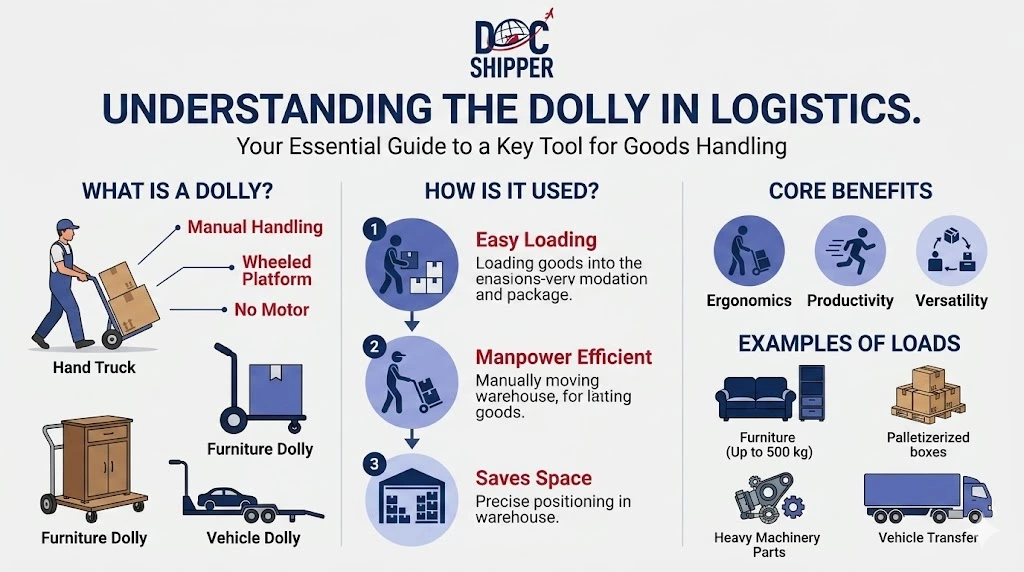
Understanding dolly classifications is critical for optimizing warehouse operations. The logistics industry recognizes several specialized types, each engineered for specific cargo handling scenarios.
Furniture dollies feature flat rectangular platforms with four swivel casters. These workhorses of warehouse operations handle palletized goods, boxed cargo, and appliances. Their low profile allows sliding underneath loads without lifting.
Hand truck dollies (convertible dollies) transform from vertical hand trucks to horizontal platforms. This dual functionality makes them ideal for mixed cargo environments where boxes and pallets require different handling approaches.
Piano dollies incorporate cushioned surfaces and reinforced frames. Despite the name, logistics operations use these for delicate electronics, artwork, and temperature-sensitive pharmaceuticals requiring vibration dampening during transport.
Container dollies represent heavy-duty industrial equipment capable of moving 20-foot and 40-foot shipping containers. These specialized units feature hydraulic systems and multi-axle configurations for port and intermodal terminal operations.
According to OSHA material handling standards, proper dolly selection and usage reduces workplace injuries by 30-50%. Weight distribution principles dictate that loads should remain centered with the center of gravity positioned over the wheel axis.
At DocShipper, our warehouse teams standardize dolly equipment across facilities to ensure consistent handling protocols. This uniformity reduces training time and minimizes cargo damage during cross-docking operations.
Practical Examples & Data
Real-world applications demonstrate the dolly’s impact on operational metrics. Consider these comparative scenarios from documented logistics operations:
| Operation Type | Without Dolly | With Dolly | Efficiency Gain |
|---|---|---|---|
| Warehouse pallet transfer (50m) | 8 minutes (2 workers) | 3 minutes (1 worker) | 62.5% faster |
| Container yard repositioning | 45 minutes (forklift) | 18 minutes (container dolly) | 60% time reduction |
| Appliance loading (per unit) | 12 minutes (manual) | 5 minutes (furniture dolly) | 58% improvement |
Use Case: E-commerce Fulfillment Center
A 150,000 sq ft fulfillment operation implemented standardized furniture dollies across pick-pack stations. Results over 6 months:
- Order processing speed increased by 43%
- Worker fatigue complaints decreased by 67%
- Damaged goods claims reduced by 22%
- Equipment ROI achieved in 4.2 months
- Cross-dock turnaround time improved from 2.5 hours to 1.4 hours
Container terminal operations present another compelling case. A mid-sized port facility replaced 40% of forklift movements with specialized container dollies for short-distance repositioning. Fuel costs dropped by $180,000 annually while maintenance expenses decreased 35%.
The pharmaceutical cold chain provides unique dolly requirements. Temperature-controlled dollies with insulated platforms maintain product integrity during warehouse-to-truck transfers. Industry data shows these specialized units reduce temperature excursions by 89% compared to standard equipment.
Conclusion
The dolly remains a fundamental tool in modern logistics, bridging the gap between manual labor and fully automated systems. Its simplicity masks significant impact on efficiency, safety, and operational costs across the supply chain.
Need expert guidance on optimizing your material handling operations? Contact DocShipper for tailored logistics solutions.
📚 Quiz
Test Your Knowledge: Dolly in Logistics
What is the primary function of a dolly in logistics operations?
Which statement correctly describes container dollies compared to standard warehouse dollies?
A pharmaceutical warehouse needs to transfer temperature-sensitive cargo from cold storage to refrigerated trucks. Which dolly application would be most appropriate?
🎯 Your Result
📞 Free Quote in 24hFAQ | Dolly in Logistics: Definition, Types & Practical Applications
Standard furniture dollies handle 500-1,000 lbs, suitable for most palletized goods. Heavy-duty models rated 2,000-5,000 lbs accommodate machinery and dense cargo. Assess your typical load weights and add 20% safety margin when selecting capacity.
Pneumatic-tire dollies perform best on rough surfaces, offering shock absorption and traction. Hard polyurethane wheels excel on smooth warehouse floors. For loading docks, choose models with brake locks to prevent rolling during loading operations.
Container dollies feature reinforced steel frames, multi-axle configurations, and hydraulic lifting systems. They're engineered for 20,000+ lb loads and intermodal container dimensions. Standard dollies max out at 5,000 lbs and handle general cargo.
Inspect wheel bearings monthly, lubricating with lithium grease. Check for frame cracks or welds quarterly. Replace worn wheels showing flat spots or exceeding 15% diameter reduction. Clean debris from casters weekly to prevent jamming.
OSHA mandates that material handling equipment must be maintained in safe working condition. Load ratings cannot be exceeded. Workers must receive training on proper dolly operation techniques. Regular safety inspections are required under 29 CFR 1910.176.
Four-swivel configurations offer 360-degree rotation for tight spaces but provide less straight-line stability. Two-fixed, two-swivel designs balance maneuverability with directional control. Choose based on aisle width and turning radius requirements.
Yes, specialized air cargo dollies accommodate ULD containers and palletized airfreight. These feature low-profile designs meeting airport tarmac height restrictions and non-sparking wheels for safety near aircraft. They're essential for ground handling operations.
Basic furniture dollies range $50-150, suitable for light warehouse use. Industrial-grade steel models cost $300-800 with higher capacity and durability. Container dollies start at $3,000, reaching $25,000 for hydraulic terminal equipment.
Proper material handling equipment demonstrates risk mitigation to insurers. Documented dolly usage programs can reduce workers' compensation premiums by 10-15%. Cargo damage rates also decrease, potentially lowering liability insurance costs over time.
Manufacturers offer custom configurations including V-deck designs for cylindrical cargo, carpeted platforms for scratch-sensitive goods, and adjustable-width frames for variable load sizes. Custom solutions typically add 30-50% to base pricing.
Quality steel dollies last 8-12 years under normal warehouse conditions with proper maintenance. Aluminum models extend to 15+ years. Heavy industrial use reduces lifespan by 30-40%. Wheel replacements every 18-24 months are typical.
Electric dollies eliminate pushing effort for loads exceeding 2,000 lbs, moving at 3-4 mph. They cost $2,000-8,000 versus $200-600 for manual equivalents. Battery runtime averages 6-8 hours. Best for high-volume operations with heavy cargo.
Need Help with
Logistics or Sourcing ?
First, we secure the right products from the right suppliers at the right price by managing the sourcing process from start to finish. Then, we simplify your shipping experience - from pickup to final delivery - ensuring any product, anywhere, is delivered at highly competitive prices.


Fill the Form
Prefer email? Send us your inquiry, and we’ll get back to you as soon as possible.
Contact us




