



In short ⚡
Efficient Consumer Response (ECR) is a strategic supply chain management approach where retailers and suppliers collaborate to optimize product flow, reduce costs, and enhance customer value. By leveraging shared data and synchronized processes, ECR minimizes inventory waste, improves product availability, and accelerates response times to consumer demand fluctuations.
Introduction
Why do retailers face chronic stockouts while simultaneously dealing with excess inventory? This paradox stems from inefficient information sharing between supply chain partners.
ECR emerged in the 1990s to address these inefficiencies. It fundamentally transforms relationships between manufacturers, distributors, and retailers from adversarial negotiations to collaborative partnerships focused on consumer satisfaction.
The methodology impacts international trade by:
- Reducing lead times through synchronized production and distribution schedules
- Minimizing storage costs by implementing just-in-time inventory replenishment
- Enhancing product traceability across borders with standardized data exchange protocols
- Improving demand forecasting through real-time point-of-sale data sharing
- Accelerating customs clearance via pre-shipment documentation alignment
ECR Framework & Strategic Implementation
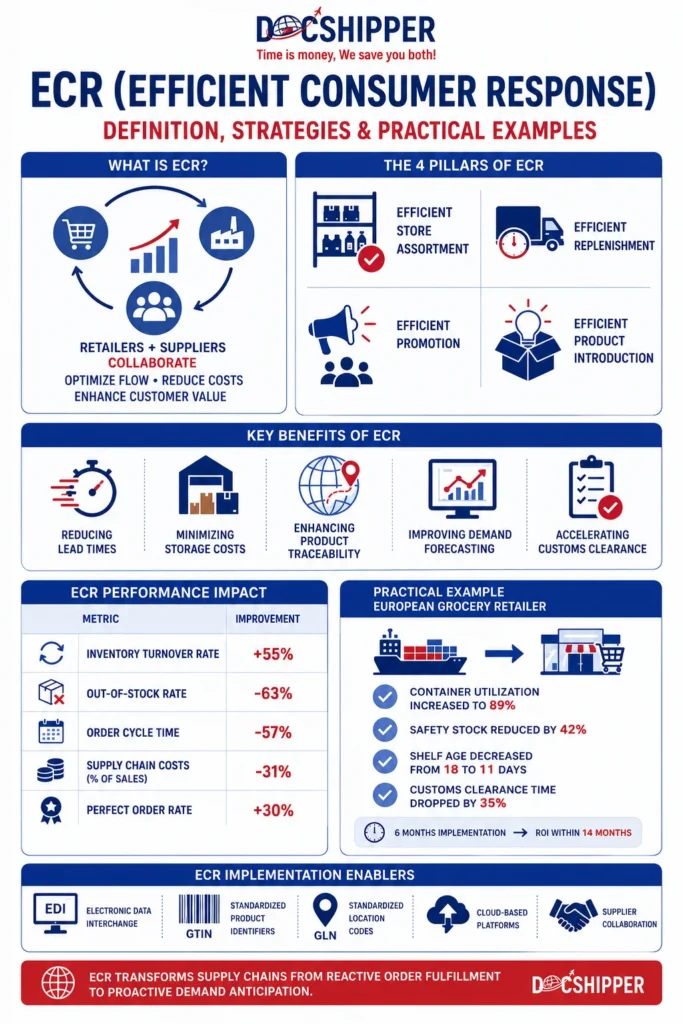
ECR operates through four fundamental pillars that restructure traditional supply chain dynamics.
Efficient Store Assortment eliminates unprofitable SKUs while ensuring optimal product variety. Retailers analyze sales velocity, profitability per linear foot, and consumer preferences to curate assortments that maximize space productivity. This prevents overstocking slow-moving items that tie up working capital.
Efficient Replenishment synchronizes ordering processes with actual consumption patterns. By sharing point-of-sale data directly with suppliers, retailers enable continuous replenishment systems. This replaces periodic bulk ordering with frequent, smaller deliveries aligned to real demand.
Efficient Promotion coordinates marketing activities across the supply chain to prevent demand distortions. Traditional forward-buying creates artificial demand spikes followed by troughs. ECR partners design promotions that stimulate genuine consumer demand without disrupting production schedules or warehouse operations.
Efficient Product Introduction streamlines new product launches through collaborative planning. Manufacturers share development timelines, retailers provide shelf-space commitments early, and logistics providers align distribution capacity. This reduces time-to-market and minimizes launch failure rates.
Implementation requires technology integration through Electronic Data Interchange (EDI) or cloud-based platforms. According to GS1 standards, standardized product identifiers (GTINs) and location codes (GLNs) enable automated data exchange without manual reconciliation errors.
At DocShipper, we facilitate ECR implementation by connecting importers with suppliers who maintain EDI compatibility and real-time inventory visibility systems, ensuring your international supply chains operate with maximum responsiveness.
Practical Applications & Industry Data
ECR delivers measurable improvements across key performance indicators. Industry studies document consistent efficiency gains when properly implemented.
| Metric | Pre-ECR Average | Post-ECR Average | Improvement |
|---|---|---|---|
| Inventory Turnover Rate | 8.2 times/year | 12.7 times/year | +55% |
| Out-of-Stock Rate | 8.3% | 3.1% | -63% |
| Order Cycle Time | 7.4 days | 3.2 days | -57% |
| Supply Chain Costs (% of sales) | 14.2% | 9.8% | -31% |
| Perfect Order Rate | 71% | 92% | +30% |
Use Case: European Grocery Retailer
A multinational supermarket chain importing packaged foods from Asia implemented ECR with its top 15 suppliers. Previously, container utilization averaged 68% due to misaligned ordering schedules across different product categories.
After establishing daily POS data sharing and coordinated replenishment calendars, the retailer achieved:
- Container utilization increased to 89%, reducing freight costs by €1.2M annually
- Safety stock reduced by 42%, freeing warehouse space for faster-moving items
- Product freshness improved as average shelf age decreased from 18 to 11 days
- Customs clearance time dropped by 35% through pre-arrival documentation synchronization
The initiative required six months of system integration but delivered ROI within 14 months through combined logistics savings and sales increases from better availability.
Conclusion
ECR transforms supply chains from reactive order fulfillment to proactive demand anticipation, delivering cost reductions and service improvements simultaneously. For international traders, ECR principles are essential to compete in markets where consumer expectations demand both variety and immediate availability.
Need help implementing ECR strategies with your international suppliers? Contact DocShipper to optimize your cross-border supply chain partnerships.
📚 Quiz
Test Your Knowledge: ECR (Efficient Consumer Response)
Question 1: What is the primary goal of ECR in supply chain management?
Question 2: Which statement correctly describes the relationship between ECR and Vendor-Managed Inventory (VMI)?
Question 3: A European grocery retailer implementing ECR with Asian suppliers achieved 89% container utilization. What was the primary enabler of this improvement?
🎯 Your Result
📞 Free Quote in 24hFAQ | ECR (Efficient Consumer Response): Definition, Strategies & Practical Examples
ECR encompasses broader collaboration including assortment planning, promotions, and new product launches, while VMI focuses solely on inventory replenishment. ECR creates strategic partnerships; VMI addresses operational inventory management. Both share demand data, but ECR integrates commercial planning across categories.
ECR improves customs efficiency through standardized documentation and pre-clearance coordination. When suppliers share advance shipping notices with harmonized product codes, customs brokers can prepare declarations before cargo arrival. This reduces port dwell time by 30-50% in typical implementations.
Minimum requirements include EDI capability or API-based integration for automated data exchange, standardized product identification systems (GTIN/EAN codes), and inventory management software with real-time visibility. Cloud platforms like SAP Ariba or Oracle SCM offer pre-built ECR modules for mid-sized enterprises.
Absolutely. Small businesses can adopt ECR practices by sharing weekly sales reports via email, establishing fixed delivery schedules, and using standardized ordering templates. Even basic collaboration reduces safety stock needs and improves cash flow without requiring expensive technology investments.
ECR partners develop joint forecasts using historical data, market trends, and promotional calendars. Flexible manufacturing agreements allow production adjustments within agreed parameters. Safety stock buffers are strategically positioned at distribution centers rather than accumulating throughout the chain.
The primary obstacles include cultural resistance to data sharing, incompatible IT systems, misaligned incentive structures, and insufficient change management. Success requires executive sponsorship, dedicated cross-functional teams, and willingness to restructure traditional buyer-supplier relationships.
Key performance indicators include perfect order rate, cash-to-cash cycle time, forecast accuracy, inventory days of supply, and total supply chain cost as percentage of sales. Leading companies track category-level metrics monthly and conduct quarterly business reviews with ECR partners.
ECR shifts focus from lowest unit price to total cost of ownership. While competitive bidding remains valid for commodity products, ECR categories require long-term partnerships where suppliers earn business through innovation and service excellence rather than periodic price negotiations.
Collaborative quality management within ECR includes shared specifications, joint pre-shipment inspections, and root-cause analysis protocols. Suppliers gain incentive to maintain quality since poor performance immediately impacts replenishment schedules and shared metrics visibility.
3PLs act as neutral coordinators, managing cross-docking operations, consolidation centers, and multi-supplier shipments. They provide visibility platforms that aggregate data from multiple trading partners, enabling synchronized decision-making without requiring direct system integration between competitors.
Operational reviews occur weekly or biweekly to address immediate issues. Tactical reviews quarterly assess metrics, refine forecasts, and adjust replenishment parameters. Strategic annual reviews evaluate category strategies, technology upgrades, and contractual terms to ensure continuous improvement.
Yes, industrial manufacturers successfully apply ECR concepts through vendor-managed inventory programs, collaborative forecasting, and synchronized production scheduling. The approach requires adaptation for longer lead times and engineer-to-order products, but the fundamental principles of shared information and aligned incentives remain equally valuable.
Need Help with
Logistics or Sourcing ?
First, we secure the right products from the right suppliers at the right price by managing the sourcing process from start to finish. Then, we simplify your shipping experience - from pickup to final delivery - ensuring any product, anywhere, is delivered at highly competitive prices.


Fill the Form
Prefer email? Send us your inquiry, and we’ll get back to you as soon as possible.
Contact us




