


In short ⚡
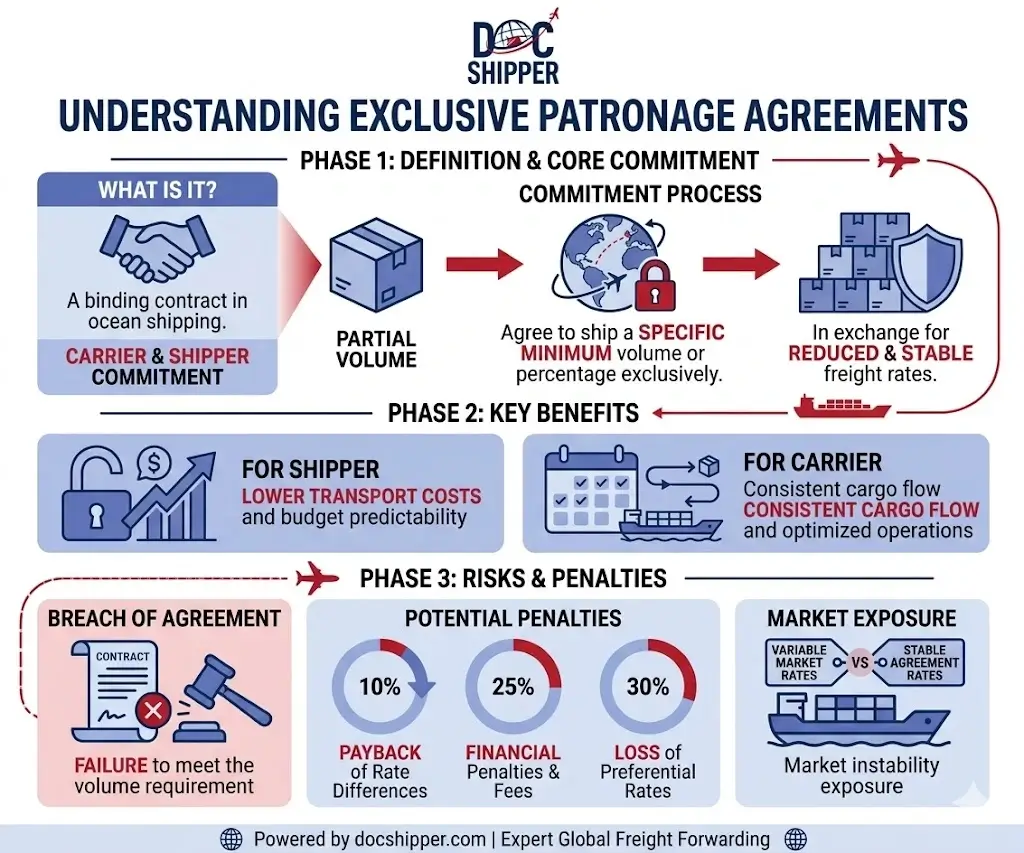
Exclusive Patronage Agreements are contractual arrangements where a shipper commits to using a single carrier or freight forwarder for all or specified cargo shipments over a defined period. In exchange, the shipper receives preferential rates, priority service, or enhanced terms. These agreements optimize supply chain predictability and reduce logistics costs significantly.
Introduction
Many importers and exporters struggle with unpredictable freight rates and inconsistent service quality across multiple carriers. Exclusive Patronage Agreements address this challenge by establishing long-term partnerships that stabilize costs and streamline operations.
In international trade, these agreements have become critical instruments for mid-sized to large shippers seeking to negotiate volume-based discounts while ensuring capacity during peak seasons. They fundamentally alter the buyer-seller dynamic in freight procurement.
Key characteristics of Exclusive Patronage Agreements include:
- Volume commitments: Minimum tonnage or container requirements per quarter or year
- Rate stability: Fixed or index-linked pricing structures immune to spot market volatility
- Service guarantees: Priority booking, dedicated account management, and expedited handling
- Contract duration: Typically 12 to 36 months with renewal or renegotiation clauses
- Performance metrics: KPIs covering on-time delivery, damage rates, and compliance standards
Understanding these agreements is essential for companies optimizing their procurement strategies and reducing total landed costs. At DocShipper, we regularly advise clients on structuring these arrangements to maximize leverage without sacrificing flexibility.
Legal Framework & Strategic Implications
Exclusive Patronage Agreements operate within commercial contract law but intersect with competition regulations in most jurisdictions. The European Union’s Article 101 TFEU and U.S. antitrust laws scrutinize exclusivity clauses that may restrict market competition.
The contractual structure typically includes minimum volume thresholds expressed in TEUs (Twenty-foot Equivalent Units) for ocean freight or weight/dimensional metrics for air cargo. Failure to meet these triggers penalty clauses or rate adjustments. Conversely, exceeding targets may unlock tiered discounts.
Force majeure provisions have gained prominence post-2020. Modern agreements specify which disruptions—port congestion, pandemic restrictions, geopolitical conflicts—allow temporary suspension without penalty. Ambiguous language here creates litigation risk.
The termination clauses require careful drafting. “For convenience” exits allow either party to terminate with 60-90 days’ notice but may include financial penalties. “For cause” terminations demand documented breaches like repeated service failures or safety violations.
Confidentiality and non-compete stipulations protect negotiated rates from disclosure to competitors. Carriers increasingly demand these to prevent rate-shopping across multiple forwarders. At DocShipper, we verify that confidentiality terms don’t impede our clients’ ability to conduct future competitive bids.
A strategic consideration involves capacity allocation during crises. The 2021-2022 supply chain disruptions exposed weaknesses where non-exclusive shippers lost container space. Well-structured agreements guarantee space allocation or provide compensation when carriers fail to deliver committed capacity.
Practical Examples & Comparative Data
Consider a mid-sized electronics manufacturer shipping 300 TEUs annually from Shenzhen to Rotterdam. Under spot rates averaging $4,500 per TEU during volatile periods, annual costs reach $1.35 million. An Exclusive Patronage Agreement might secure a flat rate of $3,200 per TEU, reducing costs to $960,000—a 29% savings.
The table below compares key parameters across different agreement structures:
| Agreement Type | Volume Commitment | Rate Discount | Contract Length | Flexibility |
|---|---|---|---|---|
| Spot Market | None | 0% | Per shipment | Maximum |
| Named Account | 50-100 TEUs/year | 8-12% | 6-12 months | High |
| Exclusive Patronage | 200+ TEUs/year | 18-30% | 12-36 months | Medium |
| Alliance Partnership | 1,000+ TEUs/year | 35-45% | 36+ months | Low |
Case Study: A European automotive parts supplier negotiated a 24-month agreement covering 800 TEUs with guaranteed container availability during Q4 peak season. When spot rates surged 140% in late 2021, the locked-in rate saved the company approximately €720,000 versus market alternatives.
Critical success factors for these agreements include:
- Accurate demand forecasting: Overcommitting triggers penalties; underestimating forfeits potential discounts
- Performance benchmarking: Quarterly reviews comparing carrier KPIs against contractual obligations
- Escalation protocols: Pre-defined procedures for resolving service failures or rate disputes
- Exit strategy planning: Defined conditions allowing contract modification without catastrophic cost implications
- Multi-carrier hedging: Reserving 10-15% capacity for spot market purchases maintains competitive pressure
In air freight, exclusive agreements differ structurally. A pharmaceutical company shipping 50 tons monthly of temperature-sensitive cargo might secure dedicated cold-chain handling and priority boarding. The premium over standard rates (typically 15-20%) becomes justified through reduced spoilage and regulatory compliance assurance.
Conclusion
Exclusive Patronage Agreements represent strategic tools for shippers balancing cost optimization against operational flexibility. When properly structured with clear performance metrics and fair exit provisions, they deliver measurable savings while securing capacity during market disruptions.
Need expert guidance on negotiating favorable terms or evaluating carrier proposals? Contact DocShipper for personalized logistics consulting tailored to your shipping volume and trade lanes.
📚 Quiz
Test Your Knowledge: Exclusive Patronage Agreements
What is the primary defining characteristic of an Exclusive Patronage Agreement?
A company consistently ships 180 TEUs annually but signed an Exclusive Patronage Agreement committing to 200 TEUs. What is the most likely consequence?
Which scenario represents the most appropriate application of an Exclusive Patronage Agreement?
🎯 Your Result
📞 Free Quote in 24hFAQ | Exclusive Patronage Agreements: Definition, Legal Framework & Practical Examples
Most carriers require annual commitments starting at 150-200 TEUs for ocean freight or 30-50 tons for air cargo. Smaller volumes may qualify for semi-exclusive "preferred customer" arrangements with reduced but still significant discounts. Volume thresholds vary by trade lane and carrier market position.
True exclusivity involves a single carrier, but you can structure "primary-secondary" agreements where one carrier receives 70-80% of volume while a backup handles overflow or specific routes. This maintains competitive tension while securing volume discounts. Transparent communication about arrangement terms prevents contractual conflicts.
Most agreements include "shortfall penalties" calculated as a percentage of unmet volume multiplied by the negotiated rate discount. Some contracts allow volume adjustments after force majeure events or provide "make-good" periods to compensate in subsequent quarters. Penalty structures should be negotiated carefully during contract drafting.
Common approaches include annual CPI adjustments, quarterly reviews tied to published freight indices (Shanghai Containerized Freight Index, Baltic Dry Index), or bunker adjustment factors (BAF) for fuel cost fluctuations. Fixed-rate agreements offer maximum predictability but may become disadvantageous if market rates decline significantly.
Enforceability depends on governing law clauses. Contracts governed by maritime law typically include arbitration provisions under UNCITRAL or ICC rules. Including jurisdiction clauses specifying London, Singapore, or New York maritime courts enhances enforceability. Legal counsel familiar with international commercial arbitration should review agreements before execution.
Essential guarantees include on-time delivery percentages (typically 95%+), maximum transit time commitments, damage/loss rate limits (under 0.5%), container condition standards, and communication response times. Performance failures should trigger service credits or rate reductions rather than just vague "best efforts" language.
If you work with forwarders like DocShipper, they can negotiate these agreements on your behalf, pooling multiple clients' volumes for greater leverage. Alternatively, direct shipper-carrier agreements may limit forwarder involvement. Clarify whether your forwarder relationship is compatible with direct carrier exclusivity before committing.
Early termination typically requires "for cause" justification—repeated service failures, safety violations, or material breach. Some agreements allow penalty-free exits after 12-18 months with 90-120 days' notice. Negotiating reasonable exit clauses during initial contracting prevents being locked into underperforming arrangements.
Comprehensive agreements may bundle transportation with value-added services at discounted rates. However, many shippers prefer separating these to maintain specialized provider relationships. Clearly specify which services fall under exclusivity to avoid unintended contractual obligations or missed opportunities for competitive pricing on ancillary services.
Well-structured agreements include quarterly or monthly volume bands rather than rigid annual totals. For example, Q4 commitments might be 40% higher than Q2 for retail-oriented shippers. Seasonal flexibility clauses prevent penalties during predictable low-volume periods while maintaining carrier confidence in overall commitment levels.
Critical metrics include 24-month shipping volume history, lane-specific cost breakdowns, carrier performance scorecards, seasonal demand patterns, and projected growth rates. Conduct sensitivity analysis showing financial impact if volumes fluctuate ±20%. This data-driven approach ensures commitments align with realistic operational capabilities.
Yes—"volume commitment agreements" guarantee minimum shipments without exclusivity, typically offering 10-15% discounts versus 20-30% for full exclusivity. "Preferred carrier" designations provide priority service without binding commitments. These hybrid models suit shippers needing flexibility while still accessing better-than-spot rates.
Need Help with
Logistics or Sourcing ?
First, we secure the right products from the right suppliers at the right price by managing the sourcing process from start to finish. Then, we simplify your shipping experience - from pickup to final delivery - ensuring any product, anywhere, is delivered at highly competitive prices.


Fill the Form
Prefer email? Send us your inquiry, and we’ll get back to you as soon as possible.
Contact us




