


In short ⚡
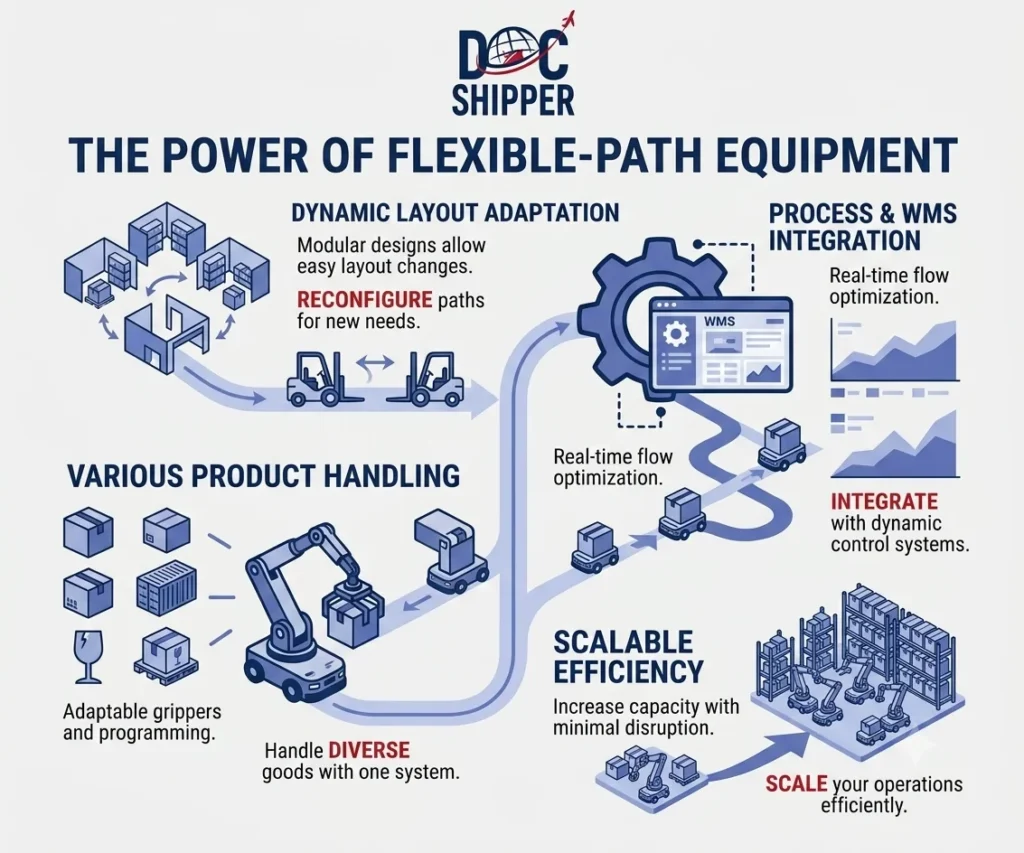
Flexible-Path Equipment refers to material handling systems capable of adapting their routing and movement patterns dynamically to accommodate varying product flows, layouts, or operational demands. Unlike fixed-path conveyors, these systems enable multi-directional transport, reconfigurable pathways, and responsive logistics operations essential for modern warehousing and distribution centers.Introduction
Many logistics operations struggle with rigid conveyor systems that cannot adapt when product mixes change, seasonal peaks occur, or facility layouts evolve. Traditional fixed-path equipment creates bottlenecks, limits scalability, and increases downtime during reconfiguration.
Flexible-path equipment addresses these challenges by enabling dynamic routing decisions. This technology has become critical for e-commerce fulfillment, cross-docking operations, and automated warehouses requiring rapid response to fluctuating demand patterns.
Key characteristics of flexible-path systems include:
- Multi-directional movement – goods can be routed along multiple paths without manual intervention
- Reconfigurable layouts – pathways adapt to operational changes without major infrastructure modifications
- Automated decision-making – integrated software determines optimal routing based on real-time conditions
- Scalable deployment – systems expand incrementally as volume requirements increase
- Integration capability – seamless connection with WMS, ERP, and robotic systems
Technical Mechanisms & Operational Expertise
Flexible-path equipment encompasses several technological approaches. Autonomous Mobile Robots (AMRs) represent the most adaptive solution, using onboard sensors and AI-driven navigation to determine routes independently. These units adjust paths in real-time based on obstacles, priority assignments, or changing destination requirements.
Modular conveyor systems provide another approach, utilizing interchangeable belt segments, pop-up transfers, and diverter mechanisms. These configurations allow operators to redirect product flows by activating specific modules without stopping the entire line. The European Materials Handling Federation published technical standards for modular conveyor interoperability in their FEM 9.511 guidelines, establishing compatibility benchmarks across manufacturers.
Automated Guided Vehicles (AGVs) with flexible routing software bridge the gap between fixed and fully autonomous systems. Modern AGVs no longer require physical guidance tracks, instead following virtual paths programmed into fleet management software. Route modifications occur through software updates rather than infrastructure changes.
The operational advantage lies in zone-based control logic. Rather than predetermining every movement, the system divides facilities into operational zones. Equipment receives destination instructions and autonomously selects optimal paths within defined boundaries. This approach reduces programming complexity while maintaining operational control.
Sortation accuracy improves dramatically with flexible-path systems. Traditional fixed sorters achieve 99.5% accuracy under stable conditions, but performance degrades when handling mixed SKU profiles. Flexible systems maintain accuracy levels by dynamically adjusting sort logic based on package characteristics detected in real-time.
At DocShipper, we evaluate flexible-path equipment during warehouse design consultations, ensuring material handling solutions align with client volume projections and product diversity. Our logistics engineers assess integration requirements between flexible equipment and existing infrastructure to prevent compatibility issues during implementation.
Concrete Applications & Comparative Data
Operational performance varies significantly across flexible-path technologies. The following comparison illustrates capabilities relevant to import/export distribution environments:
| Equipment Type | Path Flexibility | Throughput Capacity | Reconfiguration Time | Typical Application |
|---|---|---|---|---|
| Fixed Conveyor | None | 8,000 units/hour | 2-5 days | High-volume single-flow |
| Modular Conveyor | Moderate (5-8 paths) | 6,500 units/hour | 4-8 hours | Multi-SKU distribution |
| AGV Fleet | High (software-defined) | 4,200 units/hour | 15-30 minutes | Variable routing needs |
| AMR System | Maximum (autonomous) | 3,800 units/hour | Real-time | Dynamic fulfillment |
Use Case: E-commerce Fulfillment Center
A European fashion retailer processing 42,000 orders daily implemented AMR-based flexible-path equipment to handle seasonal volume fluctuations. During non-peak periods (January-March), the system operates with 18 active robots across standard pathways. When Black Friday demand surges to 96,000 orders daily, the fleet expands to 34 units without layout modifications.
The financial impact proved significant. Traditional conveyor expansion would have required €480,000 capital investment plus 6 weeks downtime. The AMR approach cost €310,000 with zero operational interruption. Annual maintenance expenses decreased by 23% due to modular component replacement versus full-system servicing.
Cross-Docking Operations benefit particularly from flexible-path capabilities. A logistics provider handling pharmaceutical imports implemented modular conveyor zones enabling direct product transfer from inbound containers to outbound regional trucks. Path reconfiguration occurs between shifts based on the next day’s delivery schedules, reducing staging area requirements by 38% and cutting average dwell time from 14 hours to 6 hours.
Key operational advantages observed across implementations:
- Labor flexibility – workers reassign between zones without retraining on different equipment
- Peak absorption – systems handle 40-60% volume increases without infrastructure changes
- Error recovery – automated rerouting when paths encounter blockages or malfunctions
- SKU adaptability – handling profiles adjust for products ranging from envelopes to pallets
- Future-proofing – incremental technology upgrades without complete system replacement
Conclusion
Flexible-path equipment represents essential infrastructure for logistics operations facing variable demand, diverse product portfolios, or evolving facility requirements. The technology transforms material handling from static constraint into dynamic competitive advantage.
Need assistance evaluating flexible-path solutions for your distribution network? Contact DocShipper for expert consultation on material handling system design and implementation.
📚 Quiz
Test Your Knowledge: Flexible-Path Equipment
1. What is the primary defining characteristic of flexible-path equipment compared to traditional conveyors?
2. A logistics manager claims that AMR systems always provide higher throughput capacity than modular conveyors. Is this statement accurate based on operational data?
3. Your e-commerce warehouse experiences seasonal volume fluctuations from 35,000 to 85,000 daily orders. Which flexible-path solution best addresses this operational scenario?
🎯 Your Results
📞 Free Quote in 24hFAQ | Flexible-Path Equipment: Definition, Applications & Operational Examples
Traditional conveyors move products along predetermined fixed routes requiring physical infrastructure changes for path modifications. Flexible-path equipment uses modular components, autonomous vehicles, or software-controlled routing to adapt movement patterns dynamically without structural alterations. This enables operational adjustments within hours rather than days or weeks.
Modern flexible-path equipment utilizes standardized communication protocols including REST APIs, OPC-UA, and MQTT for WMS integration. These systems receive pick instructions, inventory locations, and priority assignments directly from warehouse management platforms. Bidirectional data exchange enables real-time status updates, throughput monitoring, and performance analytics within existing operational dashboards.
Autonomous mobile robots require scheduled battery management, sensor calibration, and software updates. Typical maintenance intervals include daily battery cycling, weekly sensor cleaning, monthly navigation system verification, and quarterly comprehensive diagnostics. Fleet management software automates maintenance scheduling by monitoring operational hours, distance traveled, and component condition indicators.
Advanced systems incorporate vision systems and weight sensors to identify product characteristics automatically. Routing logic adjusts based on detected dimensions, weight distribution, and handling requirements. Products exceeding standard parameters trigger alternative pathways designed for oversized items, while small parcels route through high-speed sortation zones. This dynamic classification occurs without manual intervention or pre-sorting.
Physical facility constraints pose the primary limitation. AMR systems require minimum aisle widths (typically 1.8-2.4 meters) and turning radii. Network congestion becomes factor when robot density exceeds facility capacity—generally beyond 0.8 units per 100 square meters. Modular conveyor systems face space limitations for zone expansion and require electrical infrastructure for additional modules. Software architecture must support increased communication loads as equipment quantities grow.
Specialized equipment variants operate in refrigerated and frozen storage facilities. Cold-rated AMRs function in temperatures down to -25°C using insulated battery compartments and heated sensor housings. Modular conveyors designed for cold-chain applications utilize food-grade materials, condensation-resistant motors, and sealed control systems. Performance specifications vary by manufacturer, with throughput typically reduced 10-15% in sub-zero conditions compared to ambient temperature operation.
ROI varies significantly based on operational volume and labor costs. High-volume e-commerce operations typically achieve payback within 18-24 months through labor reduction and increased throughput. Distribution centers with seasonal volatility see returns in 24-36 months by avoiding fixed infrastructure costs. Third-party logistics providers report 30-42 month payback periods when amortizing equipment across multiple client operations. Energy efficiency gains and reduced maintenance contribute 8-12% to total ROI calculations.
Priority handling utilizes queue-jumping algorithms within routing software. High-priority items receive preferential path allocation, bypassing standard queuing sequences. Systems reserve dedicated fast-lanes for express shipments or implement dynamic lane assignment based on real-time priority levels. Visual indicators (lights, displays) alert operators to priority items requiring expedited processing. Integration with order management systems enables automatic priority assignment based on service level agreements or customer classifications.
Equipment must comply with ISO 3691-4 for driverless industrial trucks and ANSI/ITSDF B56.5 standards in North America. European installations require CE marking demonstrating compliance with Machinery Directive 2006/42/EC. Safety features include emergency stop systems, collision avoidance sensors, speed limiters in pedestrian zones, and audible warnings. Risk assessments following ISO 12100 methodology determine appropriate safety measures for specific operational environments.
Weather-resistant AMR variants handle outdoor operations with IP65-rated enclosures protecting against rain and dust. Navigation systems compensate for GPS signal variations and changing environmental conditions. Multi-floor operations utilize elevator integration protocols allowing autonomous equipment to traverse levels. Specialized AMRs incorporate ramp-climbing capabilities for gradual elevation changes. Outdoor implementations require protected charging stations and regular weather-related maintenance beyond standard indoor protocols.
Modern systems generate comprehensive operational metrics including throughput rates, path utilization, equipment efficiency, and bottleneck identification. Machine learning algorithms analyze historical patterns to predict maintenance needs and optimize routing strategies. Dashboard interfaces display real-time KPIs such as average transport time, zone congestion levels, and order completion rates. Exportable data integrates with business intelligence platforms for strategic planning and continuous improvement initiatives.
Equipment operating in bonded warehouses must support customs compliance through precise inventory tracking and zone segregation. Systems maintain audit trails documenting product movements between duty-paid and duty-suspended areas. Integration with customs management software ensures proper documentation for goods entering or exiting controlled zones. Physical barriers and software geofencing prevent unauthorized movement across customs boundaries. Regulatory authorities may require specific reporting capabilities demonstrating compliance with local customs procedures.
Need Help with
Logistics or Sourcing ?
First, we secure the right products from the right suppliers at the right price by managing the sourcing process from start to finish. Then, we simplify your shipping experience - from pickup to final delivery - ensuring any product, anywhere, is delivered at highly competitive prices.


Fill the Form
Prefer email? Send us your inquiry, and we’ll get back to you as soon as possible.
Contact us




