


In short ⚡
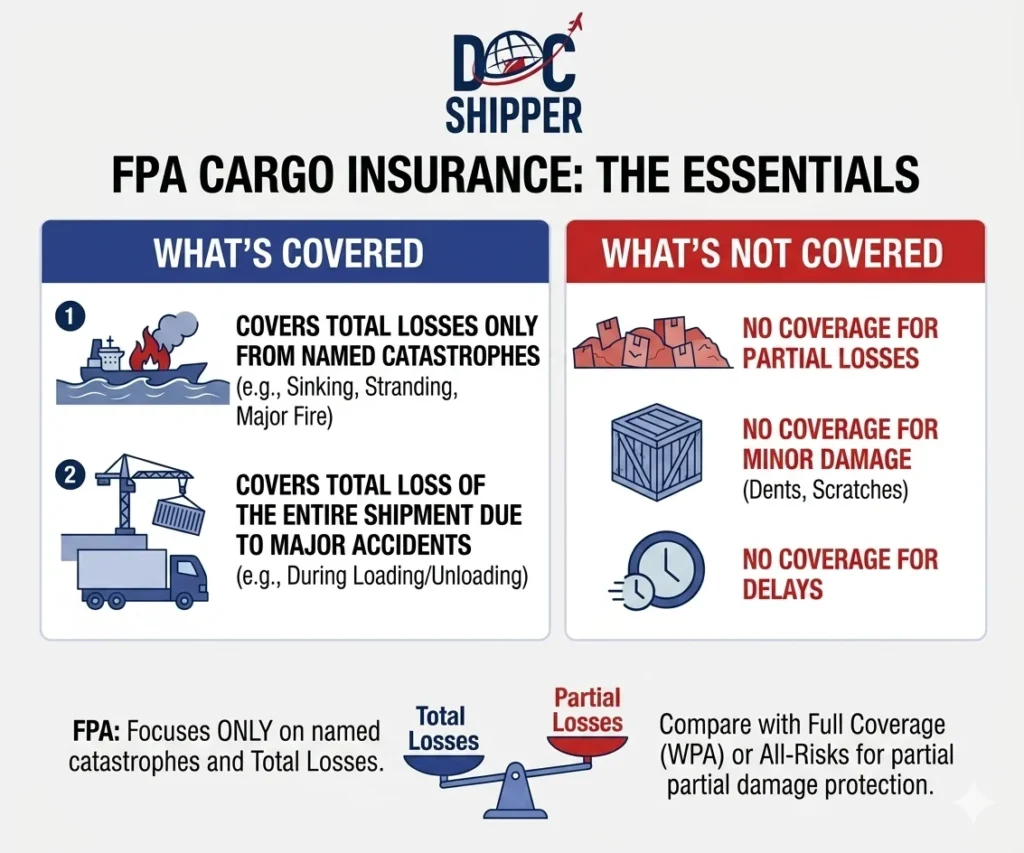
Free of Particular Average (FPA) is a marine insurance clause that excludes coverage for partial losses unless caused by specific perils like stranding, sinking, burning, or collision. Under FPA, the insurer only pays for total losses or damage from major incidents, protecting carriers from minor claim liabilities while keeping premiums lower for shippers.Introduction
Many importers unknowingly accept FPA insurance clauses without understanding their exposure to unrecoverable losses. When a container suffers water damage during transit but the vessel doesn’t sink, businesses discover too late that their policy won’t cover the claim. This insurance term fundamentally shapes financial risk in international shipping.
Free of Particular Average represents the most restrictive marine insurance coverage available. It originated in maritime law to balance premium costs against risk exposure. Unlike comprehensive policies, FPA shifts partial loss risk entirely to the cargo owner.
Key characteristics of FPA coverage include:
- Total loss protection: Full coverage when cargo becomes a complete loss
- Named peril limitations: Partial damage covered only for stranding, sinking, burning, collision
- General average inclusion: Contributions to shared maritime sacrifices remain covered
- Lower premium structure: Reduced cost compared to All Risks or With Average policies
- Claim burden shift: Cargo owner assumes responsibility for most partial damages
Understanding FPA Coverage & Legal Framework
The FPA clause operates under maritime law principles established through centuries of shipping practice. It distinguishes between “particular average” (partial loss affecting one party) and “general average” (shared loss from intentional sacrifice). While FPA excludes the former, it maintains coverage for the latter under the York-Antwerp Rules.
Total loss criteria require complete destruction or cargo becoming commercially worthless. A container of electronics damaged beyond repair qualifies, but water-stained packaging on salvageable goods does not. The distinction creates frequent disputes during claims processing.
Named perils coverage applies only when partial damage directly results from vessel stranding, sinking, burning, or collision. Rust from condensation doesn’t qualify, but smoke damage from an engine fire does. Documentation proving the specific peril becomes critical for successful claims.
Jettison and washing overboard receive automatic coverage under FPA terms. When crew throws cargo overboard to save the vessel during a storm, insurers compensate the loss. This protection extends to containers swept off deck by heavy seas, regardless of negligence questions.
The York-Antwerp Rules govern general average calculations under FPA policies. When a ship intentionally grounds to prevent sinking, all cargo owners contribute proportionally to the sacrifice. FPA coverage includes these mandatory contributions, protecting against unexpected shared expenses.
At DocShipper, we systematically review insurance clauses during shipment setup, explaining FPA limitations before clients commit to policies that may leave them financially exposed during transit incidents.
Practical Examples & Data Comparison
Understanding FPA implications requires examining real-world scenarios where coverage differences become financially significant. The following comparison illustrates how identical incidents receive different treatment under various insurance types.
| Incident Type | FPA Coverage | With Average (WA) | All Risks (AR) |
|---|---|---|---|
| Container falls during loading | Not Covered | Covered if >3% value | Fully Covered |
| Vessel collision partial damage | Covered | Covered | Covered |
| Condensation rust damage | Not Covered | Not Covered | Covered |
| Vessel sinking total loss | Covered | Covered | Covered |
| Theft at transshipment port | Not Covered | Not Covered | Covered |
Use Case: Electronics Shipment Shanghai to Hamburg
A shipment valued at $80,000 containing laptops experiences water ingress during heavy weather. The vessel doesn’t sink, but 15 cartons ($12,000 value) suffer moisture damage. Under FPA terms, the claim is denied because no named peril occurred. With Average coverage would pay the claim. All Risks would cover plus provide theft protection. The premium difference: FPA 0.15%, WA 0.35%, AR 0.55% of cargo value.
Statistical insight: Industry data shows 78% of marine cargo claims involve partial losses that FPA policies exclude. Only 4% of ocean freight incidents result in total losses qualifying for FPA compensation. This risk distribution explains why experienced importers rarely choose FPA for high-value or damage-sensitive goods.
Cost-benefit analysis reveals FPA suitability depends on cargo characteristics. Bulk commodities like coal or grain with low damage susceptibility benefit from premium savings. Electronics, textiles, or perishables require comprehensive coverage despite higher costs. The potential uninsured loss typically exceeds premium differences for vulnerable cargo types.
Conclusion
Free of Particular Average represents a calculated risk strategy suitable only for specific cargo types and risk tolerances. Understanding exclusions prevents costly surprises when partial damage claims arise during international shipments.
Need expert guidance on selecting appropriate marine insurance coverage? Contact DocShipper for comprehensive policy evaluation tailored to your cargo characteristics and route risks.
📚 Quiz
Test Your Knowledge: Free of Particular Average (FPA)
What type of losses does Free of Particular Average (FPA) insurance primarily cover?
A container of electronics suffers water damage during heavy weather, but the vessel does not sink or experience a collision. What happens under FPA coverage?
For which cargo type would FPA coverage be most appropriate?
🎯 Your Result
📞 Free Quote in 24hFAQ | Free of Particular Average (FPA): Definition, Calculation & Concrete Examples
FPA is a restrictive marine insurance clause covering only total losses and partial damage from specific named perils (stranding, sinking, burning, collision). It excludes most partial loss claims, transferring that risk entirely to the cargo owner while offering lower premium rates than comprehensive policies.
FPA suits low-value bulk commodities with minimal damage susceptibility where premium savings outweigh limited protection risks. Grain, coal, or scrap metal shipments often use FPA. High-value electronics, fashion goods, or perishables require All Risks coverage despite higher premiums due to partial loss frequency.
FPA covers container damage only if rough seas cause a named peril incident like vessel stranding or containers washing overboard. Water ingress from heavy weather without these specific events receives no coverage, even if cargo suffers significant damage requiring partial replacement or repair.
FPA excludes partial loss coverage except from named perils, while With Average (WA) covers partial losses from sea perils above a specified percentage (typically 3% of cargo value). WA provides broader protection with moderate premium increases, making it popular for medium-value cargo shipments.
Yes, FPA policies automatically cover general average contributions required under the York-Antwerp Rules. When a ship's master makes intentional sacrifices to save the voyage (jettisoning cargo, emergency repairs), all cargo owners share costs proportionally. FPA protects against these unexpected mandatory expenses despite excluding particular average.
FPA premiums typically cost 60-70% less than All Risks coverage. For a $100,000 shipment, FPA might cost $150-200 (0.15-0.20%), while All Risks costs $500-600 (0.50-0.60%). The savings diminish when considering potential unrecovered partial losses, which occur in 78% of marine damage incidents.
FPA policies do not cover theft unless it occurs during a named peril event like vessel sinking. Cargo stolen at ports, during transshipment, or from containers receives no compensation. This exclusion makes FPA unsuitable for high-theft-risk routes or valuable portable goods requiring comprehensive theft protection.
No, marine insurance terms are fixed when policies are issued before cargo departure. Upgrading from FPA to broader coverage mid-voyage is impossible. Shippers must assess route risks, cargo value, and damage susceptibility before selecting coverage levels. Policy amendments require new documentation and cannot apply retroactively to cargo already in transit.
FPA does not cover damage from improper stowage, inadequate packing, or normal wear during transit. Even if stowage errors cause partial damage during vessel movement, claims are denied unless the incident escalates into a named peril like collision or stranding. Proper packing remains the shipper's responsibility regardless of insurance type.
FPA claims require survey reports proving total loss or damage directly caused by named perils. Documentation includes master's protest, damage photographs, independent surveyor assessment, commercial invoices, packing lists, and bills of lading. The burden of proof lies with the claimant to demonstrate the specific peril caused the covered loss.
Yes, cargo intentionally jettisoned to save the vessel receives full FPA coverage. When crew throws containers overboard during emergencies to prevent capsizing or sinking, insurers compensate the loss. This protection extends to containers accidentally washed overboard during storms, classified as perils of the sea under traditional maritime insurance principles.
FPA insurance limitations do not reduce freight forwarder liability for negligence or contractual breaches. Forwarders remain responsible for proper booking, documentation, and cargo handling regardless of insurance coverage. When forwarder negligence causes damage, cargo owners can pursue liability claims separately from FPA policy limitations, often through forwarder liability insurance.
Need Help with
Logistics or Sourcing ?
First, we secure the right products from the right suppliers at the right price by managing the sourcing process from start to finish. Then, we simplify your shipping experience - from pickup to final delivery - ensuring any product, anywhere, is delivered at highly competitive prices.


Fill the Form
Prefer email? Send us your inquiry, and we’ll get back to you as soon as possible.
Contact us




:%20Definition,%20Calculation%20&%20Concrete%20Examples)