


In short ⚡
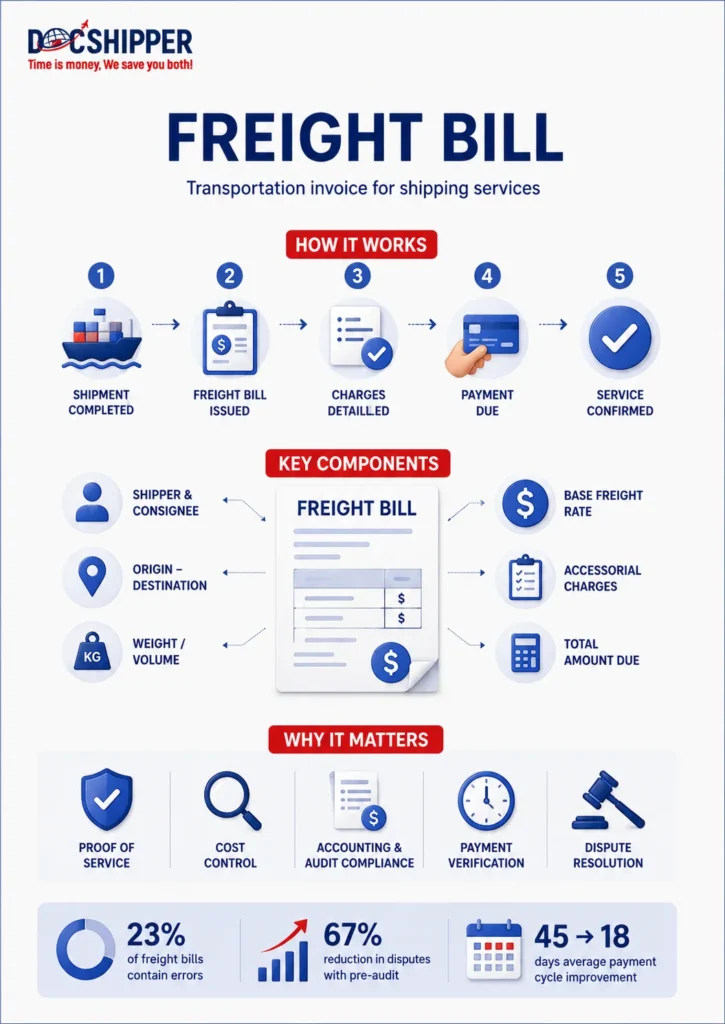
The Freight Bill is a transportation invoice issued by a carrier to charge for shipping services rendered. It details the shipment particulars, applied rates, additional charges, and total amount due, serving as both a billing document and proof of service completion in domestic and international logistics.
Introduction
Confusion between a freight bill and a bill of lading causes payment disputes and audit failures across supply chains. While the bill of lading documents custody transfer, the freight bill quantifies the financial obligation for transportation services. Understanding this distinction prevents costly errors in accounts payable processes and freight reconciliation.
In import/export operations, the freight bill becomes the foundational document for cost allocation, customs valuation adjustments, and carrier payment verification. Shippers, freight forwarders, and consignees rely on its accuracy to maintain cash flow and comply with auditing requirements.
- Issued after service completion or upon shipment departure, depending on payment terms
- Contains line-item charges including base rates, fuel surcharges, accessorials, and duties
- References the original booking or contract number for traceability
- Governed by carrier tariffs and international conventions (Hague-Visby, CMR, etc.)
- Subject to dispute resolution within specific timeframes (typically 15-180 days)
Components & Legal Framework
A compliant freight bill must include shipper and consignee identifiers, shipment reference numbers, origin-destination pairs, weight/volume metrics, and itemized charges. Carriers operating under Federal Maritime Commission regulations or IATA standards structure these documents to ensure auditability and legal enforceability.
The base freight rate derives from published tariffs or negotiated contracts. Accessorial charges—such as detention, demurrage, liftgate service, or residential delivery—appear as separate line items. Fuel surcharges fluctuate based on index-linked formulas, typically updated weekly or monthly by the carrier.
Currency and payment terms follow Incoterms agreements. Prepaid freight bills require payment before cargo release, while collect terms shift the obligation to the consignee. At DocShipper, we validate every freight bill against contracted rates before authorizing payment, preventing overcharges that average 8-12% in unaudited shipments.
Legal frameworks vary by transport mode. Ocean freight bills often reference bills of lading numbers and container seals. Air waybills integrate billing directly into the transport document. Road freight under CMR convention requires signatures confirming delivery before invoicing becomes enforceable.
The dispute window for freight bill corrections typically ranges from 15 days (domestic trucking) to 180 days (international ocean). Missing this deadline forfeits the right to contest inaccuracies, making systematic invoice auditing critical for cost control.
Practical Examples & Data
Consider a Shanghai-Rotterdam containerized shipment of electronics. The freight bill itemizes:
| Charge Category | Amount (USD) | Notes |
|---|---|---|
| Ocean Freight (40′ HC) | $2,850 | Contract rate |
| Bunker Adjustment Factor | $342 | 12% of base rate |
| Terminal Handling (Origin) | $195 | THC Shanghai |
| Documentation Fee | $75 | Bill of lading issuance |
| Destination Port Charges | $420 | Rotterdam terminal fees |
| Total Due | $3,882 | Prepaid before departure |
Industry data reveals 23% of freight bills contain billing errors, primarily in accessorial charges and weight classification. Automated pre-audit systems reduce disputes by 67% and accelerate payment cycles from 45 to 18 days on average.
Use Case: Air Freight Consolidation
A pharmaceutical company ships temperature-controlled goods from Brussels to Singapore. The freight bill includes:
- Chargeable weight: 850 kg (dimensional weight exceeds actual 620 kg)
- Rate per kg: $6.40 (priority express with cool chain)
- Security surcharge: $215 (pharmaceutical screening compliance)
- Fuel surcharge: 18.5% of base ($950)
- Total invoice: $6,785 due within 7 days of departure
DocShipper’s freight audit identified a misapplied density calculation that would have inflated costs by $840. Proper dimensional weight verification and tariff cross-checking recovered the overcharge before payment processing.
Conclusion
Mastering freight bill analysis ensures cost accuracy, contract compliance, and dispute prevention across global supply chains. Systematic auditing and carrier relationship management transform this document from a passive invoice into a strategic cost control instrument.
Need expert assistance with freight bill validation and carrier negotiations? Contact DocShipper for comprehensive logistics support.
📚 Quiz
Test Your Knowledge: Freight Bill
What is the primary purpose of a freight bill in logistics operations?
A shipper receives a freight bill showing a fuel surcharge of 18.5% applied to base ocean freight. Which statement correctly describes this charge?
Your company discovers a $450 overcharge on a freight bill for a shipment delivered 85 days ago. What is the correct course of action?
🎯 Your Result
📞 Free Quote in 24hFAQ | Freight Bill: Definition, Components & Practical Examples
A bill of lading is a transport contract and receipt for goods, while a freight bill is the invoice for transportation services. The bill of lading documents custody and shipment terms; the freight bill quantifies charges and payment obligations. Both reference each other but serve distinct legal and financial functions.
Dispute windows vary by mode and jurisdiction. Domestic trucking typically allows 15-90 days, ocean freight permits 60-180 days under carrier tariffs, and air cargo disputes must be filed within 120 days per IATA standards. Always verify specific terms in your carrier contract or governing tariff.
Accessorial charges are fees beyond base transportation rates, including detention (truck waiting time), demurrage (container storage), liftgate service, residential delivery, inside pickup/delivery, reweighing, address corrections, and hazmat handling. These represent 18-30% of total freight costs in complex shipments.
Yes, split billing arrangements allow origin charges to be prepaid while destination fees remain collect. This is common in DDP (Delivered Duty Paid) shipments where the seller covers main carriage but local delivery/customs clearance is consignee responsibility. Clear notation prevents double-billing disputes.
Carriers apply fuel surcharges as a percentage of base rates, indexed to petroleum price benchmarks like the DOE diesel average or Singapore bunker fuel prices. Percentages adjust weekly or monthly. Ocean carriers publish BAF (Bunker Adjustment Factor) schedules; trucking companies use tables correlating fuel prices to surcharge percentages.
Effective disputes require the original freight bill, bill of lading or air waybill, rate confirmation or contract, proof of delivery, photographs of discrepancies (damage, weight), and correspondence logs. Submit through the carrier's formal dispute process within the specified timeframe to preserve legal recourse.
Yes, customs authorities use freight bills to verify transportation costs included in transaction value calculations under WTO Valuation Agreement. Accurate freight documentation ensures correct duty assessment and prevents valuation disputes. Some jurisdictions require certified copies for high-value or controlled goods.
3PLs consolidate multiple carrier freight bills, audit for accuracy, allocate costs to client accounts, and issue consolidated invoices. They leverage volume discounts and negotiate carrier contracts on behalf of shippers. Advanced 3PLs provide freight bill audit services that identify and recover overcharges systematically.
Incoterms dictate which party pays specific freight charges. Under FOB, the buyer pays ocean freight; under CIF, the seller includes freight and insurance. EXW places all transport costs on the buyer; DDP on the seller. Freight bills must align with agreed Incoterms to ensure proper cost allocation.
Yes, Electronic Data Interchange (EDI) transmits freight bills as standardized messages (e.g., EDI 210 invoice) between carriers and shippers. Automation reduces processing time by 70%, minimizes manual entry errors, and enables real-time payment matching against purchase orders and rate agreements in ERP systems.
Standard terms range from immediate payment (prepaid/cash-on-delivery) to Net 30 or Net 60 for established accounts. Carriers may offer 1-2% discounts for early payment (Net 10). Late payments incur finance charges (1.5-2% monthly). International shipments often require letters of credit or freight collect to mitigate payment risk.
Professional audits identify duplicate charges, incorrect weight classifications, unapplied discounts, unauthorized accessorials, and tariff misapplications. Studies show audits recover 3-8% of annual freight spend. Continuous auditing also reveals carrier performance patterns, enabling better contract negotiations and route optimization.
Need Help with
Logistics or Sourcing ?
First, we secure the right products from the right suppliers at the right price by managing the sourcing process from start to finish. Then, we simplify your shipping experience - from pickup to final delivery - ensuring any product, anywhere, is delivered at highly competitive prices.


Fill the Form
Prefer email? Send us your inquiry, and we’ll get back to you as soon as possible.
Contact us




