


In short ⚡
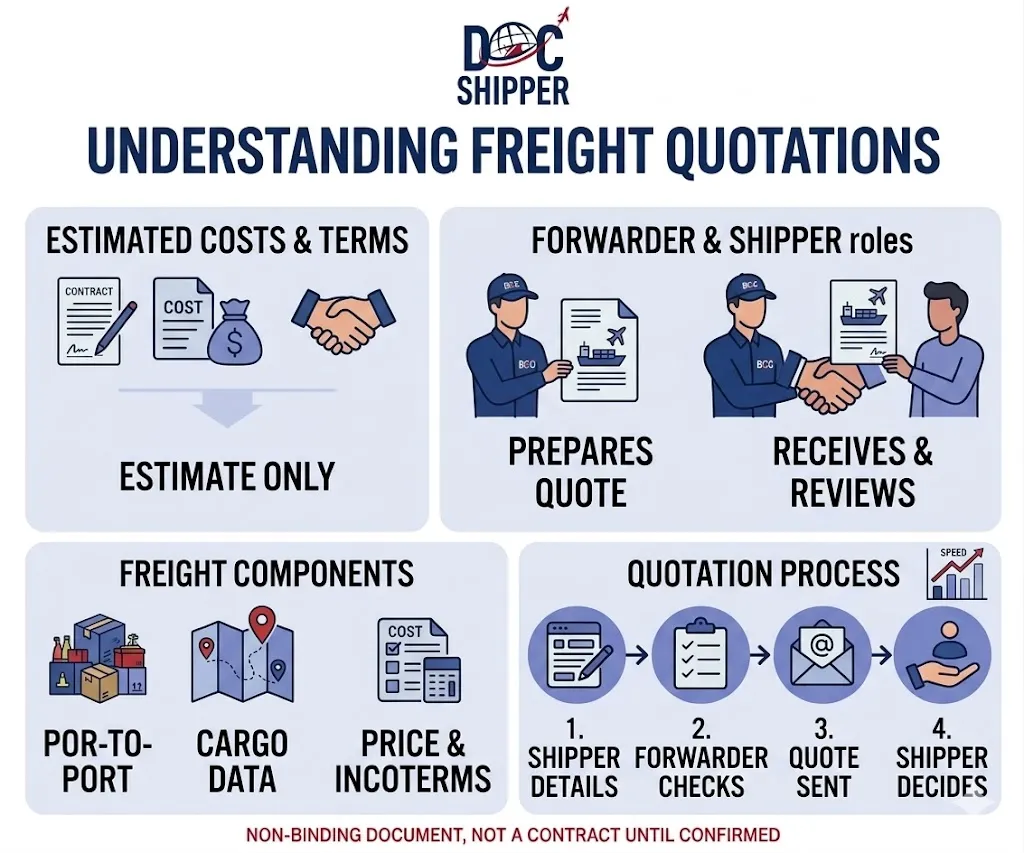
A Freight Quotation is a detailed pricing document provided by freight forwarders or carriers estimating transportation costs for shipping goods from origin to destination. It includes base freight rates, surcharges, handling fees, and specific service charges, serving as a preliminary cost agreement before formal booking.
Introduction
Many importers receive wildly different quotes for the same shipment, creating confusion about actual shipping costs. A freight quotation forms the foundation of logistics budgeting.
Understanding quotation structures prevents budget overruns and enables accurate comparison between service providers. In international trade, transparent pricing directly impacts profitability and competitive positioning.
Key characteristics of comprehensive freight quotations include:
- Itemized cost breakdown separating base rates from accessorial charges
- Validity period defining how long quoted prices remain guaranteed
- Service scope specification clarifying included and excluded services
- Route and transit details outlining transportation pathways and estimated timelines
- Terms and conditions establishing contractual obligations and liability limitations
Components & Expertise
Professional freight quotations contain multiple pricing layers beyond simple per-kilogram rates. Understanding these components enables informed decision-making when comparing service providers.
The base freight rate represents the core transportation charge calculated per weight unit, volume, or container. Ocean freight typically uses Twenty-foot Equivalent Units (TEUs), while air freight calculates using chargeable weight (greater of actual or volumetric weight).
Fuel surcharges fluctuate with petroleum prices and appear as Bunker Adjustment Factor (BAF) for sea freight or Fuel Surcharge (FSC) for air transport. These percentages change quarterly or monthly depending on carrier policies.
Terminal handling charges (THC) cover port operations including loading, unloading, and container yard management. Origin THC and destination THC often appear separately on quotations. According to industry data from iContainers, THC can represent 15-25% of total ocean freight costs.
Documentation fees encompass bill of lading issuance, customs declarations, and certificate processing. These administrative costs vary significantly between forwarders, ranging from $50 to $300 per shipment.
At DocShipper, we provide fully transparent quotations with zero hidden fees, breaking down every cost component to enable accurate budget forecasting for our clients’ international shipments.
Practical Examples & Data
Comparing quotations requires understanding how different shipment scenarios affect final costs. Real-world examples illustrate pricing variations across transport modes and service levels.
| Shipment Details | Sea Freight (LCL) | Air Freight | Express Courier |
|---|---|---|---|
| Route | Shanghai to Rotterdam | Shanghai to Rotterdam | Shanghai to Rotterdam |
| Cargo | 2 CBM / 500 kg | 2 CBM / 500 kg | 2 CBM / 500 kg |
| Base Rate | $180 (per CBM) | $1,250 (chargeable weight 583 kg) | $2,800 (volumetric pricing) |
| Surcharges | $85 (BAF + others) | $220 (FSC + security) | Included |
| Total Quote | $625 | $1,870 | $2,800 |
| Transit Time | 28-35 days | 5-7 days | 3-4 days |
This comparison demonstrates how service speed correlates directly with cost. Ocean freight offers the lowest rate but longest transit, while express services provide rapid delivery at premium pricing.
Quotation validity periods significantly impact planning. Standard validity ranges include:
- Ocean freight quotations: 14-30 days validity, with rates subject to space availability
- Air freight quotations: 7-14 days validity, highly sensitive to capacity fluctuations
- Contract rates: 3-12 months for regular shippers with committed volumes
- Spot quotations: 3-7 days during peak seasons (October-December typically shows 30-50% rate increases)
Hidden costs frequently emerge in incomplete quotations. Professional quotes explicitly state exclusions like destination customs clearance, delivery to final address, storage beyond free time, and cargo insurance coverage limits.
Conclusion
Comprehensive freight quotations provide the transparency necessary for accurate logistics budgeting and supplier comparison. Understanding each cost component prevents unexpected expenses that erode profit margins.
Need assistance evaluating freight quotations or securing competitive rates for your shipments? Contact DocShipper today for expert guidance on international freight solutions.
📚 Quiz
Test Your Knowledge: Freight Quotation
1. What is the primary purpose of a freight quotation in international logistics?
2. A shipment measures 100×80×60 cm and weighs 50 kg. For air freight quotation purposes, what will be charged?
3. You receive two freight quotations for the same Shanghai-Rotterdam shipment. Quote A is $625 with 28-35 days transit, Quote B is $1,870 with 5-7 days transit. Both are for identical cargo. What best explains this pricing difference?
🎯 Your Result
📞 Free Quote in 24hFAQ | Freight Quotation: Definition, Components & Practical Examples
You must supply cargo details (weight, dimensions, quantity), origin and destination addresses with postal codes, commodity description (for customs classification), desired shipping timeline, and any special handling requirements like temperature control or hazardous material declarations. Incoterms selection also affects quotation scope.
Validity periods vary by transport mode and market conditions. Ocean freight quotes remain valid for 14-30 days, air freight quotations for 7-14 days, and express services for 3-7 days. During peak shipping seasons or periods of market volatility, validity windows shorten significantly as carriers adjust rates frequently.
Pricing differences stem from carrier relationships, volume discounts negotiated by forwarders, service scope variations, routing options, and included/excluded services. Some quotes include customs clearance and delivery, while others cover only port-to-port transportation. Always compare identical service scopes when evaluating quotations.
A freight quotation represents a preliminary cost estimate provided before shipment booking, while a freight invoice details actual charges after service completion. Final invoices may differ from quotations due to dimensional weight adjustments, additional services requested during transit, or surcharge changes between quotation and shipping dates.
Fuel surcharges typically appear separately from base rates and fluctuate with petroleum prices. Ocean freight shows Bunker Adjustment Factor (BAF), while air freight displays Fuel Surcharge (FSC). These percentages change monthly or quarterly, making them variable cost components rather than fixed base rate elements.
Negotiation success depends on shipment volume, frequency, and timing. Regular shippers with consistent monthly volumes secure better rates through contract agreements. Single shipments offer limited negotiation leverage, though competitive bidding between multiple forwarders can reveal more favorable pricing options.
All-in pricing includes all charges from origin pickup to destination delivery, encompassing base freight, surcharges, handling fees, customs clearance, and final delivery. This comprehensive approach eliminates hidden costs but requires verification that your specific requirements (insurance, special handling) are included in the quoted scope.
Air freight chargeable weight equals the greater of actual gross weight or volumetric weight. Calculate volumetric weight using the formula: (Length × Width × Height in cm) / 6000. For example, a 50 kg shipment measuring 100×80×60 cm has volumetric weight of 80 kg, making chargeable weight 80 kg.
Dimension changes after booking typically result in revised charges. If actual cargo exceeds quoted dimensions, carriers recalculate costs based on actual measurements, potentially increasing final invoiced amounts. Always provide accurate measurements when requesting quotations to avoid unexpected cost adjustments during shipment processing.
Most basic freight quotations exclude comprehensive cargo insurance, covering only minimal carrier liability (typically $20-50 per kilogram for ocean freight). Adequate insurance requires separate purchase, usually costing 0.3-1.5% of cargo value depending on commodity type, route risk, and coverage limits selected.
Request quotations 2-4 weeks before planned shipping dates for ocean freight and 1-2 weeks for air freight. This timeframe allows comparison shopping, documentation preparation, and booking confirmation before space becomes scarce. During peak seasons (Q4), extend lead times by 50-100% to secure competitive rates.
General Rate Increases (GRI) are scheduled freight rate hikes announced by carrier alliances, typically occurring quarterly or during peak seasons. These increases affect quotations obtained before implementation dates but applied after effective dates, potentially creating cost discrepancies between quoted and actual shipping charges unless rates are locked through confirmed bookings.
Need Help with
Logistics or Sourcing ?
First, we secure the right products from the right suppliers at the right price by managing the sourcing process from start to finish. Then, we simplify your shipping experience - from pickup to final delivery - ensuring any product, anywhere, is delivered at highly competitive prices.


Fill the Form
Prefer email? Send us your inquiry, and we’ll get back to you as soon as possible.
Contact us




